Review Process
Reviewed by professionals, accurate by design
Every piece of content that touches clinical practice, therapeutic modalities, or neuroscience is shaped by a collaboration between our expert authors and qualified medical reviewers. But how do we ensure accuracy and quality? This page explains how our fact-checking and review process works, and how our Review Board Members help verify the information you find on States of Mind — keeping it evidence-based, nuanced, and genuinely useful.
Our standard is simple: we refine every article until each reviewer can confidently put their name and their professional statement beneath it, vouching for it with their own expertise, and certain of the accuracy of the facts it contains.
How the review process works
Any article that includes medical claims or psychological concepts goes through the following steps before we publish it:
Step 1
An author or expert writes the article.
Content is created by experienced writers, journalists, researchers, and practitioners who bring genuine subject-matter expertise and a distinctive human voice.
Step 2
The draft is sent to a medical reviewer with focused expertise.
We assign a reviewer from our Review Board whose specialization matches the precise topic of the piece, so the assessment comes from someone working at the heart of that field.
Step 3
The reviewer shares suggestions and personal perspective.
We always ask reviewers to go beyond fact-checking and structure. We ask for their view on how the topic is framed: Are there blind spots or pitfalls we have not accounted for? Is there a medical consensus on the subject that should be reflected? Reviewers also suggest additional sources whose findings can strengthen the article.
Step 4
The author or expert works through the comments.
Authors and experts engage with every comment. Crucially, they may accept a suggestion or decline it — provided they can argue their position with sound reasoning and evidence. Our review process is a dialogue.
Step 5
The reviewer takes a second look.
After revisions are made, the reviewer reads the article again and, where needed, leaves further comments. At the reviewer’s discretion, this can run to two or even three rounds, depending on the complexity and sensitivity of the subject.
Step 6
The approved article goes live.
Once the reviewer signs off, we publish the final text, showing the author’s name, the reviewer’s name, and the review date. We update articles as new information comes out, and the latest update date appears at the top of each page.
The reviewer’s statement
For every article they approve, the reviewer adds a short statement: a closing thought, a key takeaway, or a brief intro pointing the reader to what matters most. It’s written in the reviewer’s own words and published below the article. To us, it’s a sign of our standard at work: we refine each article until the reviewer can confidently put their name to it, sure of every fact inside.
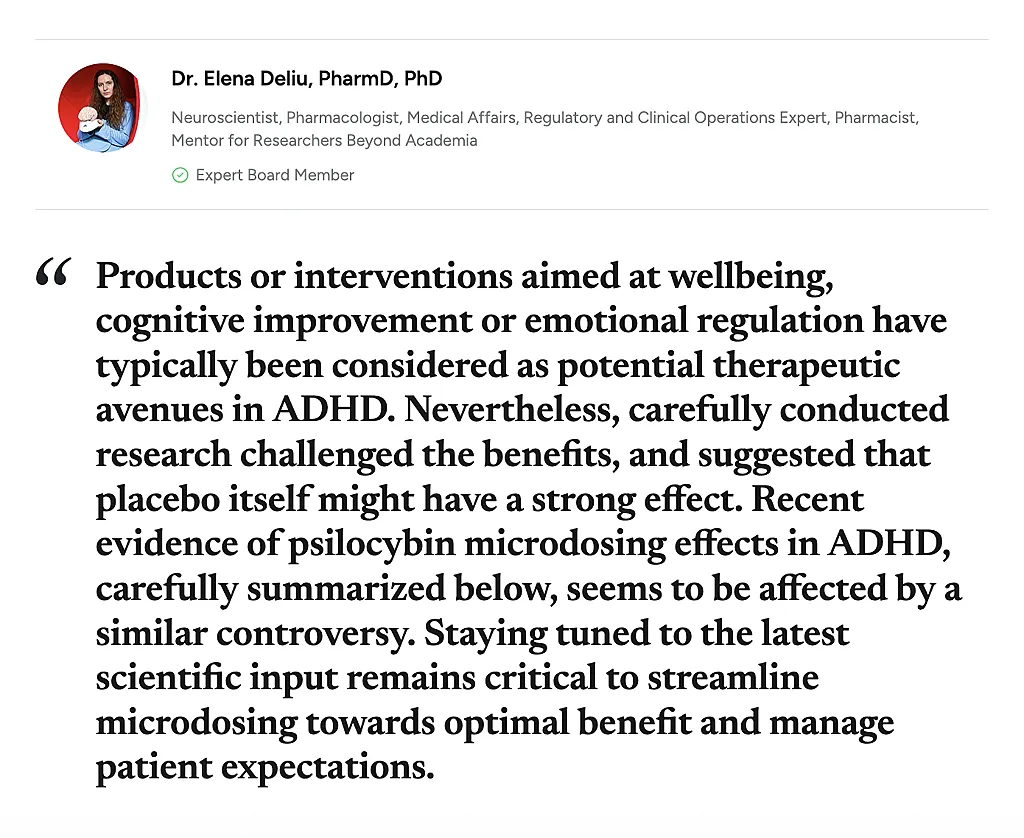
Who reviews our content
Our Review Board is a team of licensed clinicians, psychotherapists, neuroscientists, mental health counselors, and specialists who ensure accuracy and relevance. We deliberately value expertise from both conventional and progressive domains, so that every article is matched with a reviewer who understands its subject from the inside.
Meet our reviewers
Transparency and conflicts of interest
We strive for full transparency about our reviewers’ relationships with commercial and non-commercial institutions. That’s why our reviewers must disclose any financial, professional, or personal relationships that could influence their perspective: including affiliations with clinics, retreat centers, pharmaceutical companies, research institutions, or advocacy organizations. If a potential conflict of interest exists, we assess whether it needs to be disclosed, mitigated, or whether the assignment should be redirected.