Reading Navigation

This content is grounded in peer-reviewed research, clinical guidelines, and established best practices. Claims are reviewed for accuracy and transparency. Learn more about our evidence standards
Can Changing Our Worldview Improve Our Mental Health?

With rising cases of mental health conditions across the globe and a desperate need for new treatment alternatives, psychedelics offer the opportunity for people to break out of rigid thought patterns and gain new insights into their selves and lives.
States of Mind spoke to experts about how psychedelics can induce lasting changes to our worldviews, and how this may improve psychedelic therapy outcomes.
Psychedelics and Our Worldviews
In modern society, many people’s worldviews — their metaphysical beliefs — are based in physicalism/materialism. This reflects the idea that consciousness and mental states arise from complex physical processes in the brain, or the “mind emerges from matter”.
However, interestingly, recent research1 has revealed that the psychedelic experience can shift these views.
Following a psychedelic experience, people often report their metaphysical beliefs shifting towards non-materialist views.
These include worldviews such as:
- Pantheism, the idea that the universe is god
- Panpsychism, the idea that consciousness is a feature of the universe
- Animism, the idea that inanimate objects, such as plants, are conscious
One study has suggested that these changes in worldview may contribute to improved mental health outcomes1.
The study sought to investigate whether psychedelics can affect our core beliefs about reality, consciousness and free will, what the relationship is between belief changes and mental health, and what psychological mechanisms may be involved in the shifts.
Study researcher Chris Timmermann, PhD at Imperial College London at the Centre for Psychedelic Research, says the team initially thought that the mystical experiences that can be elicited by psychedelics would predict such changes in metaphysical beliefs.
“We were really interested in understanding if there was something in the acute experience,” says Timmermann.
“What actually predicted these changes were the personality type of individuals. The more suggestible they were, the more likely they were to change their metaphysical beliefs.
“We also found that trait absorption, which is closely linked to suggestibility, was associated with this change.”
Trait absorption — a person’s tendency to become completely engaged in an experience — can impact how susceptible someone is to hypnosis, for example.
Timmermann explains that these factors, along with increased feelings of social connectedness, explained why people shifted towards a rejection of materialism or physicalism and towards non-materialist beliefs.
 2
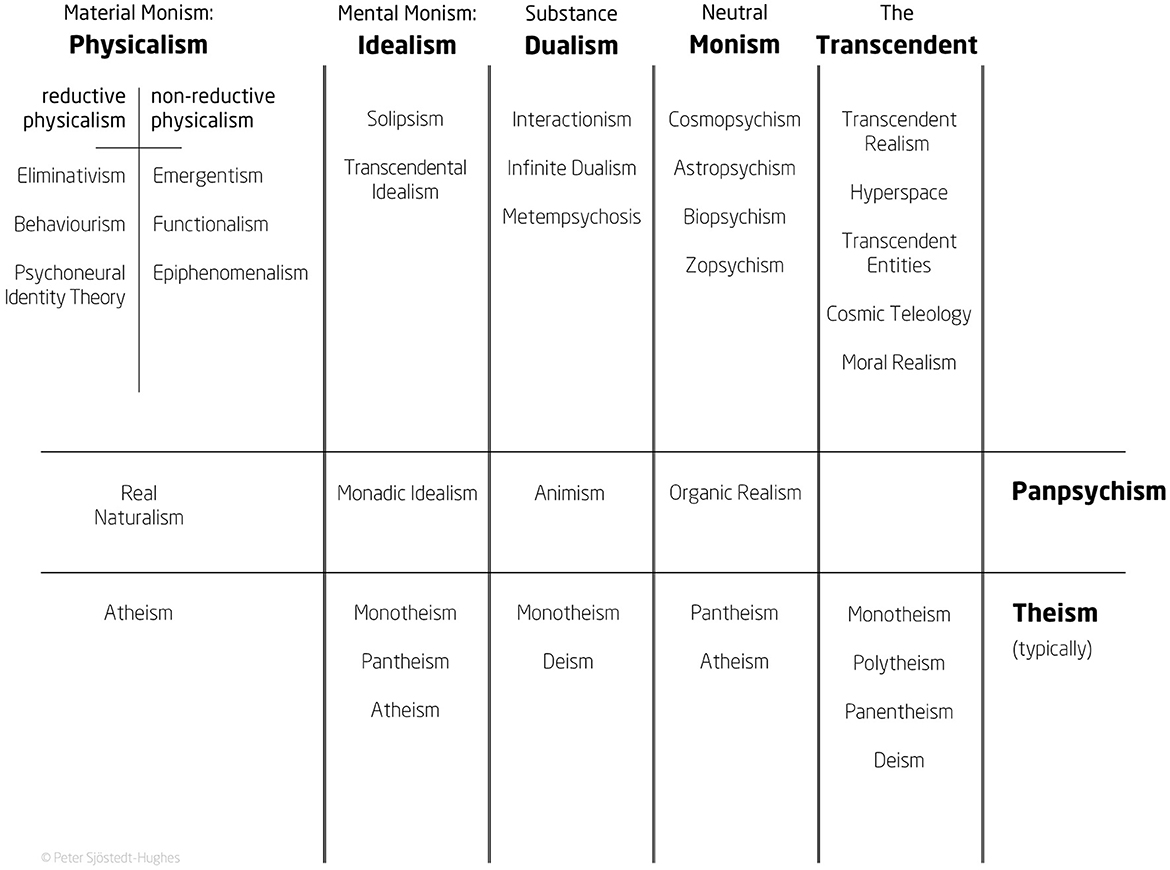
2To help psychedelic therapy participants better understand these belief shifts, Dr Peter Sjöstedt-Hughes, philosopher of mind and metaphysics at Exeter University has created a Metaphysics Matrix2 and Questionnaire to be used in therapy and as a tool for quantitative measurement of the psychedelic experience in trials.
The Matrix sets out different metaphysical beliefs which Sjöstedt-Hughes suggests can be further bridged by therapists to the participant’s life, concerns, values, aims and outlook.
By integrating an understanding of metaphysics into psychedelic therapy, Sjöstedt-Hughes believes we may see further improvements in mental health outcomes.
How Can Changing Your Beliefs Improve Mental Health?
So why might these belief shifts contribute to improved mental health outcomes?
Timmermann says that these experiences can provide a sense of meaning and hope, particularly in the context of treating end-of-life anxiety.
“In cancer patients, mystical experiences sometimes provide a sense of piercing the veil of death,” says Timmermann.
“If they believe there is something beyond, it brings comfort and hope. Michael Pollan describes this as the comforting delusion hypothesis3.
“There is also the possibility that the world is not just matter. A strict scientific worldview can feel cold and nihilistic, suggesting the universe is meaningless and indifferent.”
Psychedelic experiences that suggest unity or some inherent meaning can counter that, which can give people some comfort.
Another reason these psychedelic experiences may improve mental health symptoms, says Timmermann, is that they can make people deeply grateful for being alive and aware, even if they remain agnostic about the ultimate nature of reality.
“That, I would argue, is not a delusion, but a very real and valuable perspective,” says Timmermann.
Most important, he says, is developing a sense of lightness about reality.
“Living with that uncertainty is part of life,” says Timmermann. “I think what is important is flexibility. You can inhabit one worldview or another and immerse yourself in them, but also step back and observe.”

Spiritual Bypassing and Ethical Challenges
While the research suggests that these belief changes may contribute to improved mental health outcomes, there are potential ethical issues.
Critically, the study data revealed that a person’s suggestibility plays an important role in these belief shifts.
Timmermann says that a “New Age” setting for a psychedelic therapy, like an individual session set in a holistic wellness clinic, might foster a metaphysical belief in that direction, while a shamanic context, such as group medicine sessions led by indigenous practitioners, might encourage animistic worldviews, where nature is seen as inhabited by spirits.
“It highlights that it is not only the qualities of the drug itself that influence belief shifts, but also the context in which the experience takes place,” says Timmermann.
“These predictors show us that set and setting matter when it comes to the kind of worldview people adopt.”
While the study found a significant correlation that the stronger the change in beliefs, the greater the increase in wellbeing, the team has also found a correlation between changes in metaphysical beliefs and what is known as “spiritual bypassing”.
This is when people value these experiences more than their everyday concerns and realities.
“They may view development primarily in spiritual terms rather than personal ones, which can become a form of escape or dissociation,” says Timmermann.
“This speaks to the double-edged nature of these experiences. The same shift that brings meaning and fulfillment can also create problems.”
“Spiritual bypassing”4 is a term first coined by psychotherapist John Welwood, as the use of spiritual ideas and practices to sidestep personal, developmental, or emotional work.
“It places a lot of emphasis on how psychedelics are practised. How do we ensure they are both safe and meaningful? How do we maintain a delicate balance so that people have profound experiences, but in a way that fits with their broader life goals, social context and the secular societies we live in?”
Further research has highlighted that these changes in worldview also raise novel risks that require an enhanced informed consent process5. Psychedelics themselves expose individuals to physiological risks associated with adverse reactions. However, the psychological effects can extend to much more than transient hallucinations and alterations to consciousness.
Sjöstedt-Hughes suggests that the first way to tackle this issue is to ask for informed consent from the participant.
“Does the person consent to having the possibility of their worldviews or metaphysical views altered? That is one way of addressing the issue,” says Sjöstedt-Hughes.
“The second way, which can be combined with the first, is to present numerous metaphysical frameworks for the same experience without favouring one over another.
“In this way one opens up their minds, which is in fact the opposite of indoctrination, as one presents more options. This is what I present in my paper.”
Sjöstedt-Hughes also highlights that despite these ethical challenges, there is no neutral metaphysical worldview.
“We are all brought up in a culture that determines our worldviews: our language, our family, our schooling, our history and so on,” says Sjöstedt-Hughes.
“There is no neutral state. I do not think there really is a state of mind that has not been shaped in some way.”
This new research suggests that psychedelic experiences may improve mental health by increasing psychological flexibility and expansion of worldviews. As this field develops, careful attention to ethics, context, and integration of psychedelic experiences will be essential to ensure that worldview shifts support sustained wellbeing for those who choose to go down this route.
 Expert Board Member
This article offers a timely and nuanced examination of how psychedelic experiences can shift metaphysical beliefs and how such changes may contribute to improved mental health outcomes, drawing on emerging evidence from neuroscience and clinical research. By thoughtfully addressing mechanisms of worldview change alongside ethical considerations such as suggestibility and spiritual bypassing, it effectively bridges philosophy, psychology, and therapeutic practice in an evolving area of psychedelic science.







 Munich, Germany

 Gozo, Malta
 London, United Kingdom