
This content is grounded in peer-reviewed research, clinical guidelines, and established best practices. Claims are reviewed for accuracy and transparency. Learn more about our evidence standards

The Emotionally Intelligent Mind: Why Feelings Are the New Data
In every workplace, friendship, or relationship, one skill quietly predicts success more than IQ — emotional intelligence (EI). It’s the ability to read the room, understand emotions, and stay composed when tension rises. Research indicates that emotional intelligence promotes mental health, enhances resilience, and enables individuals to transform emotions into clear, constructive actions.
Scientists now define emotional intelligence not as a “soft skill,” but as a measurable cognitive ability — one that predicts well-being, teamwork, and leadership more reliably than technical expertise. As companies shift their priorities toward empathy and psychological safety, high-EI individuals are becoming the quiet architects of healthier, more human workplaces.
Defining Emotional Intelligence
To be emotionally intelligent means more than just being “in touch with your feelings.” Psychologists Peter Salovey and John Mayer first defined emotional intelligence (or EI) in 1990 as the ability to recognise, understand, and manage emotions — both your own and those of others. Daniel Goleman later popularised the concept, breaking it down into five key components: self-awareness, self-regulation, motivation, empathy, and social skills.
These pillars describe a form of emotional literacy — understanding what you feel, why you feel it, and how those emotions influence your actions and relationships.
- Self-awareness enables you to recognise emotions as they arise.
- Self-regulation prevents you from reacting impulsively.
- Empathy helps you connect with others.
- Motivation fuels your drive.
- Social skills facilitate effective communication.
Modern research redefines emotional intelligence as the cognitive ability to perceive, understand, use, manage, and handle emotions effectively. Studies in the Journal of Intelligence and Frontiers in Psychology show that EI predicts adaptability, resilience, and overall well-being. In short, it’s not about being emotional — it’s about being emotionally skilled.
How Emotional Intelligence Shapes the Mind
Behind the buzzword, emotional intelligence is one of the most consistently researched predictors of mental health and life satisfaction. Studies show that people with higher EI experience lower anxiety, better stress regulation, and more stable relationships.
Quantitatively, the effect is small but steady — ability-based emotional intelligence explains about 4–6% of differences in well-being between individuals, even after accounting for IQ and personality factors. In a study of 400+ male university students, emotional intelligence showed a positive relationship with psychological well-being. These findings also showed that individuals with higher emotional intelligence tend to perceive greater social support, which in turn predicts higher levels of well-being over time.
In practical terms, people with high EI report higher life satisfaction, lower levels of stress and anxiety than those with low EI. Among healthcare professionals, emotional intelligence training has been shown to reduce burnout by nearly 18% and improve stress management skills by over 20%.
What sets emotionally skilled people apart is how they work with emotions. Instead of suppressing feelings, they use cognitive reappraisal, a strategy that reframes emotional experiences in more adaptive ways. This process strengthens both psychological flexibility and social resilience.
Emotionally Intelligent Teams at Work
In today’s workplace, being emotionally aware is no longer optional — it’s a marker of authentic leadership. Modern employers increasingly value empathy, communication, and emotional awareness as much as ‘hard’ skills. Leaders who can read emotions, stay composed under pressure, and handle feedback with care create stronger, more motivated teams.
According to Mental Health America (MHA), emotionally intelligent employees are better at managing stress and conflict because they recognise the emotions behind behaviour. They understand that emotions aren’t noise; they’re data that guide smarter, more human decisions. High EI overlaps with strong interpersonal skills, particularly in areas such as conflict management and communication, which are essential in the workplace. Companies that foster emotional intelligence report higher workplace engagement, lower burnout, and stronger collaboration. In hiring, EI has become a strategic advantage — high-EI individuals adapt more quickly, communicate more effectively, and maintain team stability during times of uncertainty.
Being emotionally intelligent at work doesn’t mean being endlessly calm or agreeable — it means understanding the emotional climate. In fast-moving workplaces, that’s not just emotional skill — it’s strategy. Here’s a quick checklist to build your own emotional strategy:
- Pause before reacting — take a breath before replying in tense moments.
- Listen beyond words — tone and body language often reveal more than sentences.
- Name what you feel — labelling an emotion lowers its intensity.
- Match your mood to the task — calm focus for analysis, positive energy for brainstorming.
- Show empathy, not absorption — understand others’ feelings without carrying them as your own.
Related reading

Emotionally Intelligent Relationships
Emotional intelligence doesn’t just shape how we work — it shapes how we love. Studies show that emotionally aware couples report greater satisfaction, lower conflict, and stronger trust over time. According to research from the Yale Centre for Emotional Intelligence, partners who can recognise and name emotions clearly are better at resolving disagreements and maintaining closeness.
A study in the Journal of Personality and Social Psychology found that emotional intelligence predicts higher empathy and secure attachment styles in romantic relationships. Emotionally skilled partners tend to de-escalate tension more quickly and communicate their needs without defensiveness — turning emotional awareness into emotional safety.
Emotionally intelligent relationships, whether romantic or platonic, share the same foundation: awareness, honesty, and emotional regulation. High-EI people don’t avoid tension; they navigate it calmly.
Everyday habits make the difference:
- Noticing emotions early instead of ignoring tension.
- Listening to understand, not to reply or fix the person.
- Pausing before reacting and regulating their tone.
- Owning their mistakes and apologising without defensiveness.
- Expressing gratitude often and meaning it.
- Respecting boundaries and giving space when needed.
- Staying curious about others’ feelings and perspectives.
- Seeking balance, maintaining reciprocal relationships.
In relationships, being emotionally intelligent means more than understanding someone’s words — it’s recognising the feeling behind them. And that awareness, quiet but constant, is often what keeps love steady when emotions surge.
Becoming Emotionally Skilled: Daily Checklist
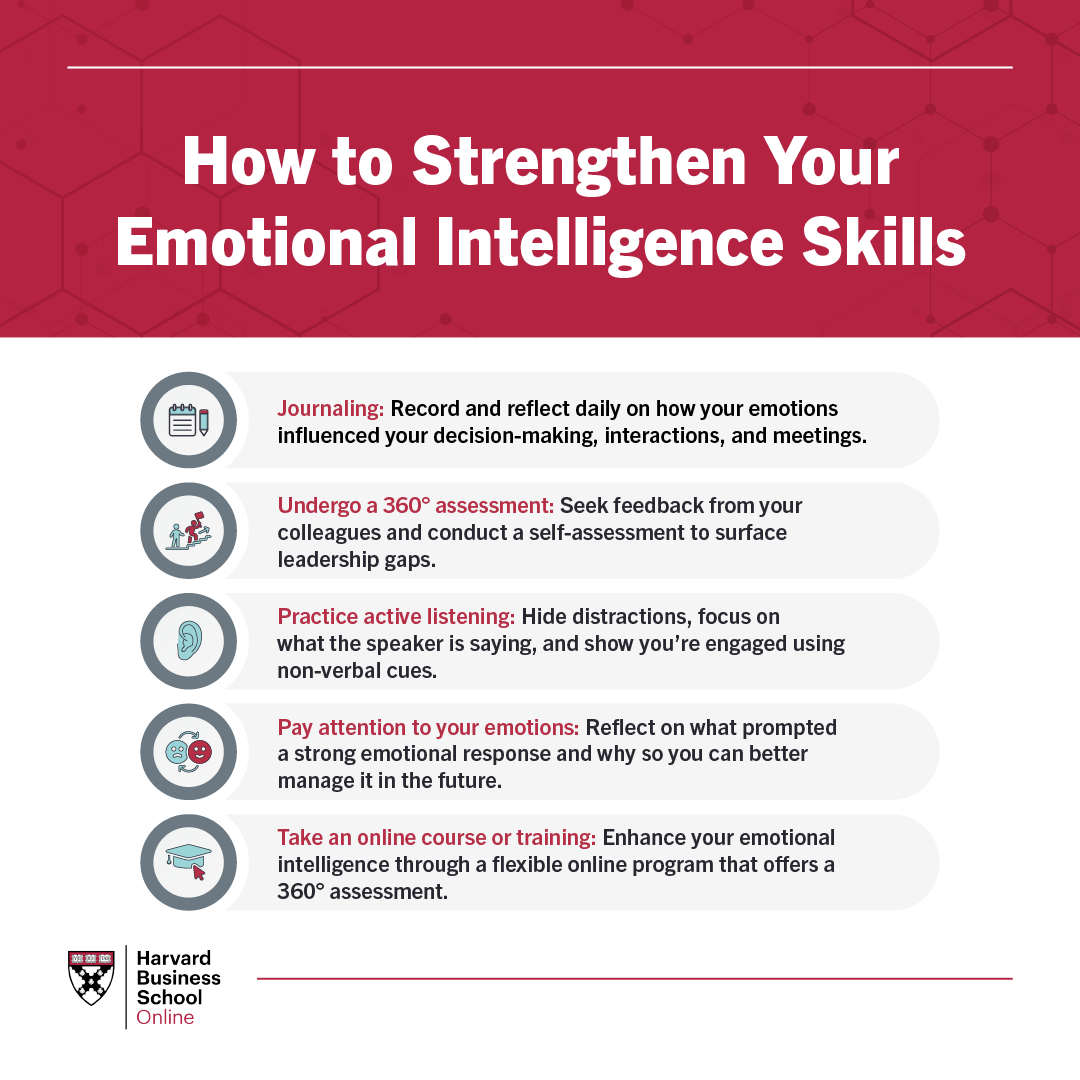
Emotional intelligence doesn’t appear overnight — it’s strengthened through daily practice. Studies show that reflection, empathy, and intentional regulation can reshape emotional patterns over time. Here’s how to start developing your emotionally intelligent habits in practical, evidence-based steps:
Step 1. Learn to Name Your Emotions
Before you can manage feelings, you need to recognise them. Studies show that putting feelings into words (also called affect labelling) activates brain regions, such as the prefrontal cortex, which is responsible for self-regulation and reduces impulsivity.
Tip: Pause before reacting and describe what you feel: “I’m irritated,” “I’m anxious,” or “I’m disappointed.” Awareness is always the first intervention.
Step 2. Practice Emotional Reappraisal
Emotionally aware people don’t suppress emotions; they reframe them. This technique, known as cognitive reappraisal, helps reinterpret stressful situations more adaptively, improving both mood and performance.
Tip: Instead of thinking “My colleague ignored my idea,” reframe it to “Maybe they were focused on another thing — I can bring it up later.”
Step 3. Listen Like a Researcher
High-EI individuals are active listeners. They focus on what someone feels before deciding how to respond.
Tip: Reflect what you’ve heard — “It sounds like you’re frustrated because…” — before offering your own view. It builds empathy and trust.
Step 4. Build Emotional Awareness Through Practice
Mindfulness and cognitive-behavioural techniques are proven to enhance emotion regulation and resilience.
Tip: Practice short, mindful pauses throughout the day — a few breaths before meetings or important decisions. Over time, this strengthens emotional control and perspective-taking.
Step 5. Strengthen Social Connection
Social support mediates the relationship between EI and well-being — meaning emotional intelligence works best when exercised in relationships.
Tip: Check in with a colleague or friend daily, not just when something’s wrong. Emotional awareness grows through interaction.
Step 6. Ask for Feedback — and Use It
Feedback is a mirror for emotional blind spots. Asking how others perceive your communication builds empathy and self-awareness.
Tip: Once a month, ask a teammate or friend: “When do I come across as tense or detached?” — then listen without defending.
Emotional intelligence grows from learning its language. Each time you pause, reframe, or listen deeply, you’re literally reshaping your brain’s response patterns. That’s what it means to become emotionally skilled — learning to feel wisely.
The Emotionally Intelligent Future
Emotional intelligence is rapidly expanding beyond therapy and corporate training. It’s becoming a foundation for how we design education, technology, leadership, and healthcare. Because people — and systems — perform better when they understand emotions and process them consciously.
In hiring and leadership, EI is now a measurable competency. Employers use emotional intelligence assessments to predict adaptability and collaboration skills. Leaders who score high on empathy and regulation build trust, reduce burnout, and retain talent — outcomes now quantified.
In mental health and therapy, EI-based training is reshaping clinical practice. Programs that teach emotion regulation among physicians have been shown to reduce burnout by nearly 20% and cynicism by 50%. Emotional literacy is becoming a therapeutic method, as essential as CBT.
In education, social-emotional learning (SEL) programs improve both academic outcomes and mental health. According to the CASEL report, students who practice emotional awareness show 11% higher academic performance and greater resilience to bullying and anxiety.
In tech, affective computing and emotionally aware design are transforming how we interact with machines. Research at MIT Media Lab shows that emotion-sensitive interfaces increase user trust and engagement by 20–25%. From chatbots like Woebot to VR empathy training, emotional intelligence is becoming part of digital UX.
In finance and business culture, EI underpins decision-making in uncertain environments. Data from the CFA Institute Report show that fund managers with higher emotional awareness make 12% fewer emotion-driven decisions during market stress. Emotional regulation, once considered a personal matter, is now viewed as a form of risk management.
In healthcare and caregiving, professionals with higher emotional intelligence deliver better care and are less likely to experience burnout. A recent study found that nurses with strong EI showed significantly higher clinical performance and lower turnover rates. Emotional intelligence, in this context, is a clinical competency.
The future of emotional intelligence isn’t about always being nice — it’s about being necessary. As automation scales and attention fractures, the ability to read emotion becomes a survival skill, not a soft one. Being emotionally intelligent is not about feeling more: it’s about understanding feelings faster.
FAQ

 Expert Board Member
Emotional intelligence has evolved from a "soft skill" into a measurable cognitive ability that predicts mental health, workplace leadership and performance, and relationship quality. In fact, EI is a learnable competency built on five core pillars: self-awareness, self-regulation, motivation, empathy, and social skills that can be developed through daily practices like emotion labeling, cognitive reappraisal, and active listening.