Wellness 2.0: Self-Awareness and Self-Responsibility as the Next Big Trend

Over the past decade, self-care has undergone a significant transformation driven by technology. Wearables, health apps, and biometric trackers give us instant feedback on everything from heart rate to sleep cycles.
This unprecedented access to personal health data has empowered many to take charge of their wellness. At the same time, however, it has introduced a paradox: while technology enhances awareness, it can also undermine it. Instead of paying attention to our own inner cues, such as emotions or bodily sensations, we increasingly look to our devices for validation. But what happens when the screen knows us better than we know ourselves?
The Shifting Landscape of Self-Care
Clinical psychologists warn that hyper-tracking can increase anxiety and perfectionism, especially when metrics become a source of pressure rather than guidance. A Global Wellness Institute trend report notes that constant monitoring risks distancing us from the natural rhythm of our bodies. Similarly, research in the Journal of Medical Internet Research found that reliance on fitness trackers sometimes led to stress when users couldn’t meet “ideal” benchmarks, like 10,000 steps per day.
This shift suggests that while technology can inform, it cannot replace embodied awareness. The future of self-care lies in learning to integrate external data with internal listening. In other words, wearables should be companions, not crutches. True self-care begins with understanding our own signals.
Why Self-Awareness is the New Wellness Currency
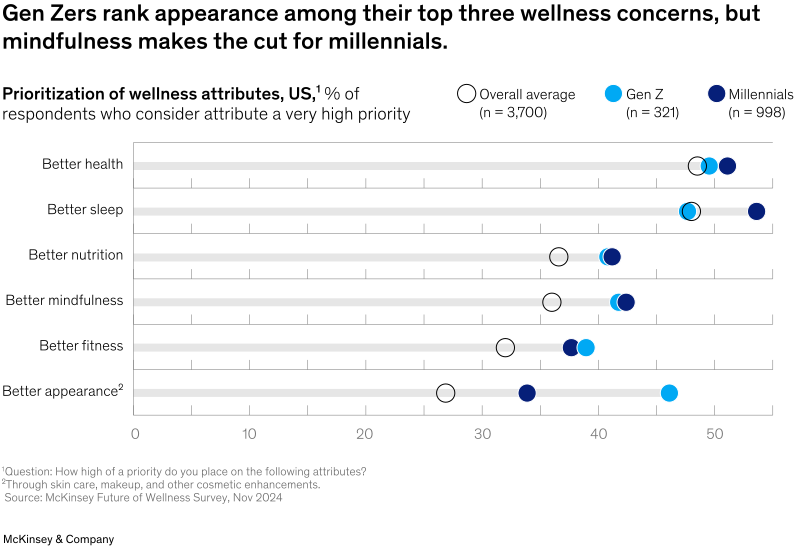
Wellness has never held such a central place in people’s lives. In the United States alone, the market is valued at more than $500 billion, expanding steadily at 4-5% a year. Even amid the economic turbulence of early 2025, the sector continues to prove its resilience.
Surveys show the sentiment runs deep: 84% consumers in the USA, 79% in the United Kingdom and an impressive 94% in China consider wellness a top or important priority.
In the wellness space, self-awareness has emerged as one of the most valuable skills. Defined as the ability to observe and interpret our thoughts, emotions, and physical sensations, self-awareness strengthens our capacity to manage stress and make healthier choices. Mindfulness practices, for example, have consistently been shown to reduce anxiety and improve emotional regulation.
Clinicians note that patients who cultivate body awareness often detect early signs of burnout, illness, or emotional overload before these escalate. This aligns with findings in Frontiers in Psychology, which showed that interoceptive awareness — the ability to sense internal bodily states — correlates with greater resilience and wellbeing.
In a culture saturated with external noise, self-awareness becomes a currency of clarity. It allows individuals to distinguish between genuine needs and external pressures. For instance, is fatigue a signal for rest, or an emotional stress response? Recognising the difference shapes healthier, more responsive self-care practices. The rise of mindfulness apps, body scanning techniques, and reflective journaling isn’t just a trend—it reflects a growing recognition that inner listening is the foundation of sustainable wellbeing.
The Rise of Self-Responsibility in Mental Wellbeing
Self-care is no longer limited to products or spa days — it has become an act of responsibility. Where once people were passive consumers of wellness services, today they are increasingly expected to take active ownership of their mental and physical health. This shift reflects broader societal trends: healthcare systems strained by chronic stress and burnout are encouraging individuals to adopt preventative, self-managed practices.
Trendwatch data shows a growing desire for agency. A 2023 Global Wellness Institute Report noted that consumers are seeking autonomy and customisation in their wellness journeys. Instead of one-size-fits-all solutions, people want tailored approaches that reflect their unique needs. Psychologists echo this, observing that self-responsibility builds a sense of empowerment, counteracting the helplessness often associated with stress and anxiety.
Clinical observations reveal that when clients take responsibility — whether by setting boundaries, engaging in therapy, or practising self-care — their recovery outcomes improve significantly. Responsibility does not mean self-blame; rather, it is the recognition that well-being requires active participation.
Self-Care and Intentional Practices
Self-care has often been marketed as a checklist: drink water, exercise, meditate, sleep eight hours. While these habits are valuable, the future of self-care lies in intentionality rather than repetition. Deliberate self-care means making conscious choices aligned with one’s values and circumstances, not merely following generic wellness advice.
2019 research highlights that intentional practices — rooted in personal meaning — are more sustainable and effective than superficial routines. For example, a mindful walk chosen to decompress after work will likely be more restorative than forcing oneself to jog solely to close a fitness ring.
By moving beyond quick fixes, self-care evolves into a way of life. It’s not about doing everything perfectly but about consistently choosing practices that nurture long-term wellbeing. This reframing makes self-care less of a trend — and more of a sustainable, conscious decision.
Balancing Technology and Inner Listening
As technology becomes more integrated into our wellness routines, the challenge is not whether to use it, but how. Devices can be powerful tools for feedback, yet they should complement inner listening. Over-reliance risks turning self-care into a performance measured by metrics rather than lived experience.
Strategies for balance include setting intentional boundaries: using wearables for trend insights rather than obsessing over daily fluctuations, or practising “device-free” check-ins with the body. A 2023 study suggested that individuals who combined digital tracking with mindfulness reported better outcomes than those relying solely on devices.
The future of self-care will be hybrid: informed by technology but grounded in self-awareness. By blending external insights with internal wisdom, individuals can create sustainable practices that honour both innovation and intuition.
FAQ:
- What does “Wellness 2.0” mean?
It’s the next phase of self-care, focused on combining technology with self-awareness and personal responsibility.
- How is Wellness 2.0 different from traditional self-care?
Earlier, self-care often meant simple, not regular activities: workout plans, spa days, or food supplements. Wellness 2.0 adds deeper elements: self-awareness, intentional practices, and active ownership of mental health.
- How can I practise intentional self-care?
Choose activities that feel meaningful and aligned with your values, rather than just ticking off generic wellness tips.
- What does “self-responsibility” mean in wellness?
It means shifting from passive consumption to active participation — setting boundaries, choosing meaningful practices ourselves, and taking preventative steps for mental health.