Transcript
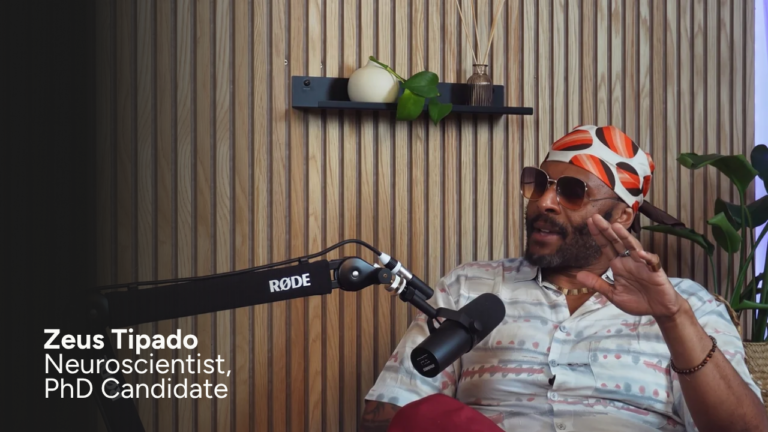
Zeus Tipado 00:00 I'm gonna tell you a story that I haven't told anyone else. And it was the beginning of this psychosis, this anxiety, this sort of remnant anxiety, these panic attacks. I thought that at any point I was gonna stop breathing and that I would die, I would suffocate.
Jason Najum 00:15 Thank you. Thanks for sharing, man. I appreciate it.
Zeus Tipado 00:18 Yeah, for sure.
Jason Najum 00:21 Today's guest is Zeus Tipado, neuroscientist and PhD candidate at Maastricht University. Besides his scientific research, Zeus is a dynamic speaker, educator, and content creator, bringing passion and pragmatism to a variety of psychedelic subjects. Welcome to the Human Journeys Podcast by States of Mind. Real people, real stories, life-changing conversations of personal growth and healing. Welcome to the Human Journeys Podcast.
Zeus Tipado 00:47 Super excited. Thank you for having me out here in Berlin. It's a good thing. Fantastic time.
Jason Najum 00:52 Yeah, good to sit with you. So y you seem to be a man of many talents, a a a modern renaissance psychedelic man. So I I won't attempt to define or introduce you, I'll let I'll let you give yourself a brief introduction.
Zeus Tipado 01:05 Yeah, so I would classify myself as a neuroscientist. definitely that is first. I place science first. I place the value of obtaining science, obtaining facts first beyond everything else.
Jason Najum 01:19 Your research is in the Netherlands now?
Zeus Tipado 01:22 Yeah, Maastricht, down south. Yes, yeah, so I'm focusing on DMT, and I'm focusing on the visual cortex. So basically I'm focused on the effects of DMT. You take DMT, you have this visual experience that's profound, that's ridiculous, that's clear, vivid. And I'm looking at what's happening in the brain when a person has that experience. I'm using tech to look at the brain. NIRx. Which is the company that makes the devices that lets me look into the brain and yeah, it's been it's been a pretty pretty fun stuff so far. Mm.
Jason Najum 02:01 yeah, I wanna get to your research, but this is the human the human journeys podcast. So is there is there a human journey that brought you to psychedelics or is it just a intellectual exploration for you? Is there is there a personal path that got you here?
Zeus Tipado 02:17 Yeah, so I mean, I think it all I I would like to say that it began with my first time taking anything, you know, and that was back when I was a sophomore in college at the University of Arizona. And it was a party. I went to a party and my friend gave me a bag of shrooms. Mushrooms, dried mushrooms. I've like heard of these before, but I really didn't understand them. And and he g he gave me a bag and and I took the whole bag. I ate the whole bag. Lo behold, I found out that that bag was for three people. So I had five grams of shrooms for my first dose ever. And yeah, man, it it was a really intense trip. really intense trip. The party was really eclectic, the people turned into shapes and colors. Things really didn't flow with physics, you know, it didn't really make any sense. So it was a profound experience. and before that, when I was at Arizona, I had a bachelor in psychology. I was working towards my bachelor in psychology and it was fun. I'm doing research and labs and everything. And from that experience, I just added a second bachelor's, bachelor's in religion. Because I wanted to, I thought that a sort of combination of psychology and religion could help me understand this profound experience I had, my first ever, you know, trip. And and, you know, that's sort of what brought me to psychedelics. But I mean, it kind of goes back a little bit further. My upbringing is sort of not that traditional to say. and that sort of was the beginning of my pursuit towards altered states of consciousness. It's just when I was a kid, growing up in a household in like Louisiana, this very voodoo household where there's like incantations, there's there's sort of people being possessed and you know, very non traditional. culture. and that that was my first sort of glimpse into the idea of altered states of consciousness.
Jason Najum 04:19 So spirituality was in the house.
Zeus Tipado 04:21 Spirituality spirituality for sure, that's you want to call it that, and I guess you should want to call it that, but voodoo. Voodoo was a huge thing and and I thought that there was this realm right here that we're all in, you know, tables and chairs. But then there was some other realm that had an influence on this, you know, realm with things like incantations and dolls and spells. And that's just what I believed for a very long time of my life. And then my father, he got employed in a position in in like Texas, Dallas, Texas. So we left Louisiana and went to Texas. We went from voodoo culture to all of a sudden these huge, giant churches, yeah, mega churches with pastors jumping and yelling and screaming. And I'm like, what is going on, man? I I didn't have a clear understanding of reality. It it I thought that this was it, but now I'm learning about Jesus.
Jason Najum 05:03 Mega Church.
Zeus Tipado 05:19 So I think it took a hard turn to science when that happened. And that's sort of what brought me to psychology and of course everything else. Yeah.
Jason Najum 05:27 So this kind of spiritual background, like foundational, and then you started to see it through a more like an analytical lens. I see there's an analytical lens in your content. Even though you're talking about eclectic psychedelic stuff, you seem to want to ground it in the pragmatic. So is that part that's part of the evolution?
Zeus Tipado 05:48 Yeah, so that's the thing about psychedelics is that the whole field, you know, you you have you take something and you have this very unique experience, this subjective experience that doesn't really reside in the realm of understanding, you know, it's there's a lot of things happening. So the field tends to go towards this, I like to say like airy theory modality of thinking. magical thinking, mystical thinking, mystical beliefs, mystical experiences. And whenever a field goes into that realm, then a lot of people it's easier to believe things that aren't true. So that's the reason why I do talk about very, yeah, very, you know, eccentric things, but I really like to hammer it into facts and and and real, you know, truth and empirical evidence, because we have to ground these wild experiences into something. If you if you have a trip you need to ground it in correlates in the brain or something, you know. So so they that's that's the reason why I implore facts and and empirical evidence into my stuff and my content and my research for sure.
Jason Najum 06:58 Yeah, I I was thinking about that the last couple of days and leading up to this conversation. And I wonder there is a I wonder if there's a spiritual bypassing or or a therapeutic bypassing when we talk too much about parallel dimensions and DMT entities and and those bigger kind of terms and views of things. that's there. Let's explore it. But when when we lead with that, is that I I think there could potentially be a few negatives like from that. Like, do we want this to be the c the leading conversation? especially if we're trying to speak about psychedelics in a therap from a therapeutic way. And i is that a way of focusing less on the inner work?
Zeus Tipado 07:47 Yeah, so you know
Jason Najum 07:49 Is there an avoidance when we start talking about focusing on the big on those on those bigger altered dimensional states instead of like, Hey, I'm here as a person that's maybe trying to do something internally.
Zeus Tipado 07:59 Yeah, I mean you know, they both play in each other and and with that said, I I I was fortunate enough to go to the last talk of Roland Griffiths it was at ICPR two thousand twenty two. And he's the scientist that coined the term mystical experiences. And in this talk, he actually at the end of the talk, he says that perhaps him s calling these experiences mystical experiences was sort of a Mistake, misstep. Because he even saw that the field was going towards this spiritual heavy approach, this sort of gr like I guess grandiose approach of psychedelic experiences when really it's a very personal thing, it's a very inner thing. And he said it was sort of a misstep and and I appreciate that honesty from him. And as far as The you know, it's so wow, like psychedelics, they call them ego dissolving. You know, it's an ego-dissolving experience. You take these substances and then all of a sudden you you forget who you are, you know. But in actuality I don't I don't think that that's true. Yeah, because I mean every single experience, you always refer to the experience as I experienced this, I fell through a void, I
Jason Najum 09:15 Has it happened to me yet?
Zeus Tipado 09:25 Had this. And if you're saying I, I, I, then that's still your ego referring to yourself. So I I don't know, man. It's it's it's a it's a very unique I I think overall we need to change the language that we use when we talk about psychedelic experiences and make them a little bit less grandiose, more personal, so that we can embody these experiences as opposed to having as opposed to believing that these experiences are external things, and entities talking to us or different dimensions. No, man. It's happening within yourself and appreciate y what your body and your brain is capable of doing and creating. That's a beautiful thing.
Jason Najum 10:03 Yeah, that's definitely one way to look at it. Love that. and that's part of what w I want this conversation to be and and part of what what States of Mind is trying to do, like, th the I don't want to be kind of preaching to the already converted psychonaut cri choir. Like, people I would like psychologics to feel accessible to anyone and part of that is grounding it in like a therapeutic lens and a personal lens so that anyone like someone who's not looking for a a multi dimensional psychedelic journey, but maybe they they want to get better, they want to heal, they want like adding a more grounding aspect to to psychedelic therapy, I think would help. And yeah.
Zeus Tipado 10:49 Yeah, so I you know, psychedelic therapy it's at a very interesting time right now because there is no gold standard. You know, there there there isn't one therapist or one organization that has like figured it out. You know, it's still the very wild, wild west approach of psychedelic therapy, which, you know, is good because you could be a pioneer in therapy, but it's also bad because a lot of sort of bad practices can sort of ch you know, f come and evolve and change and and really have harm to people. You know, there's there's been a lot of, you know, I'm sure you've seen a lot of things with therapists abusing their patients, especially when they're in vulnerable states with psychedelics. And and we you know, we don't wanna we we could go into all of this stuff, but it's a very vast collection of people doing this. But you know, therapists like, okay, I'm a you know, listen, therapists, they have the biggest responsibility in the entire field because you have a person that takes something And their entire perception collapses, their entire reality collapses. And then the therapist has the responsibility of helping them reassemble this entire world, this entire structure that they've been holding on their entire lives. And you need to have a therapist that really is good, that is using a good protocol, an effective protocol. And we don't really have that yet. We just have a collection of people that say that they're therapists. Okay, perhaps you are a therapist, but but But are you a good therapist? We don't even have a way to validate therapists. And this is the biggest responsibility of the entire field and like, you know, you know, therapeutic benefits and like healing. So I think that right there, I think therapists need to really figure out what what they're trying to do and how to do it.
Jason Najum 12:36 Well, shameless plug states of mind is building a therapist verification part of our stuff. So that that's one of our projects too. So
Zeus Tipado 12:43 Super important. Super important stuff. Yeah.
Jason Najum 12:45 Right. So so I li I so I like this. Like I think we both want the place to be a bit more grounded. how do like pop these conversations I think will help. Like let's so let's bring it back to to the personal. is there something that you think psychedelics can still help you with? Is there stuff you're still working on personally that psychedelics have helped you with, still you still need to work on?
Zeus Tipado 13:13 So, okay, you know what? I'm gonna tell you a story that I haven't told anyone else. And it's about how I approach psychedelics. When I was a kid, I was in sixth grade. I was on the basketball team, you know, tall guy doing my thing. And one time I had a practice, and we were practicing doing our thing, and I went for a rebound and I went for the rebound. I think maybe my head must have turned or tilted wrong or something, and I got dizzy. And it was a feeling I haven't felt before ever. And I just sat down, you know, sort of got my head back together and I sat down and practiced. And everyone else finished the practice. I sat, sat down, my father came and got me. I told my dad what happened. He's like, you know, just relax, breathe in, breathe out. But I felt weird on the way back home. A feeling I've never felt before. This dizziness, this lightheadedness. I get back home. And it was and it was the beginning of this psychosis, this this this anxiety, the this this sort of reminant anxiety, these panic attacks. I thought that at any point I was gonna stop breathing and that I would die, I would suffocate. So I went to sleep that night. My father reassured me that I was okay. I woke up the very next day, still the same psychosis, still thought That at any second I would stop breathing. I asked my father, how did my skin look? Do I do I look blue? My father's like, no, you look great, you look fantastic. And this thing, this psychosis, at the age of like 10 or like 11, it went on to the point where I had to be pulled out of school because I would have panic attacks. I would I would be in class and I would all of a sudden run out. And find a corner and hide because I thought I was going to die, Jason. I thought that at any second my heart, my chest, my respiratory system would just give out and I would die. And then it got to the point where I stopped eating. Because I thought that the food would get caught in my throat and I would die. I would choke. I lost 60 pounds at the age of eleven. I went to the I went to therapist, I went to this one psychologist, Barrett Ackerman. I would go to him.
Zeus Tipado 15:37 He would say, Zeus, why do you believe you're gonna die? You're a perfectly healthy 10-year-old, 11-year-old kid. And then I would come to the therapist session with printed out articles of kids around the entire planet at the same age, dying randomly from random things, random deaths, r look this this kid died in in Iowa. This kid died in in San Francisco. This this kid died. And anything he told me, I would not hear, I wouldn't I would block it out. So At this point, Jason, I lost all my friends. All my friends were done. My parents thought that I just lost my mind. They thought that this is the kid I was going to be for the rest of my life, the psychosis, this is it. They just agreed to it. So I had one friend, one friend, out of all my friends, and he was with me. And we we had a slumber party at my place, you know, sit down, blankets, TV, and everything. And I had this game. Called ActRaiser 2. And it was a game, you know, you play this like this like guy with the sword, you know, you're f going from level to level, beating all these baddies, monsters, you know, of course at the end of the level, there's like a big boss, a big monster. You kill that monster, you go to the next level. You go to the next level. So as I'm playing this game with my friend Nathan, every single level, the end, you beat the boss, beat the monster. But the monster. That I was beating in the game was a monster within myself. Mm-hmm. And that continued throughout the entire game. At the end of the game, the big sort of boss monster goes in and you have to figure out how he f you know operates the patterns and everything. Eventually we beat him.
Jason Najum 17:20 Yeah.
Zeus Tipado 17:22 And then I beat him. I beat this big monster, this big demon. Mm-hmm. And then I went to sleep. It was late. Woke up the very next day, early in the morning. I knock I walk up to my parents' door, knock on my parents' door. Mom opens up the door. I'm like, Mom, can you make me pancakes? And she almost broke her ankle trying to get there to make me pancakes to the kitchen. Bro, it was a light switch. Like like that. So
Jason Najum 17:49 Made
Zeus Tipado 17:52 With that said, the way I approach psychedelics, Jason, I've already been to the darkest denizens of my own inner psyche. Nothing, no substance at any amount could ever take me to that point. Which is the reason why I'm so adventurous with my own psychedelic use and boycottes and adventures. That's the first time I've ever told that story.
Jason Najum 18:17 Thank you. Thanks for sharing, man. I appreciate that.
Zeus Tipado 18:22 Yeah, for sure.
Jason Najum 18:27 So you've done it, like your rock bottom was early.
Zeus Tipado 18:30 Early man, at age of ten or or yeah, ten.
Jason Najum 18:34 So that's why you can explore with more freedom. Like I see a lightness in your in in in in how you approach it now 'cause hitting rock bottom isn't is is somehow important when you're trying to work through your stuff. And you hit it fucking at a
Zeus Tipado 18:48 It is at eleven years old. Yeah, yeah. That I mean that that that was the darkest sort of depths of my own psyche I've ever been in in my entire life. It was beyond depression. It was like imminent death at every single second, scared to eat, losing weight.
Jason Najum 19:04 Was it was it the was it the voodoo house?
Zeus Tipado 19:06 No, it was when I was in Texas. I was in Texas. Yeah. I was in Texas. It was when I went to Texas. And I've look looking back on that moment, I've tried to pinpoint what caused it. And I think maybe there was like an NBA player that I think earlier that summer he was on the court and he like died of like a mysterious heart problem or something. And and I I remember very vaguely a Sports Illustrated cover
Zeus Tipado 19:33 that I looked at and I read the cover, then I may must have read the article inside. And I just like sort of put it away and just in passing, I just sort of processed that. And then something must have happened where I was like, well maybe that is gonna happen to me. Mm-hmm. but it was very subconscious. It wasn't it wasn't really implied. It was just
Jason Najum 19:51 I mean I d I don't know a a lot about about like voodoo religion but like death is is is part of it. Like is
Zeus Tipado 20:00 Yeah, so death, I mean, the thing about death in voodoo is that death is a it's it's just it's it's like you almost look at life in a fourth dimensional aspect. Mm-hmm. In the sense of like death is just a small part of life. And just because you're just because you're dead, you know, just just because you you like die doesn't mean that like you're always dead. It just means that you're dead in one part of your life. but In a fourth dimensional aspect, you know, your death is a small portion of your life. Right. and that's sort of how it is, you know.
Jason Najum 20:37 all right. So you feel like you can you can move forward with psychedelics and psychedelic therapy in like I personally when I when I when I hit rock bottoms, I've had like a lot of mini rock bottoms, right? And there's always a freedom after that where I feel like I can move forward like you. When you hit some sort of bottom, there's an openness for you to like explore and you you kinda left some of the crap behind. So you feel as if there's a There's an open field now w when when you're when you're working with psychedelics 'cause of 'cause of that past of yours.
Zeus Tipado 21:12 Yeah, yeah. And also my understanding of what psychedelics does to the brain is also a great sort of br it grounds me. Like I understand that things are happening with my perception, with my vestibular system, with my visual system, because of the, you know, 5-HT2A agonism, the NMDA antagonism, the, you know, global regressive energy landscapes that happen, all this stuff that happens with with the brain. so it it helps me understand the subjective states that I am.
Jason Najum 21:19 It grounds you.
Zeus Tipado 21:42 However, you know, you trip hard enough and even that kinda goes away. But that's fun. That that's fine but
Jason Najum 21:49 Yeah. Yeah, but there's a y you've minimized the fear 'cause you understand the mechanisms of what's happening. You're going in with f with full knowledge. Yeah. So w if if shit gets weird, you you understand, you know?
Zeus Tipado 22:03 Yeah, yeah. Like the thing about people that trip hard on psychedelics, you always go to the thing of I'm dying or I'm dead. Mm. That that's always the sort of fallback. I'm dying, I'm dead. It's like, dude, death is just a little small it's so insig it's so insignificant in the grand scape of everything, you know? Mm. Mm-hmm. Yeah, yeah, yeah.
Jason Najum 22:14 Did that already.
Jason Najum 22:25 any little any little bits left over from that childhood trauma that you gotta like
Zeus Tipado 22:30 Man, you know what? It was literally a light switch. Like there's not I mean, there's there's like I don't deal with anxiety or panic attacks anymore. It almost has emboldened me to not even experience anxiety anymore because I realize that things like anxiety, you know, when you have this unfounded panic towards something that you can't clearly recognize, it's so silly, you know? It's it's it it's like all of a sudden you have this very physiological demanding response to something you cannot identify. And that is silly. And I see how silly it is. And and now I I see how it is. But for people that are dealing with, you know, panic attacks and and like I understand. It's it's frightening. It's frightening, man. It's it's like you believe something bad is gonna happen and you don't know why or how or from where. but yeah, I man, I don't have that anymore, man. I really don't have that in me. At all. It was a light switch. It was a light switch. Just like that.
Jason Najum 23:32 It sucks you to go through all that, but in some ways, like you went, like you got it, you got it out of the way. you relieve yourself. Like what when I get I guess mild ambient anxiety would be something that that I've had to deal with, and that's been my my path to psychedelics. And I'll I'll catch myself caught in some thought loop, some worry thing. And it's it's always like mild stuff. It's not the end of the world. I've never had full blown panic attacks, but it's there. And then I'll catch myself and I'll snap out of it and I'll start I mean, you you said silly.
Zeus Tipado 23:37 And
Jason Najum 24:01 And I'll laugh at myself. I'm like, where were you, bro? Where what were you just doing for the last like fifteen, twenty minutes? Right. And I'll snap out of it and then you you get better at catching yourself and I'll have these like little mini rock bottoms where I'll I'll do like a mini spiral and then I'll snap out of it and I'm like why did you go?
Zeus Tipado 24:18 Yeah, man, you know, like for in a lot of people they take psychedelics and you have perhaps you have like a panic attack, you know. Or you're there it that could happen, you know. And I I would say that the thing and if if if a person can just take this tidbit away from this podcast is that just it's all about acceptance. Accept that you have taken a substance and accept whatever happens in the next hour, few hours. Is something that you sought for and that it will pass. It doesn't matter how many demons are talking to you or how many past ghosts are inhabiting your psyche, it's something that you've accepted, and therefore it will pass. And if you can just understand that, then you can appreciate the beauty of absolute fear. And that absolute fear. isn't something that's daunting. It's something that's a learning moment. It's something that you can you can really evolve from. You could become better. But it's about acceptance and not fighting it.
Jason Najum 25:31 Yeah. I mean it's just it's just us. It's all it is. It's it's something it's something within you and yeah, when when I tell but I tell people I work in this space and a lot of times people who haven't really been with psychedelics, you see they're really like, nah no, I could I couldn't. They're like and I say what why? There's some fear and they're like, Yeah, yeah. I'm like, but it's just it's just you. It's just it's just gonna be you f sitting with yourself. And yeah, that's the most daunting thing ever. but yeah, it passes, right?
Zeus Tipado 26:00 Yeah, you know, and you brought up something very interesting. And I'm sure a lot of people out there, you have friends, and you're like, Hey, do you want to try this psychedelic? You want to try this? Or why haven't you tried psychedelics? And they'll they'll say, I don't want to have a bad trip. That's the first thing you hear. I don't want to have a bad trip. Yeah. Or, you know, or you know, and it's like, look, to take psychedelics requires a level of courage that some people don't have. And and it's sad to say they don't know that they have it, or else they have fear of their own selves, their fear of what they're capable of. and that is interesting too, you know, to to fear yourself. Like I understand fearing other external things out there. Yeah. Because you don't understand how they operate, but to fear yourself is saying, I don't understand how I operate, therefore I'm afraid of what I'm capable of.
Jason Najum 26:32 They don't know that they have it.
Jason Najum 26:59 Yeah. That's the craziest thing to admit, right? It's similar to mm sitting down for meditation. Like that's a difficult thing to do for for many people. For for for myself. I mean, I could do it a little bit now, but yeah, just sitting with oneself is daunting. And that's kind of why I wanna like ground I try to have these conversations grounded in psychedelics about a more pragmatic conversations about it because
Zeus Tipado 27:00 Which is wow.
Jason Najum 27:27 I don't want people to associate I mean if if we're assuming the goal is to help the psychedelics just to help people get better, give people more access, have more people be able to just improve themselves and in turn make their relationships better, make the world better, make themselves I think yeah, getting rid of maybe don't even talk about bad. I mean, bad trips are a thing, but changing the conversation around bad trips, changing the conversation around the experience in in a in a bit more that's why I bring it back to like I don't love talking about like the interdimensional stuff. Right. I'd rather talk about like this is you just trying to get a little bit better and this is a tool in the toolkit to help you, you know, step away from those anxious thoughts, to have a little bit of distance, to reassess, you know, the the the Michael Pollan fresh blanket of snow to break those like bad habits of thought. Like that's where I personally like to bring and I guess I'm missing maybe little bit the spiritual conversation, but I wanna I wanna ground things in a little bit more in the pragmatic. I think that'll welcome more people in.
Zeus Tipado 28:32 Yeah, man, I I think you're absolutely right. And you know, my research is DMT. Dimethyltryptamine. It's a substance you take, and within seconds, you're in this hyperspace reality. But the thing about DMT that happens quite often is that these this experience of entities, entities could could be aliens, insect freaking reptilian, whatever faces you're talking to, they're talking to you. And You know, of course that brings up these people thinking about, well, maybe you take DMT and your brain goes to a different frequency and you g explore to a different dimension of reality that isn't accessible that is inaccessible with whatever. Listen, okay, I'm not gonna get too deep into this because I talk about this all the time. But you've taken a powerful substance that is that makes you see visual things. So if you take the substance and you see visual things, it's not That you're going to a different dimension. It's just that you're taking a drug. But I tell people this, and this is the whole reason why brought this up is entities. You know, you have this dimensionality, dimensions, different dimensions. It's the question, the the boring question: what are these entities? That that's the boring question. You there's even a There's there's even a university out there, I'm not gonna name them, but they're trying to map out this hyperspace of these beings and everything. That's a boring question. The more interesting question is why are you seeing entities? What are these entities telling you? Because really what's happening is you're telling something to yourself. That's it.
Jason Najum 30:11 Right.
Jason Najum 30:19 It's a form of dream. It's a you're yeah. This the message of the entities, not the entities themselves. I what are they telling you? I mean, I think there was some what was it? It's it's you're not projecting what was it? I think I saw it on one of your clips about explaining ex expectancy? Expectancy effect. Right. Yeah. So yeah, I've heard about the DMT elves. So yeah.
Zeus Tipado 30:37 Expectancy of that.
Jason Najum 30:44 If I the next time I do a DMT experience, my brain knows that, right? And maybe that's how I'm going to project the story I need to tell myself with the story I've already heard. Yeah.
Zeus Tipado 30:55 Yeah. Yeah. F for sure. And and it's like and you know, I always tell people like, okay, these entities, they talk to you. It's like they don't give you new information. They're not telling you how to solve some unsolvable mathematical equation. They're they're they aren't telling you a new language. It's just what vr you know, reassuring what you already know, like, you know, treat others kindly or, you know, do this or do that. Because you're trying to you're it's it's like you it's like Some sometimes things in our lives are so personal that we have to externalize it as if it's some other person and then hear back ourselves to actually accept it. I think that's what's happening with these entities is that it's we're externalizing something that we've been telling ourselves for a long time, but we only confirm it when it's an external thing telling us.
Jason Najum 31:46 Yeah. What it is. Yeah. Yeah. And I I want to give permission to not need those projections and stories that like if if people are into some people are just psychonauts and they want to explore for fun, and that's fine. But like if people come to psychedelic therapy, I think there needs to be more of like a permission structure to like lead with the personal and to lead with what they I think if people lead with in an open way of why am I here? What do I need to fix? What do I feel like I need to work on? Maybe the experiences will be more personal and less external and less out outer dimensional. I I'm wondering.
Zeus Tipado 32:33 I mean, but also you gotta understand, Jason, like some people they don't even understand what they want or who they are. So for them to even pose that question to themselves and have it answer, yeah, that's as alien as an entity talking to them.
Jason Najum 32:46 Yeah. That's true. Well, that brings it back to the the therapists and the structures we want to build. Right. So I I did a two month program with Kinisi shout out. Yeah. And it was a month of prep in advance. And that gives you and it was w with the facilitator and there was some like so conversations ahead of time. So like the intention setting was really there. Right. And then I and I'm somewhat experienced in psychedelics, but still there's apprehension and the mu the the month of preparation, like two or three remote sessions with my facilitator, like I was felt much more grounded. So that when I went into the actual experience, it was a re it was it was it was a very present and grounding experience. Like I'm I wasn't running off anywhere. I was there. I knew what I wanted. So yeah, I think building building like the infrastructure is gonna like help people maybe have more grounded experiences and
Zeus Tipado 33:50 And that's that's the key. Building the infrastructure. And to be honest with you, it's not built. It's not built. It's it's it's like scattered. It's it's it's listen, to be honest with you, it's hidden behind corporate intentions. it's it's it's not there yet. And will it be there? I hope so. I I really hope so, man. I really I really hope there's an infrastructure of people to follow to really truly heal themselves. But currently, right now, we don't have that. And and and it's sad because it makes psychedelics dangerous. It it does. I mean it it makes it it makes it sporadic. It makes it almost chaotic if there's no infrastructure to follow. No? Mm-hmm. And it's dangerous. It's and and that's and that's also why like I'm very hesitant on the idea of full Legalization. Yeah. Everyone's like, legalize everything. And I think what happened in Australia recently with the legalization of MDMA for clinical use, I think that's dangerous. Because number one, we don't we're still researching the effects of MDMA. Number one. Number two, there we don't have that protocol. There's no therapeutic po like protocol to follow in order to get better. It's still this wild, wild west. So you so it's almost like you've unleashed a match in a w tinder box. Yeah. When you just should when you wanted to put a match on a candle.
Jason Najum 35:30 You know? Yeah. Yeah. yeah, I I I tend to agree with that. I'm happy we're taking the slow so it it is frustrating that we gotta peel back all these layers of regulation and we gotta, you know, fifty years of anti drug propaganda and and our institutions have built all these layers of resistance against us. So it is annoying and there's people who need access who don't have it and they need help and they can't get it. So that sucks. but I d Do you agree that doing it in a slower, responsible way that gives us the chance now to build the bones and do it responsibly? Cause like one bad event and it's gonna set back the whole space. So I've and I've been in the space now for six years and like knock on wood, we ha like there hasn't been that much bad news. Like we've been doing it responsibly, as frustrating as it is. So yeah, it's slow and steady. It's not perfect, but it's kinda it's kinda happening. these next years are gonna be interesting. I feel I feel quite positive. There's like a nice mix of peeling back the layers, moving things forward, but moving it forward slowly, like there's much more conversations around integration and preparation that are happening now. What's gonna look like when things get legalized? We'll see. is the FDA gonna approve it with a mandated psychotherapy or not? Are the people who deliver it gonna like so yeah, all that's to be discovered but like
Zeus Tipado 36:56 Man, I I really hope that I mean I like told you earlier, man. I I think the single most important thing in the field of psychedelics, I would say myself neuroscientist, but it's not. It's therapists. It's literally therapists. They have the biggest responsibility because, you know, to to give a person a substance that collapses their entire belief system, at least in certain doses, and then to have the Even the ethical compass, the moral compass, the the the cognitive ability to help that person rebuild their belief system, not that same day, but over the course of days, weeks perhaps. Integration isn't just a single day event. It it it takes days and weeks to really process these really big, strong psychedelic, you know, changes and and experiences. So man, I man, I I I wouldn't Wanna be a therapist right now because, you know, your job's gonna be I mean, it it's good that you'll have work, but it's gonna be difficult because you're gonna have the most important work.
Jason Najum 38:05 But it's a nice burden to have. And I've met some some facilitators, you know, whose hearts are in the right place. And yeah, I think it's like a it's an aw awesome responsibility in the if you take it if you take it in a good way. yeah, so back to a little bit about maybe some another kind of controversial question about psychedelics. I thought about if the this kind of therapeutic bypassing that maybe I'm seeing and I'm wondering, no, psychedelics don't have addictive chemical properties, which is great. but I wonder the normalization of psychedelics, normalization of microdosing, even if the compounds themselves aren't addictive, now they're becoming part of our culture and our habits. And I've microdose and I've like almost caught myself. I'm like, am I reaching for a microdose? do I need it right now? Now thankfully the chemical pull isn't there with psychedelics, but I'm wondering, are we getting too used to habitualizing psychedelics as part of our lives.
Zeus Tipado 39:07 Yeah, so I I think that and that that's a very important question. And it's I'm gonna go to a different realm of that question because I know you want to focus on the microdosing, which any that's another topic. Yeah. But I think to understand F-psychedelics are habit forming, we need to look at this other thing, VR, virtual reality. So, you know, that's a pretty wild topic to talk about, but in Gen Z. the people, the kids that are gin Gen Z th there's a thing. It's it's called I can't even think of I'll I'm gonna sp but th there's a thing in which People that are immersed in VR, they have this problem in which it's difficult for them to come back to reality. It's almost like an addiction to having an alternate state of reality. And it's it's a serious thing. It's it's a two-folded thing. I can't think of the names right now, but it I'll give you the names later. But it's a problem that we're seeing. So I would say if you translate that to psychedelics, you can have somewhat of an addiction to having your reality removed, replaced, and changed. Right. And while it's not the substance that that is addictive, you know, the escapism. It's it's the escapism. But yeah, it's the escapism. It's the escapism. It's it's the the addiction to having your reality replaced. And but that's only with heavy, heavy sort of doses. but you see that also with people like ketamine, you know, that I've seen people that Have strong habits of of ketamine daily, you know. And it's not that ketamine is addictive, it's the effects that are addictive. The disassociation, the removal of reality. So in and then so that that's a thing that needs to be figured out. it does, it just it just needs to be figured out. And perhaps the reason why people are removing themselves from reality is because this reality is so sick and so.
Zeus Tipado 41:19 been so deprived of of human connection. I mean, look at what's happening across the world and wars and battles and you know, we we it's it's something that you don't want to really embody. So you remove yourself from from this and d deal with VR, psychedelics. So that could be a thing. That that could be a thing that we need to focus on. And that's a real thing that needs to be looked at. As far as microdosing
Jason Najum 41:40 Well before we drop off to that, maybe part brings it back to previous part is that like if we ground psychedelics in more pragmatic views in in understanding what's happening neurologically, in understanding, hey, why am I here? Like why am I doing psychedelics? Is it here for a therapeutic reason? Am I here am I doing this for an escapist reason? Beforehand. Like the preparation, I'm starting to see preparation almost as as important or more important than the integration. Like why am I taking this substance? And maybe like reiterate to yourself the reasons you're here. I'm doing it for A, B, and C, 'cause I want to get better, 'cause I want to move myself forward. And maybe that will like mitigate the escapist
Zeus Tipado 42:21 Interesting. Yeah. Right there. That's a valid solution that yeah, that needs to be looked at or that should be incorporated. Yeah. Preparation is important.
Jason Najum 42:34 But strong intention setting will like yeah, I think maybe minimize the escapism, yeah.
Zeus Tipado 42:41 I mean that's yeah, that's that's the only thing that I can really look at is yeah, there Yeah, like why why would why do you want to trip at all? You know, is it because you're at a party, you want the the party to be elevated? You wanna have, you know, some trippy effects 'cause you're at a festival. All right, that's fine. You know, it's sort of temporary displacement of your own consciousness via festival. So it's it's you it's that's fine, you know, it's not like a permanent thing. But if you're tripping on like a Thursday, you know, by yourself, why? Are you tripping on a third? Is it is it because work is unbearable? Is it because school's unbearable? Is it because your family is unbearable? Yeah. Okay. And if that's the case, then why is your family unbearable? Why is your work unbearable? And if it's unbearable, perhaps you should, you know, make other adjustments to your life aside from taking a dose of whatever and just zonk it out for the next five hours.
Jason Najum 43:30 Yeah. Hundred percent. Yeah, it's not it's yeah, it's still an external reaching instead of an internal one. Yeah.
Zeus Tipado 43:38 And I I think psychedelics are gonna reveal more about human consciousness than we're ready for. Mm-hmm. Mm-hmm.
Jason Najum 43:49 Mm. Yeah, and I th yeah, I think we still I I don't want to put it on an altar, but I don't like I don't know I don't love when I see people talk about taking psychedelics in like such a casual manner. And I I don't wanna judge. I've also again I'm not perfect with my consumptions of things, but I do think we should like keep it in a somewhat I don't say sacred category, but like this is something else and we should address it. And like psychedelics I'm I'm so happy it's getting mainstreamed and there's a bigger acceptance, but in that mainstreaming, we're mainstreaming it. And you know, you know, we're popping we're taking out and we're taking out psychedelics at the party now. And there's good and there's bad with that.
Zeus Tipado 44:34 There's good, there's bad, but there's always weird. You know? And the weirdness can be fun. The weirdness is definitely weird. The weirdness could be bad. And, you know, it's like psychedelics at at parties, I see it as like a little bit of seasoning on an already prepared dish. It's nice. A little bit of seasoning, you know. But yeah, man, it's it's it's like yeah, you know, the consumption of psychedelics, you know, and it's not like a one tier thing. There's different tiers of of consuming psychedelics. There's microdosing, there's party, there's, you know, perhaps there's a productivity element to it. You hear people in San Francisco in the Bay Area s talking about they do a little bit of 2C-I before they go into work to code. You know, and you hear the story of Steve Jobs doing LSD before he you know made Apple and everything. So I think psychedelics they they alter state of consciousness. And how do you how you perform in those altered states is really up to yourself, but it's also up to your own personality, your own, you know, how you approach things, you know, your own behavior, your own personality, you know. That's that's and that's and that and that that's what I'm saying is that I think psychedelics will they're they're gonna reveal things about consciousness that we are just not prepared f to handle. Cause it's we don't understand enough about, you know, humans and and and and You know, and and how we perform in cognition to understand, okay, now let's take your brain and put it at the max chaotic capacity and then work our way backwards, which is what we're doing in like science. Yeah, it's it's it's man, psychedelics is gonna be a wild it's a it's a wild you know what, honestly, Jason. I think that we aren't even at the tip of the iceberg when it comes to what psychedelics will g will give us or will inform us about the human condition. Mm-hmm.
Jason Najum 46:37 Yeah, there's all kinds of other directions, right? I mean, imagine ten years from now, twenty years from now, I could be used for maybe I'm gonna say like psychedelics for like non explorative, like for inflammation of the brain, for other wellness things. I mean, there's the creativity stuff. So yeah, we're still in this we're still in the Wild West and I mean you work in that field, you probably see all kinds of like more niche specific research happening. So what what are you excited about?
Zeus Tipado 47:05 Yeah, so I mean, man, just in our lab alone in Maastricht University, like we we we do some really interesting things. For example, we just wrapped up a study in which we're looking at synchronizations, brain synchronizations of couples taking LSD at the same time and looking at literal brain synchronizations of of F I I can't give too much of the study. I mean it's unpublished, but we're We're looking at how the brain syncs between couples when they do LSD. And are we finding synchronizations? Yes, we are. Where? I can't tell you, but when that drops, it's gonna be like, my God, this is un like we this is unexpected, you know? Mm-hmm. so we're we do stuff like like that. We we have a fantastic scientist, Sarah Roach, she's doing research on the idea of environmental Being connected with the environment and psychedelics. How psychedelics can help us sort of be have this connection with the environment, why we're connected with the environment, all this stuff. you know, my own research with you know, DMT and virtual reality and F mirrors, it's just cyberpunk weirdness that I'm still working on. Man, you know, I I don't want to get too deep into it, but yeah, it's it's so my research isn't
Jason Najum 48:21 Yeah, you wanna you wanna tell a bit about Europe?
Zeus Tipado 48:30 Really therapeutic at all. It's just, it's just pure like science, pure neuroscience. I'm looking at when a person takes DMT, I've identified this area of the brain that lights up, basically, you know? And this area of the brain that lights up also lights up when a person is inside VR, doing a very s you know, interesting thing in VR. I can't tell you what it is. But now I'm combining DMT and VR. Basically, I'm giving people DMT while they're inside VR.
Jason Najum 49:00 Damn.
Zeus Tipado 49:00 And I'm looking at this brain area that's lighting up. And is it tricky? Yes. It's very tricky to look at the brain when a person is tripping and inside VR. It took a lot of years, a lot of practice to get to this point as far as just you know understanding neuroscience and just people and everything. But yeah, man, it's it's we're it's no, not yet. Not yet. Surprisingly enough, not yet. I would say that.
Jason Najum 49:22 Any brains exploding?
Zeus Tipado 49:29 one of the most difficult studies our lab has encountered, I mean what n not one yeah, I guess one of the most difficult ones was actually the study that we did with you know, it's called JWH-018, I think. It's spice, the idea the s the sort of spice, the sort of fake synthetic cannabis back in the day. that was a big thing in Florida back in the day. But we had some of the most intense trips when a person takes spice. And we've looked at we've run fMRI studies with people taking spice and it and and this it's I think it's JWH-018 is the is a sort of chemical compound, but it's a hundred percent cannabis receptor, cannabinoid receptor agonist a hundred percent cannabis is like twenty percent thirty percent this is a hundred percent so it's we we've been seeing intense trips of people taking in this cannabis synthetic cannabis you know who would have thought you know so yeah man we're we're we're doing a lot in the lab. We've done 5-MeO-DMT research. We've done THC research. we're doing some microdosing of research with Eva. she's a fantastic scientist. but I can tell you this, and this is a f guaranteed fact. The future of psychedelic science is going to be like women crushing it. Because like our lab is filled with the most intelligent women guys like I'm I'm just trying to keep up with them. They're just we have like Eva, we have Natasha, Kim Kuypers Aline, you know, Melissa Vasque, all these people are just crushing it. so shout out to women and STEM. You know, they're gonna they perhaps already are controlling the entire psychedelic science industry field and they will continue for the next decade, decades upon decades. And and I'm fortunate to be able to research with them.
Jason Najum 51:18 Yeah. Good for you. Yeah, yeah. All right. Invite on. all right, man. We're like wrapping up. this was let them say thank you. this was good this was great. I appreciate you sharing. Yeah. Yeah. let's do this again.
Zeus Tipado 51:21 For sure, yeah.
Zeus Tipado 51:37 Yeah, man. whenever I'm in Berlin, it's always a fantastic time. It it starts off with the talk or a conference, goes into a party, and a couple of days later I'm trying I'm just doing something well, you know. it's the same thing here. So I'm very fortunate to also come come on board your the this podcast and really talk about very intimate things. I really haven't told that story about me as a kid dealing with anxiety ever. You know, that's that's that's a first. but you know. Why the heck not, you know?
Jason Najum 52:07 Yeah, I mean I mean I I w I wanna give people permission to to go there. So thanks man.
Zeus Tipado 52:15 For sure, for sure. If this is a safe place. It feels very safe. You have a very safe disposition and demeanor. So I felt I or I felt comfortable coming on and telling you this. So I so props to you, Jason, for for having this sort of calmness about you that makes people want to share these intimate things and want to really connect with, you know, yourself and the people out out there. So I I appreciate you just being yourself, man.
Jason Najum 52:40 Yeah. And on that. All right. Thanks, man.
Zeus Tipado 52:42 Sure. See you later. All right. Much love.