Where Is CBD Legal? Country-by-Country Guide to Cannabidiol Regulations
Cannabidiol, or CBD, has stepped out of the shadows and into wellness culture: people sip it, rub it on their skin, and drop it under their tongues for anxiety, insomnia, mood swings, or even skincare issues. Some evidence (though far from conclusive) suggests CBD may ease anxiety and sleep problems. But here’s the catch — laws around CBD still look like a maze, shifting faster than you can say “cannabis.”
So, where exactly is CBD legal in 2025, under what conditions, and what fine print and loopholes should you watch out for? This guide breaks it down.
Brief History of CBD
CBD was first isolated in the 1940s, but it only began gaining widespread attention decades later with increasing research into cannabis compounds. CBD does not cause intoxication or “high”, which has made it more acceptable in many legal systems. Alongside CBD, hemp also produces THC — the psychoactive compound in cannabis — which is why the legality of CBD often depends on the precise ratio of these two cannabinoids in each product.
In 2018, the Farm Bill excluded hemp — a cannabis plant — from the legal definition of marijuana under the USA’s Controlled Substances Act (CSA). As a result, hemp and its derivatives became legal, provided they contain less than 0.3% delta-9 tetrahydrocannabinol (Delta-9 THC) by dry weight. Since then, many countries have introduced regulations to accommodate or restrict CBD products, often distinguishing hemp-derived CBD from cannabis-derived products with higher THC content.
Hemp vs. Marijuana: What’s the Difference?
Both belong to the Cannabis sativa species, but they differ in chemical profile and legal treatment. Hemp is cultivated to contain only trace amounts of THC, while marijuana varieties have higher levels that cause psychoactive effects. This distinction is central to how lawmakers separate safe “industrial hemp” from controlled cannabis.
Types of CBD Products
CBD now comes in almost every format imaginable — oils, capsules, gummies, creams, drops, and even vape liquids — each with its own quirks and potential benefits.
- Oils and tinctures are the classic choices, taken under the tongue for relatively fast absorption.
- Capsules and softgels deliver a measured dose in a familiar “pill” format, making them discreet and consistent.
- Edibles like gummies, chocolates, teas, and sparkling waters take effect more slowly but often last longer.
- Topicals — including creams, balms, and lotions — are applied to the skin, often marketed for joint or muscle soreness and skincare purposes.
- Vaping or inhalation products, including CBD vape juice and hemp flower, provide the fastest onset but raise safety concerns — studies have found inflammatory responses in lung tissue after CBD vaping.
On the chemical side, CBD products are usually grouped into 3 main types:
- Full-spectrum CBD contains multiple cannabinoids, terpenes, and trace THC, thought to work together in what’s called the “entourage effect”.
- Broad-spectrum CBD keeps many of these compounds but removes or minimises THC.
- CBD isolate is pure cannabidiol with no other cannabinoids or terpenes, often chosen by people who want zero THC.
Interestingly, recent research suggests that trace THC may actually improve CBD’s bioavailability when taken orally compared to isolate formulations.
CBD in Cosmetics
CBD isn’t just something you swallow — it’s also showing up in bathroom cabinets. From serums and face creams to muscle balms, beauty brands have embraced cannabidiol as the latest “active ingredient.” CBD creams and oils are often marketed for their soothing and anti-inflammatory properties, with users reporting relief from dryness, irritation, or redness. Research also suggests that CBD may help regulate sebum production, which is why it’s increasingly used in acne-focused skincare. However, the rules for applying it to your skin are often very different from the rules for ingesting it.
In many countries, CBD lotions and skincare fall under cosmetics law, which is usually looser than the regulations for supplements or medicines. In the European Union, for example, CBD is listed in the official CosIng database as an allowed cosmetic ingredient, provided it’s derived from legal hemp sources. That loophole explains why you might find CBD facial masks on a department store shelf, even when ingestible oils require a prescription.
Still, “looser” doesn’t mean “anything goes.” Regulators strictly control both the concentration of CBD and the trace levels of THC in topical products. In the United States, the FDA has issued multiple warning letters to companies that market CBD lotions with unproven medical claims, reminding them that cosmetics cannot claim to treat, cure, or prevent diseases.
CBD in Pharma
CBD has also entered the world of licensed medicine: research is exploring CBD’s potential for epilepsy, anxiety, psychosis, multiple sclerosis, chronic pain, and Parkinson’s disease. The clearest example is Epidiolex, a purified CBD formulation approved by the U.S. FDA in 2018 for the treatment of rare epilepsies like Dravet and Lennox-Gastaut syndromes. In Europe, the European Medicines Agency (EMA) authorised the same drug under the trade name Epidyolex, making it available across multiple EU countries. Australia followed suit, approving Epidyolex in 2020 for similar indications.
What sets these medicines apart is the process behind them. Unlike CBD oils or gummies sold over the counter, pharmaceutical-grade CBD must pass through randomised clinical trials, standardised dosing, and rigorous safety testing, the same hurdles faced by any other prescription drug. That makes them more consistent and reliable, but also far more tightly regulated — available only with a doctor’s prescription.
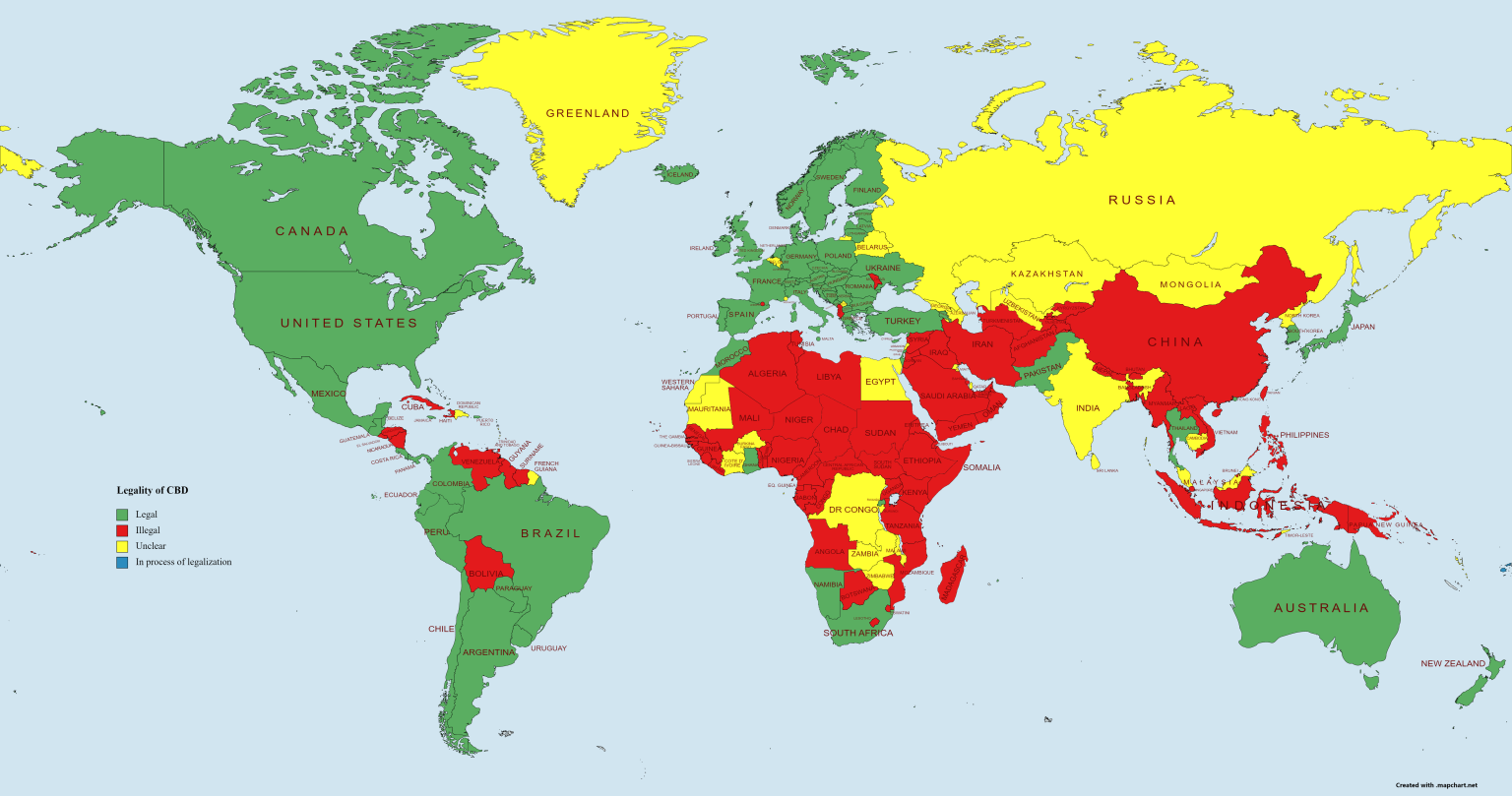
CBD Legal Status Around the World
🇺🇸 United States
In the U.S., hemp-derived CBD containing less than 0.3% THC is legal at the federal level, but not in food or dietary supplements. However, different states may have additional rules regulating production, sale, and use. For instance:
- California permits broad CBD sales and use, and became the first state to legalise the inclusion of industrial hemp in food, beverages, supplements, pet products, and cosmetics through Assembly Bill 45.
- Idaho is among the most restrictive states: only CBD with 0% THC is legal — even trace amounts are banned, and it must be derived from industrial hemp, not marijuana.
- Texas allows low-THC (under 0.3%) CBD products but restricts recreational cannabis entirely.
🇪🇺 Europe
Europe has a patchwork of laws regarding CBD, with many countries permitting hemp-derived CBD products under specific regulations. The European Union allows CBD derived from hemp containing less than 0.2% THC, but national rules vary significantly.
Countries like the UK, Germany, and Switzerland have established frameworks for medical CBD, often requiring prescriptions for higher-strength products. Some countries restrict the sale of CBD for use in cosmetics or supplements, while others adopt more liberal approaches.
- Germany — CBD is legal if derived from industrial hemp with less than 0.2% THC.
- United Kingdom — CBD is legal if it comes from an EU-approved hemp strain and contains no controlled cannabinoids like THC or CBN. Products must also comply with Novel Foods regulations.
- France — CBD products are legal if they contain no more than 0.3% THC. However, CBD flowers and raw hemp leaves remain banned, even if THC-free.
- Italy — CBD products can contain up to 0.6% THC, among the highest thresholds in the EU. Oils and cosmetics are common, though CBD flowers remain in a grey area.
- Switzerland — it has one of the most permissive frameworks, allowing up to 1% THC.
- Sweden — Only 0% THC CBD products are legal, making Sweden one of the strictest CBD markets in Europe.
- Spain — CBD is legal only in cosmetic products; ingestible oils or edibles cannot be sold legally.
- Belgium — CBD is technically illegal, though products circulate on a grey market.
- Slovakia — Legalised CBD only in 2021, but the market remains heavily restricted.
🇨🇳 🇯🇵 🇮🇳 Asia
Asia generally maintains stricter cannabis regulations, and CBD legality is often unclear or limited. Some countries, like Japan and South Korea, allow hemp-derived CBD under stringent THC limits and regulatory oversight. Many Asian countries still prohibit CBD products outright, especially those derived from cannabis plants with higher THC. Legal CBD markets remain small but are slowly emerging in select countries. For instance:
- Japan allows hemp-derived CBD with no THC, but all cannabis products remain heavily regulated.
- South Korea permits medical CBD but strictly limits THC content.
- China allows hemp cultivation but does not broadly permit CBD sales.
- In Thailand, cannabis has gone through dramatic policy swings. In 2022, the country decriminalized parts of the cannabis plant and allowed sales of products containing less than 0.2% THC. But by 2025, the government reversed course, so that cannabis is now limited to medical use with prescriptions (AP News).
- Vietnam classifies cannabis as a controlled substance, and CBD products do not have a clear legal pathway. Even in cosmetics, regulators have flagged CBD as noncompliant under current frameworks.
- In India, the situation is mixed. While cannabis is illegal under federal narcotics law, some hemp-derived CBD products circulate in a legal grey area, often marketed online or through ayurvedic licensing frameworks.
🇧🇷 🇦🇷 🇲🇽 Latin America
Latin America is witnessing increasing acceptance of medical CBD, with many countries introducing regulated programs to allow patient access. Medical CBD is generally becoming more available under prescription and government oversight. However, legal frameworks differ widely across the region.
- Brazil: Medical CBD is authorised, and patients can legally import CBD oil with a doctor’s prescription.
- Argentina: Medical cannabis, including CBD, is permitted with medical approval, and regulated production is expanding.
- Chile: The Ministry of Health regulates medical cannabis, including CBD, providing access through formal health channels.
- Uruguay — First country to fully legalise cannabis in 2013; regulation covers both recreational and medical cannabis, including CBD.
- Mexico — The Supreme Court has repeatedly ruled cannabis prohibition unconstitutional; CBD and medical cannabis are legal, though full regulation remains incomplete.
- Peru — Medical cannabis legalised in 2017; distribution through licensed pharmacies is limited and expensive, restricting patient access.
🇦🇺 🇳🇿 🇨🇰 Australia and Oceania
Oceania presents a mix of cannabis policies, with many countries supporting medical cannabis, including CBD under regulated frameworks. Increasing awareness of CBD’s medical benefits is driving reforms, especially in Australia and New Zealand.
- Australia & New Zealand — Both countries operate regulated medical cannabis programs, where CBD is available on prescription. Recreational cannabis remains illegal. Australia classifies CBD as a Schedule 4 prescription medicine, while New Zealand legalised medical CBD but rejected recreational legalisation in a 2020 referendum.
- Pacific Islands with strict prohibition — In Fiji, Samoa, Tonga, Papua New Guinea, and Micronesia, cannabis and CBD remain illegal. Enforcement varies, but overall, these countries maintain hardline policies with no formal medical access.
- Emerging reformers — The Cook Islands voted in favour of legalising medical cannabis in a 2022 referendum, and legislation is in progress. Vanuatu has also signalled interest in developing a regulated medical cannabis framework, though details remain limited.
Countries Where CBD Is Prohibited or Highly Restricted
While some regions have embraced medical CBD, many countries continue to prohibit its use entirely, often grouping CBD with cannabis under strict drug control laws. These prohibitions apply to both recreational and medical cannabis products, making legal access to CBD impossible. Enforcement can be severe, and penalties harsh.
Most Middle Eastern, African and Asian countries have strict cannabis bans, including CBD. Though some nations are beginning to explore medical cannabis, CBD remains illegal in many places, including:
- Kenya — Cannabis laws are strict; CBD use and sales are not legally permitted.
- Egypt — Cannabis and all derivatives, including CBD, are prohibited.
- Indonesia — Cannabis, including CBD, is illegal, with harsh penalties for possession or sale.
- Malaysia — All cannabis products, including CBD, are banned.
- Singapore — One of the strictest drug regimes in the world; CBD is treated the same as cannabis, with severe penalties for possession or import.
- Hong Kong — As of 2023, CBD is classified as a dangerous drug; possession can lead to up to 7 years in prison.
- Philippines — Cannabis is illegal for both medical and recreational use; CBD is not authorised.
- Saudi Arabia — Cannabis and CBD are completely prohibited; drug laws carry severe punishments.
- United Arab Emirates — All cannabis products, including CBD, are banned; even trace THC can result in criminal charges.
Legal Risks of Travelling with CBD
Travelling with CBD products presents a complex legal challenge due to highly variable regulations worldwide. What is perfectly legal in one country may be banned in another. It is especially critical for air travel, where airport security and customs officials enforce strict drug policies. The U.S. Transportation Security Administration (TSA) notes that CBD products containing no more than 0.3% THC are permitted under federal law for import and for domestic travel within the United States. However, it warns that state or international laws may still apply.
To minimise risk, travellers should thoroughly research the laws of both their destination and any transit countries, avoid carrying products with detectable THC, and consider bringing documentation such as prescriptions or certificates of analysis. Even then, enforcement can be unpredictable. When in doubt, the safest choice may be not to travel with CBD at all.
Future of CBD Legislation
Despite widespread interest and adoption, CBD’s legal status remains complex due to differing international laws, inconsistent regulations, and evolving research. The lack of global standardisation in product quality and labelling also poses risks. A 2017 study found that nearly 70% of CBD products sold online were mislabeled, often containing more or less CBD than advertised, and sometimes even detectable THC.
Still, ongoing research and regulatory updates suggest that CBD legalisation will continue to expand. As the FDA has already approved Epidiolex for epilepsy treatment, it sets a precedent for pharmaceutical CBD. Meanwhile, the European Union is gradually updating its Novel Foods framework to clarify rules for CBD supplements. All signs point to gradual liberalisation: CBD access is likely to broaden, but only alongside tighter quality control and medical oversight to ensure patient safety.
FAQ
- Can CBD get you high?
No. Unlike THC, CBD does not produce psychoactive effects or a “high.”
- Is CBD legal for pets?
CBD products for pets are legal in some regions but regulated similarly to human products; always check local laws and consult a veterinarian.
- How can I verify the quality of CBD products?
Look for third-party lab testing certificates that show cannabinoid content and the absence of contaminants.
- Does medical insurance cover CBD treatments?
Generally, no. Most insurance plans do not cover CBD, but this is slowly changing as more pharmaceutical CBD products gain approval.
- Are there age restrictions for buying CBD?
Yes, many countries and states impose minimum age limits (often 18 or 21) for purchasing CBD products.