Reading Navigation


This content is grounded in peer-reviewed research, clinical guidelines, and established best practices. Claims are reviewed for accuracy and transparency. Learn more about our evidence standards
I Went to The Netherlands For A Legal Psychedelic Therapy Retreat

Working in the mental health and psychedelic therapy space is definitely an interesting job.
You’re involved in combating stigma and moving conversations forward; educating yourself and readers in new methods and innovative models. You become familiar with the finer points of mental wellness, with terms like serotonin and neuroplasticity and the brain’s default mode network. Words like integration and journey suddenly take outsized places in your vocabulary.
You hear the personal testimonials, read the studies and see the impressive results. You become aware, and educated, and — hopefully still maintaining some journalistic integrity — a believer. This stuff seems to work.
But what happens when the opportunity presents itself to attend a psychedelic retreat? To go and experience it? To discover what psychedelic therapy is actually like?

Telling The Story of Psychedelic Therapy
My first conversation with Sophie from Kinisi was extremely pleasant. The good vibes were transmitted digitally, and before you know it, plans were being made.
We would tell the story. Show what really happens at a psychedelic therapy retreat. Suddenly, calendar dates were being confirmed — and I found myself committing to a 2-month program and 2-day psilocybin therapy experience in the Netherlands.
Recorded. On camera. For the whole world to see.
Hanging up our call, I did my best to not freak out.
One of the goals of States of Mind is to be a resource for people interested in mental health and innovative therapies. But if the mission is to enlighten and educate, we also want to be sure that we’re not just preaching to an already converted audience — but to be a resource for those who are curious about the potential of these alternative therapies.

Sophie’s description of the program at Kinisi seemed to offer the opportunity to tell a more complete story. There are many clichés and stereotypes about psychedelics out there. Ayahuasca in the Amazon. Instagram shamans in Tulum or Bali. These are the kinds of stories that grab the headlines, and bring attention to the space; but they can also stop people from considering psychedelic therapy as a legitimate therapeutic option.
Which is why, when the Kinisi program was described to me, it seemed to give an opportunity to present a more complete picture of the therapy:
A two-month program, with a one-month preparation phase. Meetings with your guide/facilitator in a sort of pre-therapy therapy session.
Then comes the actual retreat itself — usually a couple of days at a specialized retreat focused on psilocybin therapy. Legal psilocybin therapy. This is then followed by one month of post-therapy follow-up, including integration support, guide materials, and continued support.
An opportunity to paint a more complete picture of these innovative therapies. To show them as legitimate medical options. To tell a more complete story of psychedelic therapy — not as a single psychedelic event, but as an integrated therapeutic process.
Meet Kinisi Clinic and The Team

 Netherlands
For people with little time who want a private all-round solution to return to aliveness.

Starting The Process, One Month of Preparation
This process, in terms of the Kinisi program, starts once you commit to the retreat. There’s an intake form and registration. Once you’re in the books, the actual program begins, and you are gently — but persistently — eased into a framework and set of actionable guidelines.
One of the first steps was receiving the Kinisi guidebook, a very detailed guide outlining everything you would need to know about psychedelic therapy, psilocybin, preparation for the therapy, the retreat, and more. It was a thorough document.
Next came the initial meeting with my potential guide and therapy facilitator. In my case, it was suggested that I meet with Jakobien, and we had a digital meeting to test our sense of comfort and chemistry. This person would not only be your guide, but a therapist of sorts — a companion as you go on this deeply personal journey. They would be with you in-person for two days, and sitting with you, literally, while in a very vulnerable state. So a sense of comfort is crucial. Again, all part of preparation and establishing the proper set and setting.
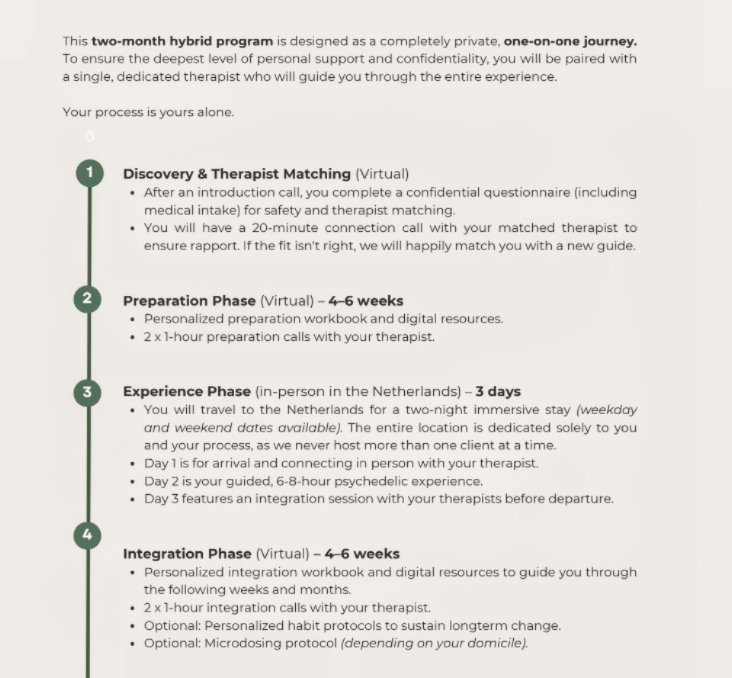
In my case, the initial meeting with my potential guide went very smoothly, and I agreed that she would be a good companion for my experience. We then scheduled our proper one-on-one: a sort of digital meeting, slash talk-therapy session, slash intention-setting, slash get-to-know-you-a-bit-better conversation.
During our talk, we discussed my history with psychedelics (or lack thereof, if you’re a rookie in psychedelic exploration). We talked about my experiences with different medicines, what they were like, what I was looking for with this therapy, and any concerns.
Basically, it was a deeper dive into who I was, where I was coming from, and what I wanted from this experience. What I was bringing to the table, and what I hoped to get from the therapy.


Committing to the Container
There are a lot of words and words of wisdom thrown around in the psychedelic medicine therapy space. Setting an “intention”. The importance of “set and setting”. All of these speak to preparation in various forms. We hear these things, and they sound like valid advice, intuitively. But life is busy. Schedules are full. And just like those promises you make to yourself to go to the gym or start meditating, it can be hard to actually implement these better habits.
Which is why committing to a process like this two-month program is a useful way to implement habits that can otherwise be hard to start.
And in the case of therapy — especially psychedelic therapy — this commitment allows you to better accomplish and work on some of the important parts of the therapy process.
We hear a lot about set and setting. Where set means mindset — the state of mind you bring into the therapy process — being crucial to how your psychedelic experience will go (and setting being the actual environment).
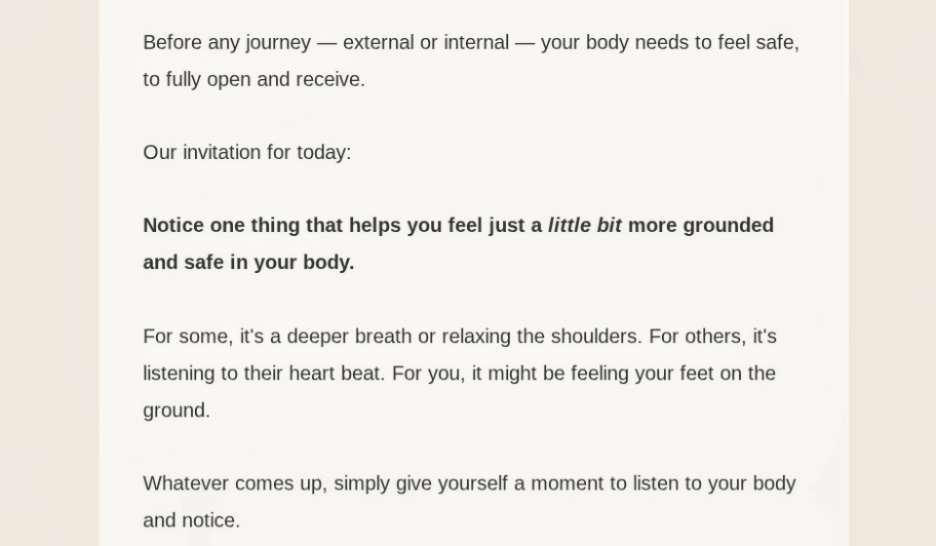
Generally, this concept is thought of as something done in more immediate proximity to the actual therapy. But what I learned through this experience is that set and setting can start early. That it does start early.
And this container — this container that I committed to — allowed (or gently forced me) to commit to the process of set and setting a month in advance.
Despite not being as disciplined as I should have been, despite not doing all of my preparation homework (sorry Sophie), I did begin the preparation process earlier than I normally would have. I was, both consciously and subconsciously, preparing myself, bit by bit.
Emails were coming in. The guidebook was there. Gentle reminders from the Kinisi team to get in touch with my intentions, to practice some mindfulness, to start preparing.
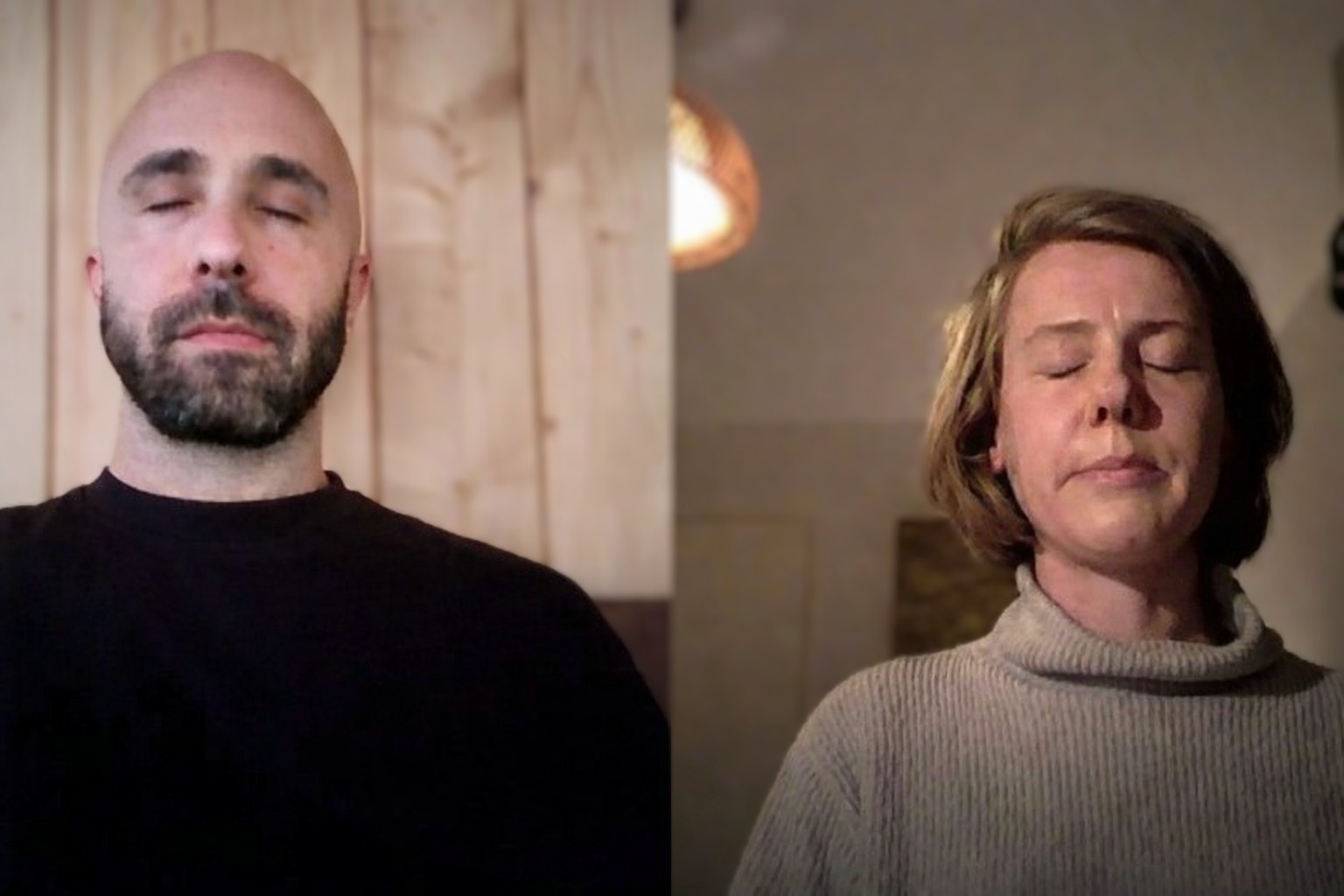
And these gentle reminders had their effect. I thought about the process. I sat, sometimes just for brief moments, and prepared.
And all of this — all of these little micro-moments of preparation — are crucial to maximizing the benefits of the actual therapy (and having a more pleasant and fruitful experience).
So there was a guidebook, and follow-up emails, and gentle reminders to check-in with yourself. The conversation I had with Jakobien was still floating with me. The vocalizing and expressing of my intentions. All of it had the effect of reminding me, grounding me, and preparing me not only for the experience to come, but for the micro-therapies of my day-to-day life.
Committing to the container allows you to prepare your mindset that much earlier — which in turn has benefits not only for the upcoming therapy, but for your own daily wellness journey.
Beginning A Journey I Had Already Started
So I’d done it. Committed. Started the process. Completed the month of the program.
The emails were coming in daily now. A soft countdown. One week out. Three days out. Tomorrow is the big day.
The plane was booked. Logistics were organized. I was packing up my bags and coinciding this journey with a change of apartment, a change of city, and perhaps a change in myself. A journey, logistically, physically, but also, potentially, personally.
What were my intentions? What did I want to get out of this?
I’d been working on myself for a while, and rather than some huge insight or life-changing shift of mind, I was hoping to use this as another step along a journey I had already begun.
On the way to the airport, I read through some of the material. I took some moments to check-in. I reminded myself of why I was here, and of the work I’d already done. I took some deep breaths. I tried to remain in the present moment and let any anxieties or apprehensions float away.
And thanks to this opportunity, to the program, I felt ready and ready to take this step.
So I packed up my apartment, packed up my suitcase, took the shuttle bus to the Barcelona airport, and got on a plane to the Netherlands, where the team from Kinisi would be waiting for me.
In retrospect, it’s a bit of a surreal experience — but the first step was taken, and off I went.



 Expert Board Member
This article effectively outlines a complete psychedelic treatment process: from preparation to the experience to integration. For those seeking these experiences, this serves as a crucial guidepost. When choosing a facility, ensure they offer these essential services and provide clear answers to all your questions. It is wise to engage only when you feel completely safe and supported by your care team.