

This content is grounded in peer-reviewed research, clinical guidelines, and established best practices. Claims are reviewed for accuracy and transparency. Learn more about our evidence standards
Inside Europe’s First Residential Ketamine Therapy Retreat

In Malta, HIVE BIO runs a legal, medically supervised ketamine therapy program built around a week-long residential stay — combining ketamine-assisted psychotherapy with a Mediterranean villa setting, yoga, and a full team of therapists and physicians. The full arc, including online preparation and aftercare, runs six to seven weeks. Here’s what that looks like in practice.
Adjust your perspective. Redefine your definitions. “Psychedelic therapy” is evolving. The options for healing are expanding. Beyond ayahuasca ceremonies in the jungle and medical clinics in the city.
In the sun-washed hills of Malta, along the Mediterranean coast, a new retreat is offering a more complete, and luxurious, way to heal with psychedelic therapy.
A full week in a resort-style retreat, with a team of in-house therapists and medical professionals, multiple ketamine-assisted therapy sessions, yoga, seafront meditations, swimming pool, healthy food, and a curated experience of holistic healing.
Is it for everyone? Wouldn’t that be nice. Unfortunately, the reality is that going deeper, taking your time, and taking a break, isn’t cheap.
But sometimes, you just need to give yourself permission to heal.
Therapy never looked so good.

A Week in Paradise, An Opportunity To Go Deeper
When the founders of HIVE BIO began their project in 2020, they weren’t trying to create just another wellness retreat — they wanted to design a new category of evidence-based and compassionate mental health care.
“We’re neither a day clinic nor a spa experience,” says Nataliya Vorobyeva, HIVE’s co-founder. “We’re residential, medically-led, and psychotherapy-centered. With only a few guests at a time, every person receives truly individualized care. Not a schedule, but a journey.”
HIVE BIO was founded by Alex Latyshev and Nataliya Vorobyeva, whose paths merged around a shared belief in the transformative potential of psychedelic-assisted therapy.
Latyshev, an entrepreneur with experience across wellness, beauty, and medical tourism, brings a systems-minded approach to re-imagining mental health care.
Vorobyeva, a neuroscientist with a background in molecular biology and longevity research, grounds the project in scientific rigor (Note: Nataliya Vorobyeva also works with States of Mind as chief science officer). Together, they’ve built HIVE to combine evidence-based care with space for genuine psychological renewal.

“We exist to help people who feel stuck finally move again. Mental-health care can feel fragmented: medication here, brief therapy there, and maybe a little integration. We wanted to bring everything together into one continuous arc — assessment, dosing, therapy, and aftercare — so change has time and structure to take root.”
That arc unfolds over six to seven weeks, including a one-week residential stay at the clinic’s seaside retreat on Malta’s northern coast. Guests arrive after several online preparation sessions with their therapist, already familiar with the process and the people who will guide them through it.
The setting feels less like a clinic and more like a modern Mediterranean villa: whitewashed walls, gardens overlooking the sea, and spaces designed for calm and connection. Yet behind the serenity is a tightly-woven clinical framework: comprehensive psychiatric assessment, continuous medical monitoring, and psychotherapy led by a multidisciplinary team.

Located at the crossroads of Europe and the Mediterranean, Malta offers an ideal setting for a medically supervised ketamine therapy retreat. The island’s climate, natural beauty, and accessibility — with direct flights from major European capitals — make it both restorative and convenient. In recent years, Malta’s government has also shown progressive support for emerging therapies, including ketamine and medical cannabis, positioning the country as a forward-thinking hub for innovative care.
“When someone steps into HIVE for the first time — perhaps burnt out or lost — the first thing we want them to feel is that it’s safe to stop bracing,” says Audra Micallef, HIVE’s Chief Psychotherapist. “We meet people as they are, not as a diagnosis. When the nervous system feels safe, the mind can explore and the heart can soften. That’s where meaningful work begins.”
“By the time someone arrives at HIVE, we’ve already been in relationship, building rapport and shaping a highly individualized program around their specific needs,” says Micallef. “What we want them to feel, first and foremost, is that they belong — that they’re welcome exactly as they are. That they can exhale and rest in an environment that offers both physical and psychological safety.”
The most important conversations shaping the future of psychedelics, delivered weekly.
From thought-provoking podcasts and original stories to research breakthroughs and industry news, stay connected to the conversations that matter.


Joined by 12,000+ readers
A look at the brochure and weekly schedule might give the impression of a luxury wellness vacation, not a place to receive a powerful psychedelic medicine. But the goal, and the value proposition, is that the psychedelic-assisted therapy is embedded in an envelope of holistic care.
Dr. Peter Muscat, Chief Psychotherapist, came to ketamine-assisted psychotherapy (KAP) after decades as a psychiatrist and psychotherapist. “I follow therapies that genuinely help patients,” he says. “After studying the evidence for ketamine-assisted psychotherapy, I saw how powerful it could be within a structured, ethical frame. Ketamine can open a window — but psychotherapy helps people step through it and keep walking.”
HIVE’s team, and program, seem to be committed to this premise: the medicine creates neuroplastic potential, the psychotherapy gives it direction, and integration anchors it in daily life.

A day at HIVE begins quietly. Guests rise with the sun, often gathering for gentle yoga or meditation on the terrace. After breakfast, they meet with their therapist or physician to review the day’s plan. On dosing days, sessions are held mid-morning in softly lit rooms — music curated for emotional contour, safety staff nearby but unobtrusive.
Afterward, there’s space for reflection: perhaps a massage, a walk through the olive groves, or journaling in solitude. Evenings bring shared meals, conversation, and sometimes sound baths or outdoor films under the stars.
Each guest follows a personalized journey through three structured phases.
Preparation (3 weeks online)
Guests begin with three preparatory sessions exploring their intentions, life context, and the factors that led them to seek treatment. They learn about the ketamine experience and how to navigate it consciously. This stage is as much about safety as about mindset — ensuring readiness for the powerful experiences to come.
Dr. Christopher Gauci, the clinic’s Chief Medical Officer, describes the process: Every participant undergoes a comprehensive medical and psychological assessment. During dosing sessions, clinicians and therapists are present at all times, monitoring vitals — oxygen saturation, heart rate, blood pressure — and emotional state in a calm, controlled environment. Clarity builds trust, and trust allows people to let go into the work.”
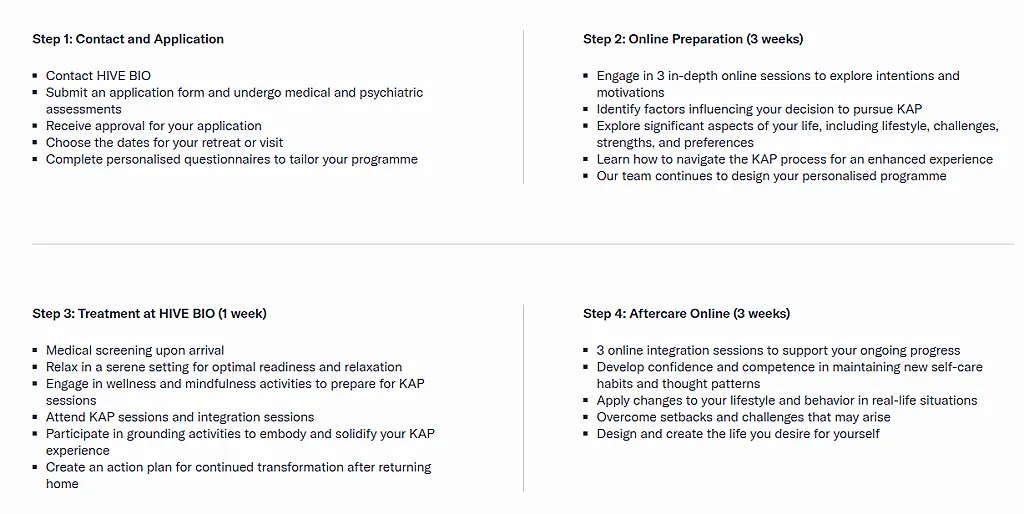
Treatment (1 week residential in Malta)
Upon arrival, guests receive a medical screening and are welcomed into a slow, grounding rhythm — morning yoga and breathwork, shared meals, afternoon rest. Over four supervised ketamine-assisted psychotherapy (KAP) sessions, held in warm, living-room-like spaces, participants are guided inward by both physician and therapist.
Between sessions, gentle practices — massage, tai chi, ice baths, meditation, nature walks — help them integrate sensations and insights into the body.
Dosing protocols follow established medical standards: each journey begins with a conservative test dose of intramuscular ketamine, adjusted gradually under supervision. Sessions are supported by a physician and a trained psychotherapist or nurse throughout.
“It’s hospital-level safety paired with therapeutic presence,” Gauci explains. “Precision and compassion in equal measure.”

Integration & Aftercare (3 weeks online)
Healing doesn’t end at departure. Over three follow-up sessions, guests continue working with their therapist to anchor the transformation — learning to maintain new self-care habits, apply behavioral changes, and design a roadmap for ongoing growth.
“Each guest moves through one arc,” says Audra Micallef. “Preparation clarifies intentions and safety. Dosing days are supported by a physician and therapist. Integration then translates insights into small, repeatable actions.
The results they witness in patients are tangible. “The profound changes are often practical,” she adds. “People sleep through the night for the first time in years. They restart conversations they were avoiding. They step back into meaningful work. Insight is precious, but integration makes it durable.”
For many guests, HIVE is the first real pause in years. “Relief,” Nataliya says simply, when asked what she hopes each person feels upon arrival. “That they don’t have to perform or prove anything here. Healing begins when people realize they can just be.”
In a world hungry for quick fixes, this kind of psychedelic therapy is a reminder that solutions often lie in the slower, deeper work.
“Depth needs space,” says Nataliya. “True healing isn’t mass-produced. Our goal isn’t to scale up, it’s to go deeper.”
 Expert Board Member
A robust psychedelic process includes preparation, the experience itself and integration. This article outlines a program that provides all three. It is important to consider this when choosing your own psychedelic experiences, and to prioritize programs and offerings that provide all three.