
This content is grounded in peer-reviewed research, clinical guidelines, and established best practices. Claims are reviewed for accuracy and transparency. Learn more about our evidence standards
EMDR Therapy in the UK, and How It Compares with Psychedelic Therapy
- EMDR is one of only two psychological therapies NICE recommends for PTSD in adults — typically over 8 to 12 sessions, free on the NHS.
- Check two things before you book: accreditation with the EMDR Association UK & Ireland, and a core professional registration with the HCPC, BACP, UKCP, BABCP or BPS. Both are public registers that take minutes to search.
- EMDR and MDMA-assisted therapy are thought to work on the same window — memory reconsolidation — one reaching it through structured recall and bilateral stimulation, the other pharmacologically.
- In the UK, MDMA and psilocybin remain controlled substances with no clinical route outside trials, which leaves ketamine at private clinics as the only legally available psychedelic therapy option.
Eye movement desensitisation and reprocessing, or EMDR for short, is one of only two psychological therapies that NICE recommends for post-traumatic stress disorder (PTSD), alongside trauma-focused CBT. It is available on the NHS and offered privately across the country, and unlike most trauma treatments it does not ask you to describe what happened in detail.
It also often comes up in the same conversations as psychedelic-assisted therapy, and there has been a good deal to talk about lately. In early August 2026, Resilient Pharmaceuticals resubmitted its application for MDMA-assisted therapy to treat PTSD to the US Food and Drug Administration, two years after the first one was turned down1.
Whether to approve MDMA-assisted therapy in the USA currently sits with the American regulator. Meanwhile in Britain, psilocybin and MDMA are both Class A, Schedule 1 substances, with no prescription route and no compassionate-access scheme outside approved research, and neither is licensed by the MHRA.
The one psychedelic-assisted therapy you can legally access today is ketamine, prescribed off-label at private, CQC-registered clinics — along with esketamine nasal spray. NICE has not recommended it for routine NHS use in England, though the Scottish Medicines Consortium has accepted it for use in NHS Scotland.
As EMDR is an approved and available treatment for PTSD, this article provides a deeper dive into what EMDR is, what the research actually supports, what it costs and how to find someone properly accredited to deliver it. And then, since the two keep coming up in the same breath, at how eye movement desensitisation and psychedelic-assisted therapy compare on mechanism, evidence, and accessibility.
To understand what EMDR therapy looks like from the inside rather than from the literature, States of Mind spoke with Dr Elizabeth Berrocal, PhD — a trauma psychotherapist, somatic practitioner and integrative healing guide, certified by EMDRIA, and founder of The Integration Room Amsterdam.

What EMDR is, and what it is used for
EMDR was developed by the American psychologist Dr Francine Shapiro, who published the first study of it in 19892. Its founding premise is a little unusual among therapies: the difficulty is not the traumatic event itself, but the way the memory of it was stored.
Dr Shapiro developed the Adaptive Information Processing (AIP) model that proposes that the human brain has an innate system to process life experiences into adaptive, healthy memories. However, trauma or stress can overwhelm this system, leading to memories remaining stuck in their raw, unprocessed form, which causes the psychological symptoms of PTSD.
For Dr Elizabeth Berrocal, that distinction between the traumatic event and the memory of it is what separates EMDR from the approaches it is usually compared with.

EMDR is a unique integrative approach that really focuses on the core assumption that trauma isn’t necessarily the problem, rather it’s the unprocessed memories which contribute to symptoms regarding mental health. Every theoretical approach has its different understanding on processing; CBT focuses primarily on thoughts, feelings, and behaviors. Somatic approaches differ in many contexts, as they generally work at the nervous system level and body regulation. I really respect the approach of EMDR’s ability to focus on the original memory network systems, whether those are images, negative cognitions, or body sensations (or a combination of all and more) to really facilitate processing. In theory, EMDR isn’t just about the management of symptoms, rather it is about the exploration and desensitization of the root issues.
Central to EMDR is the idea that a distressing experience can be encoded incompletely, held in the nervous system with its original images, sensations and beliefs still attached and ever present. The experience remains stuck rather than becoming integrated into an autobiographical memory, so simply remember it — you partly re-live it. EMDR sets out to reprocess that experience, so it becomes something you know happened in the past, rather than something that keeps happening.
The evidence for the effectiveness of EMDR is strongest in PTSD3 and where the guidelines are clearest. Beyond trauma, EMDR has been studied across a wide range of conditions: a systematic review of EMDR4 covers trials in depression, anxiety and panic disorders, specific phobias, substance use, chronic pain and psychosis, and a 2024 meta-analysis found benefit for depressive symptoms specifically. That work is genuinely promising, though most of the trials are small, and the evidence outside trauma-related presentations remains much thinner than the PTSD research.
What decides whether EMDR fits, then, is less the diagnosis than whether the difficulty grew out of adverse or traumatic experience. Age is much less of a limit: people of all ages can have EMDR, including children and adolescents, although NICE positions it differently for younger people — as a treatment to turn to when trauma-focused CBT has not helped.
Practically, this means that EMDR is not a general-purpose therapy, and it does not set out to be one. It is a targeted intervention for experiences that were never fully digested. Which is a narrower promise than “therapy” in the broad sense, and, where it fits, a more specific one.
What actually happens in an EMDR session
EMDR follows a structured 8-phase protocol5. The phases are not 8 sessions: several can happen within a single session, and the early ones may take several sessions on their own.
- History taking.
Understanding your background and identifying which memories to work with. - Preparation.
Learning how EMDR works, building grounding and stabilisation skills before any reprocessing starts. - Assessment.
Choosing the target memory, the image that represents it, the negative belief attached to it, and a baseline distress rating. - Desensitisation.
Reprocessing the memory alongside bilateral stimulation*. - Installation.
Strengthening a more adaptive belief in place of the negative one. - Body scan.
Checking for any physical tension or sensation still connected to the memory. - Closure.
Returning to a settled state before the session ends, whether or not processing is finished. - Re-evaluation.
Reviewing progress at the start of the following session and deciding what to work on next.
At each stage, a therapist provides practical support and monitors progress, following EMDR standard protocols6. Sessions usually run 60 to 90 minutes, most often weekly. Some practitioners also offer intensive formats that condense treatment into consecutive days.
*About bilateral stimulation
Bilateral stimulation is what the research literature calls a dual attention stimulus7: you hold the memory in mind while following a rhythmic left-right cue. Most often that is eye movements, though alternating taps or tones are also used, particularly where following a moving target is difficult. It belongs to the middle of the sequence.
It runs through phase 4 (desensitisation) where the reprocessing does most of its work; it continues in phase 5 while a new belief is strengthened; and it may be used again in phase 6 if residual body sensations surface. The first 3 phases involve no bilateral stimulation, which is why a first EMDR session often looks much like any other therapy session.
Dr Berrocal finds that this is the component people most often misunderstand, and that its effect is on memory rather than on conversation.
With bilateral stimulation (whether it’s eye movements, tapping, or auditory tones), it activates both hemispheres of the brain, which facilitates the working memory. In the process, it also reduces, disconnects or entirely eliminates the feelings and thoughts associated with a negative emotional charge. It also doesn’t “spend a lot of time in the talking phase”, rather conversations and treatment go straight to the encoded memory.
EMDR does not require a detailed verbal account of what happened. You just hold the memory in mind. For many people, particularly those who have found talking therapies retraumatising, or who have never told anyone the whole story, this is the reason trauma treatment becomes possible at all.
What the research says about EMDR
NICE published guideline NG116 on post-traumatic stress disorder in December 2018, and it remains the reference point for treatment in the UK. Its recommendations on EMDR are more specific than most summaries suggest.
For adults, NICE says to “offer EMDR to adults with a diagnosis of PTSD or clinically important symptoms of PTSD who have presented more than 3 months after a non-combat-related trauma”, and to “consider EMDR for adults with a diagnosis of PTSD or clinically important symptoms of PTSD who have presented between 1 and 3 months after a non-combat-related trauma if the person has a preference for EMDR”.
On length of treatment, the guideline states that EMDR should “typically be provided over 8 to 12 sessions, but more if clinically indicated, for example if they have experienced multiple traumas”, and be “delivered by trained practitioners with ongoing supervision”. For children and young people aged 7 to 17, NICE recommends considering EMDR only if they do not respond to or engage with trauma-focused CBT.
The combat and non-combat distinction reflects the trials NICE had available in 2018. The EMDR Association UK & Ireland argued during consultation that the evidence supported offering EMDR more broadly, and in practice veterans in the UK are offered it through Op COURAGE8, the NHS veterans’ mental health and wellbeing service.
The outcome figures most often quoted come from 2 studies. A controlled study in a Kaiser Permanente health plan9 found that all of the single-trauma participants, and 77% of those with multiple traumas, no longer met criteria for PTSD after 6 sessions of 50 minutes. A trial with combat veterans10 reported the same proportion losing the diagnosis after 12 sessions. Both are small trials from the late 1990s: useful for a sense of what EMDR can do, less so as a prediction about any one person.
There is also a long-running and rather interesting debate about why it works. The leading alternative to the brain hemispheric account is that the eye movements tax working memory11 while the memory is being held in mind, which reduces its vividness and emotional intensity. This idea was developed by Marcel van den Hout and Iris Engelhard12 and is still actively researched. Long-term follow-up data beyond a year or two also remains limited, as it does for most psychological therapies.

What EMDR feels like from the inside
EMDR is often described as gentler than other trauma therapies because it asks for no detailed retelling. Dr Berrocal is careful to add that gentler does not mean easy, and that the physical side can take people by surprise.
Another aspect of EMDR that I wish more people understood is that it can be quite a difficult type of therapeutic approach. It can be both demanding and layered emotional labor to revisit old memories directly; it might be new to many people to feel the sudden and intrinsic shifts within the body that they haven’t ever felt before.
There are also side effects that tend to arrive early during the process of EMDR.
In her practice, Dr Berrocal describes patients reporting heightened anxiety, lower mood, unusual tiredness, dizziness, disturbed sleep and vivid dreams or nightmares are all common in the first weeks of reprocessing, which is why she staggers sessions deliberately and builds integration work between them: “there needs to be processing for people going through EMDR, and most importantly the integration in their day to day, on how they are actively applying what they are noticing and moving through.”
A fair question at this point is whether all this can leave someone worse off. And it has been studied. EMDR in people with personality disorders13 (a group often thought too fragile for direct reprocessing) was looked at specifically for symptoms getting worse, and the feared deterioration did not show up. Reviews of trauma-focused therapy in people with psychosis14 found much the same.
The most important thing is that the memory loses its emotional charge. A client can recall the memory, but they are generally no longer able to feel it overwhelming or impending. It almost feels distant and less vivid; akin to a scar on the body, one knows something happened, but the acute pain is no longer there.
She also watches for negative core beliefs ceasing to feel true, for the nervous system settling — clients out of fight, flight or freeze, breathing returning to something more organic — and for the point at which someone can say “this no longer defines me”. As she puts it, clients stop organising their lives around the trauma.

When EMDR is not the right choice
Timing matters here more than diagnosis. Where someone is in acute crisis, actively suicidal, or living with a severe dissociative disorder, the conventional advice is to build stability first. The ISSTD guidelines for dissociative disorders set out a phased approach for any sort of trauma therapy in which reprocessing follows stabilisation rather than opening the work. The reasoning is practical: reprocessing can stir things up before it settles them, and that is harder to carry with very little to fall back on.
However, that convention is not universally accepted. A critical analysis of the complex PTSD guidelines15, written in part by EMDR researchers, argues that routinely postponing trauma-focused work is not well supported by the trial evidence and that many people tolerate it earlier than clinicians expect. So if you are told you need a year of stabilisation before anything else can begin, that is a position in a live debate rather than settled practice, and it is fair to ask why your therapist holds it.
Separately, EMDR is unlikely to help with difficulties that did not grow out of adverse experience. Where symptoms stem mainly from a neurological injury or a predominantly biological cause, a memory-based treatment has little to work with.
And the therapy takes time — more of it than most people expect. The misconception Dr Berrocal meets most often is that a handful of sessions will settle everything:
A good EMDR therapist will never tell a client it will take a certain amount of sessions to work, rather it takes all the time necessary for the person to feel they are actively making progress in their therapeutic journey. I always like to preface sessions with new clients about putting expectations and time lines in the course of therapy in general, and to keep oneself open to unexpected shifts, or perhaps no shifts at all.
I’m a believer that anything good takes time to cultivate, and the hard work one puts into healing is one’s personal journey, which looks different to everybody. If you think about the years people often carry negative memories, past belief systems, and traumas, it really begins to put into perspective time within the context of healing. All those years of embedded memories have to be reprocessed and made anew — patience is key.
Set against the 8 to 12 sessions NICE describes, and against complex or repeated trauma that routinely needs more, that is a reasonable expectation to arrive with.
How EMDR compares with psychedelic-assisted therapy
EMDR and psychedelic-assisted therapy are usually framed as opposites — one drug-free and available on the NHS, the other pharmacological and still in trials. Mechanistically, they may have more in common than that suggests.
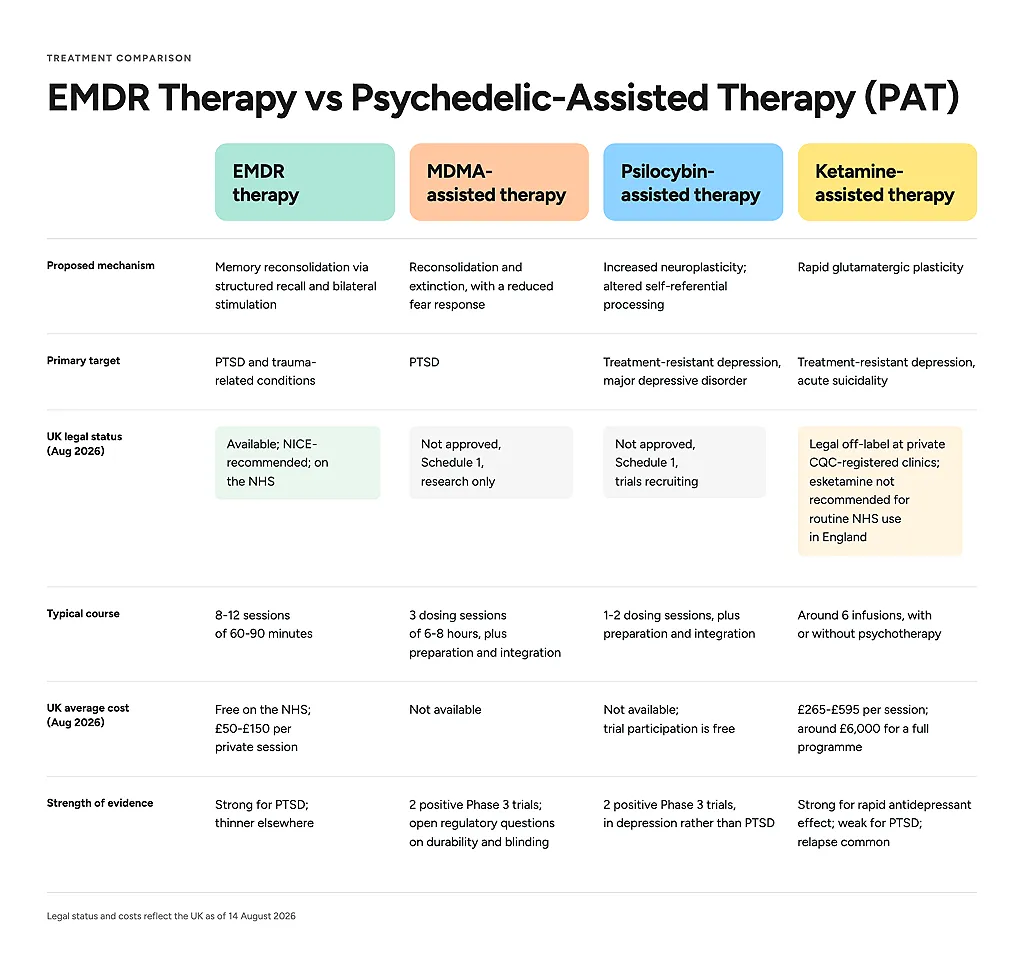
Both EMDR and psychedelic-assisted therapy are proposed by researchers to evoke the process of memory reconsolidation7: when a settled memory is deliberately brought back to mind, it becomes briefly unstable and open to modification before being stored again. EMDR approaches that window through structured recall combined with bilateral stimulation and dual attention. Psychedelic therapy, specifically MDMA-assisted, approaches it pharmacologically, reducing amygdala reactivity16 and increasing feelings of trust and safety so that the memory can be approached without the fear response that normally makes approaching it impossible.
Reconsolidation remains a leading hypothesis for both, supported by animal and neuroimaging work rather than settled beyond argument.
The most important conversations shaping the future of psychedelics, delivered weekly.
From thought-provoking podcasts and original stories to research breakthroughs and industry news, stay connected to the conversations that matter.


Joined by 12,000+ readers
MDMA-assisted therapy for PTSD
MDMA-assisted therapy typically involves 3 drug sessions of 6 to 8 hours, each with 2 therapists present, surrounded by preparation and integration sessions. It is not a prescription you take home — it is a small number of closely supervised days in a clinic.
Two Phase 3 trials have reported positive results. The second of them, MAPP217 by Lykos Therapeutics, randomised 104 people with moderate to severe PTSD. By the end of the study 71% of those given MDMA-assisted therapy no longer met criteria for PTSD, and 46% were in remission — against 21% on placebo with therapy. Just 1.9% dropped out of the MDMA arm, compared with 15% on placebo.
The regulatory picture has been less smooth. In August 2024 the FDA rejected the application from Lykos, citing weak durability data, problems with how adverse events were collected, and concerns about functional unblinding. The resubmission two years later by Resilient Pharmaceuticals (the same company under a new name) did not involve a new Phase 3 trial, drawing instead on existing datasets and a re-audit of the original data.
In the UK, none of this has changed availability. MDMA remains Schedule 1, there is no MHRA licence and no named-patient route, and as of mid-2026 no MDMA trials were recruiting here. Australia is the international outlier, having allowed authorised psychiatrists to prescribe MDMA for PTSD since July 2023, though uptake there has been modest and costs high.


Psilocybin-assisted therapy
Psilocybin comes up constantly in the same conversations, but the programmes closest to approval target depression, not PTSD. Compass Pathways’ COMP360 has met its primary endpoint in two Phase 3 trials in treatment-resistant depression, with durability data out to 6 months, and Usona’s Phase 3 trial is testing a single 25 mg dose in major depressive disorder.
PTSD work exists but sits much further back: a small Phase 2 study of 22 people found a single 25 mg dose well tolerated, which says something about safety rather than about whether it works.
Timelines shifted in April 2026, when the FDA granted National Priority Vouchers to Compass, Usona and Transcend Therapeutics, compressing review from 10-12 months down to 1 or 2. In the UK, psilocybin remains Schedule 1: trials are recruiting and participation is free, but there is no clinical route outside them.


Ketamine therapy, the one legal psychedelic-therapy option in the UK
Ketamine can be prescribed off-label by GMC-registered doctors at CQC-registered facilities. Esketamine nasal spray holds a licence but was not recommended by NICE for routine NHS use in England on cost-effectiveness grounds.
As for cost, published prices vary. The self-pay service run by Oxford Health NHS Foundation Trust18 charges £265 per intravenous infusion; a private London clinic lists £990 for a first session and £595 thereafter. A structured 6-week ketamine-assisted psychotherapy programme, with dosing and integration sessions included, starts at around £6,000.
The evidence is strongest for rapid, often short-lived relief19 in depression and for a fast reduction in suicidal thinking20. For PTSD specifically it is thinner: a randomised trial of repeated ketamine infusions in chronic PTSD found significant symptom reduction21, but a systematic review concluded that the overall evidence remains limited22 and inconsistent, and relapse after a course is common without maintenance or accompanying psychotherapy.
If you are considering it, check the clinic’s CQC registration and rating, look up the prescribing doctor on the GMC register, and make sure psychiatric screening happens before you are asked to pay. Both registers are public and searchable by name: the CQC listing shows what a provider is registered to deliver and how it scored at its last inspection, and the GMC entry shows whether a doctor holds a current licence to practise and whether any restrictions apply to it.

Why these approaches may end up complementing each other
It helps to think of these therapies as steps in a sequence rather than rivals. Psychedelics can open a window, but something still has to happen inside it — which is why every psychedelic therapy protocol builds in preparation beforehand and integration afterwards. Structured trauma therapy fits both of those jobs, helping someone feel steady enough to go in, and helping them make sense of what surfaced once they are out.
Dr Berrocal describes doing something similar inside EMDR alone. She staggers sessions deliberately and builds integration work between them, because what matters most, in her words, is “the integration in their day to day on how they are actively applying what they are noticing and moving through”. Whatever opens a memory, living differently afterwards is where the change sticks.
How to find an accredited EMDR therapist in the UK
“EMDR therapist” is not a legally protected title, and the accreditation landscape has two layers that are easy to confuse. So there are two things worth checking:
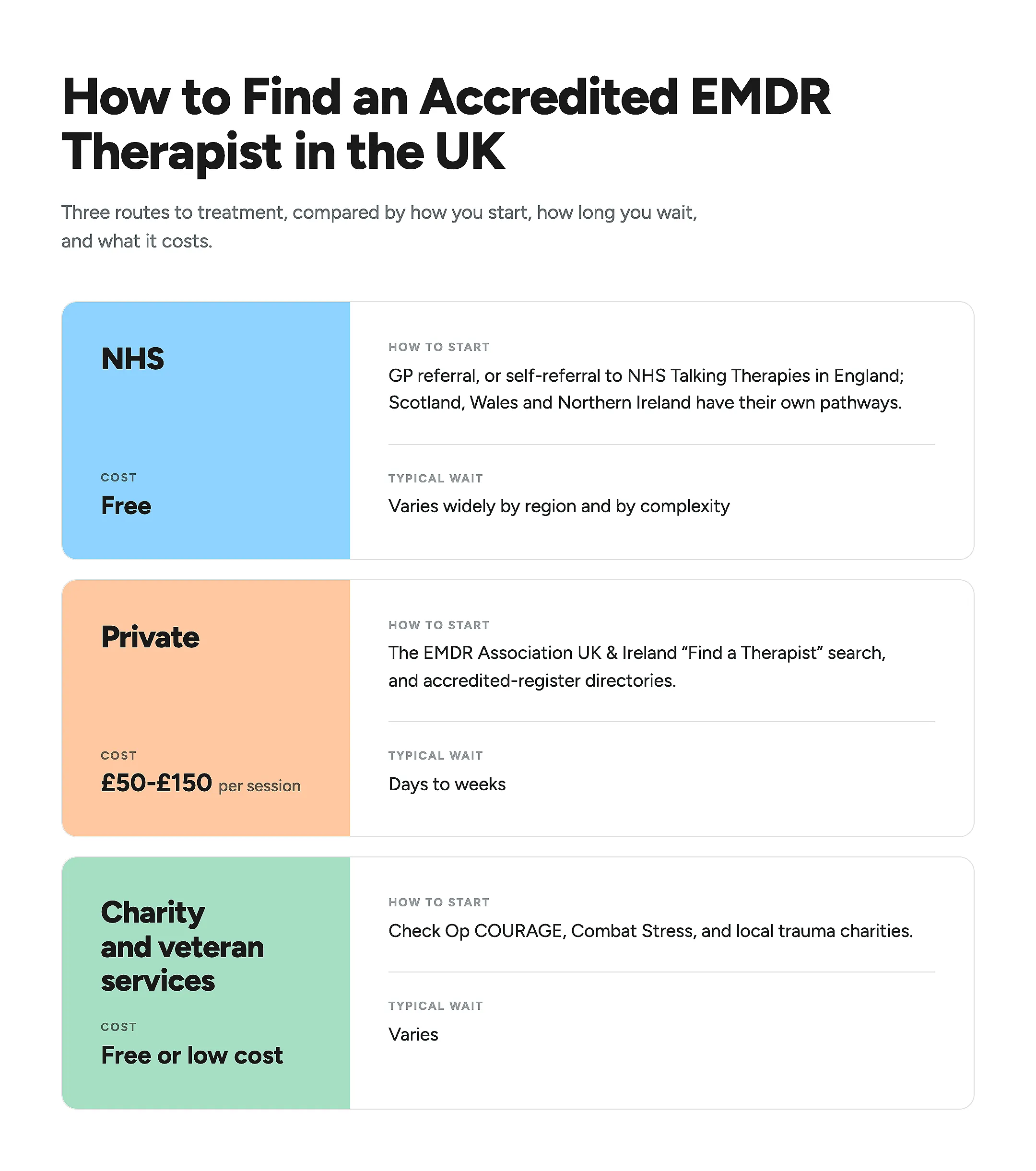
First, whether the person is a regulated clinician at all. Look for their core profession and register. The HCPC (Health and Care Professions Council) is the statutory regulator protecting titles such as practitioner psychologist and arts therapist, while the BACP, UKCP, BABCP or BPS maintain accredited registers for counsellors, psychotherapists, CBT therapists and psychologists. Someone on none of these is not a regulated mental health professional, whatever training they list.
Second, whether they are accredited in EMDR specifically. The body that matters in Britain is the EMDR Association UK & Ireland, which accredits at 3 levels: Accredited Practitioner, for those who have demonstrated competence under supervision; Accredited Consultant, an experienced practitioner qualified to supervise others towards accreditation; and Accredited Trainer. Accreditation lasts 5 years and has to be renewed.
The distinction that matters most here is between EMDR-trained and EMDR-accredited. Anyone who has attended a basic training can accurately describe themselves as trained. Accreditation is the claim you can independently verify, so it is worth asking for it by name and by level.
There is also EMDRIA accreditation: the EMDR International Association is the American body, and Dr Berrocal’s certification comes from there. Its standards are demanding, and it is what to check if your therapist is based in the US or working with you online from there. It does not stand in for UK accreditation, though, which runs through EMDR Europe-approved training and supervision.
A typical private course of 6 to 12 sessions at £50 to £150 each works out at roughly £400 to £1,800, with complex or repeated trauma often requiring more. Intensive formats concentrate that into fewer weeks. Sliding-scale fees are more widely available than most people assume, and employer assistance programmes and private medical insurance often cover a limited course — all worth checking before paying out of pocket.
Questions worth asking on a first call
What registers cannot tell you is how a therapist actually works, and that is what a first call is for. Most offer a free intro conversation, and it helps to treat it as a two-way check rather than an interview you have to pass. The questions below cover the two things you cannot judge from a website: how the therapist handles the difficult parts of the work, and what you are practically committing to.
- How much experience do you have with my kind of trauma — a single incident, or something more complex and long-running?
- How do you approach stabilisation before we begin reprocessing?
- What happens between sessions if something difficult comes up?
- How will we know the therapy is working, and at what point would you tell me it isn’t?
- How long are sessions, and how often would we meet?
- What is your cancellation policy?
- Roughly, what would you expect a full course to cost?
A therapist who guarantees a number of sessions or promises a cure is worth approaching with more caution.
So how do the options compare?
FAQ
They are history taking, preparation, assessment, desensitisation, installation, body scan, closure and re-evaluation. These are phases of a protocol rather than individual sessions — several can happen in one meeting.
NICE sets out 8 to 12 sessions, with more where clinically indicated, such as after multiple or prolonged trauma. Some single-incident cases can be resolved more quickly. Be wary of anyone who commits to a number before knowing your history.
It is free on the NHS. Privately, expect £50 to £150 per session, so roughly £400 to £1,800 for a typical course. Sliding-scale fees, charity services and employer assistance programmes can bring that down.
Yes. NICE recommends it for PTSD, and it is delivered through NHS Talking Therapies and specialist trauma services. In England you can self-refer to NHS Talking Therapies without seeing a GP first. Waiting times vary substantially by region, which is the main reason people go private.
Search the EMDR Association UK & Ireland “Find a Therapist” listing, and separately confirm their core professional registration with the HCPC, BACP, UKCP, BABCP or BPS. “EMDR trained” and “EMDR accredited” are different claims — ask which one applies, and at what level.
Neither comes out clearly ahead — NICE recommends both for adults. EMDR often involves less between-session homework and no detailed verbal disclosure, which for some people is the deciding factor.
A systematic review of remote EMDR found outcomes broadly comparable to in-person sessions, and working remotely widens access to accredited practitioners. It is less suitable where dissociation, crisis risk or complex trauma call for in-person containment.
Side effects are common early on: heightened anxiety, lower mood, tiredness, dizziness, disturbed sleep and vivid dreams. It is emotionally demanding work. And while the PTSD evidence is strong, long-term follow-up data remains limited and researchers still debate how much the eye movements themselves contribute.
Difficulties that do not have their roots in adverse or traumatic experiences. Where symptoms stem primarily from, say, a neurological injury or a predominantly biological cause, EMDR is unlikely to be the right tool.
People in acute crisis, actively suicidal, or living with a severe dissociative disorder — at least without substantial stabilisation work and additional clinical support in place first.
No. MDMA is a Class A, Schedule 1 substance with no prescription or compassionate-access route outside approved research. The August 2026 resubmission to the FDA is a US regulatory step and does not affect availability in the UK. Australia is so far the only country to have made MDMA prescribable as a medicine, through its authorised prescriber scheme. A few others allow access case by case: Switzerland grants exceptional licences for MDMA-assisted therapy, and Canada considers individual requests through its Special Access Program.
There is no contraindication. The EMDR Association UK’s journal has published case work on EMDR as a preparation and integration tool in psychedelic-assisted therapy. It is worth telling your therapist what substance you took and when, though — it affects how they pace the work.
Yes. Bilateral stimulation can be tactile, using alternating taps, or auditory, using alternating tones, and both are standard alternatives for people with visual impairments or anyone who finds eye movements uncomfortable. The research is less settled than the practice: a meta-analysis found that eye movements do add to the effect, and an experimental study found them more effective than tones at reducing how vivid a memory feels.
 Expert Board Member
EMDR and psychedelic-assisted therapy may seem very different, yet both aim to help people safely revisit and integrate traumatic experiences. From my work in psychotherapy, neuroscience and psychedelic-assisted therapy, I am particularly interested in their potential to engage the process of memory reconsolidation. Psychedelics may facilitate this window pharmacologically, while EMDR may engage similar processes through structured recall and bilateral stimulation, allowing traumatic memories to be updated and lose some of their emotional intensity.