Locked in Schedule 1. UK and the Psilocybin Question

The number of people with mental health conditions in the UK keeps growing, year on year. In England, for instance, 22.6% of adults1 now live with a common condition such as depression or anxiety — up from 17.6% in 2007.
As these numbers have grown, so has interest in treatments beyond the conventional ones. Because first-line options — whether antidepressants, stimulants for ADHD, or talking therapy — don’t reach everyone. Something similar is true at the end of life, where standard palliative care can’t always reach a person’s psychological distress. Faced with these gaps, patients, as well as clinicians and researchers, have been looking to expand the toolkit — and one of the alternatives drawing attention is psilocybin.
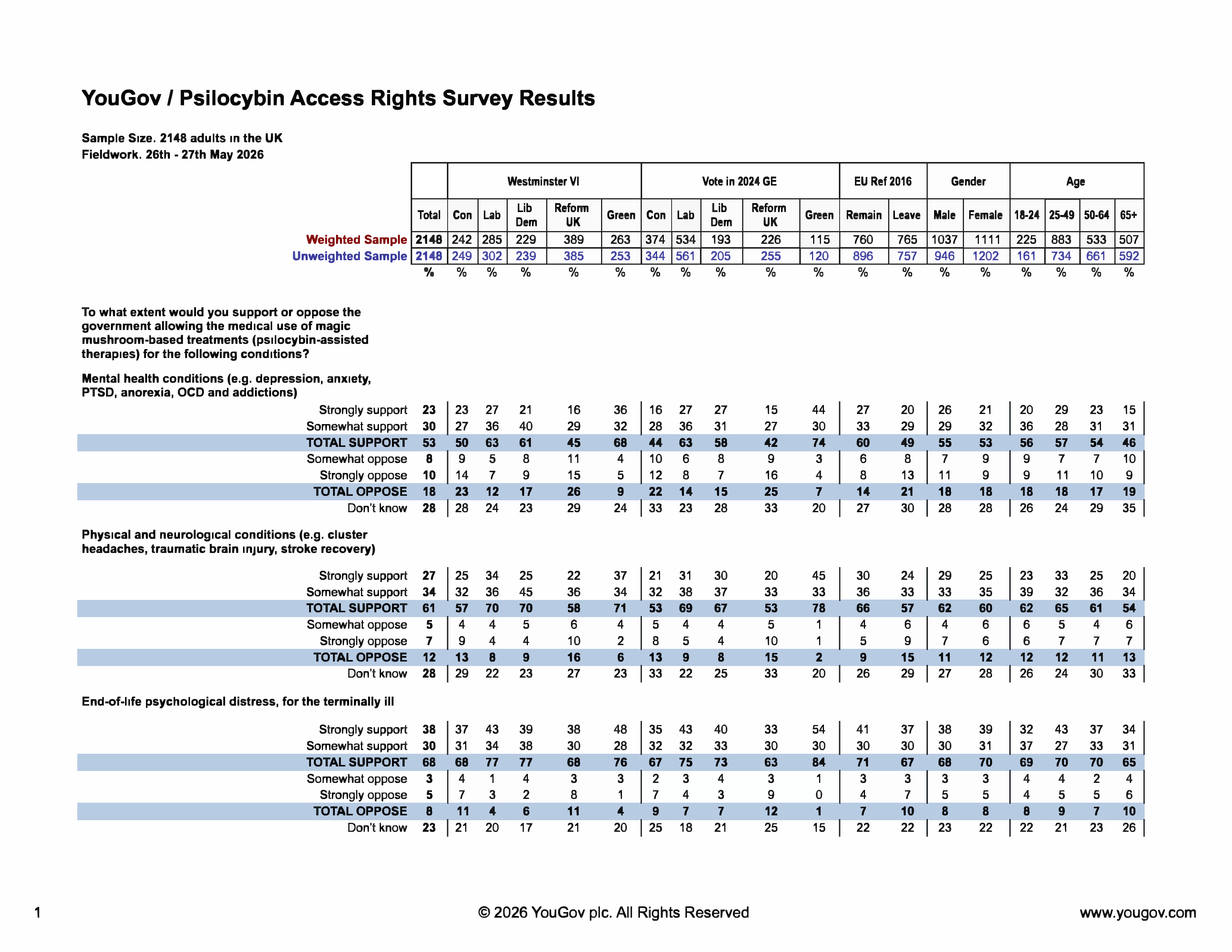
A new YouGov survey of 2,148 UK adults2, commissioned by Psilocybin Access Rights (PAR), suggests the public is increasingly open to the idea of psychedelics as a treatment. Asked whether they would support the government allowing the medical use of psilocybin, respondents backed it for end-of-life distress by 68%, for physical and neurological conditions by 61%, and for mental health conditions including depression and anxiety by 53%. Opposition was relatively low: 8%, 12% and 18% respectively.
What sparks interest is how steady that support is across gender, region, income and politics. The figures for Reform UK and Conservative voters are all but identical. On end-of-life use, for instance, both groups show 68% support and 11% opposition.
Like any poll, this one is best read in context. It was conducted for PAR, a group of volunteers campaigning for psilocybin to be made legally accessible for patients and researchers in the UK. So the survey is, in part, an advocacy instrument. Framing matters too: in one set of questions, respondents were asked how they would react knowing that several other countries like Germany and the US have already expanded access to magic mushrooms. With that context added, support rose by a few points. None of this undoes the main finding, but it’s the right lens to read it through.

The bigger picture on support
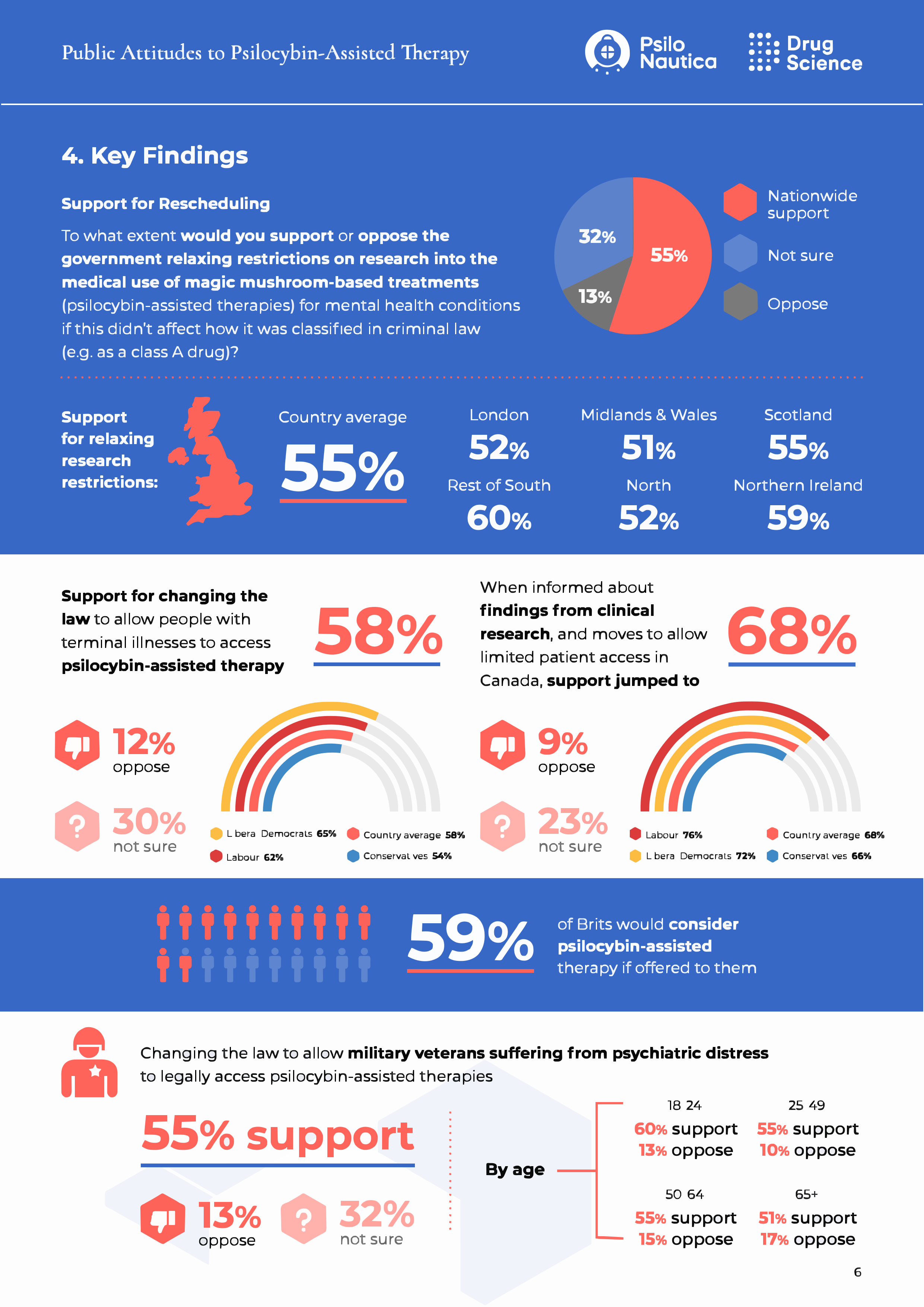
The 2026 survey is not the first one of its kind. In 2021, Drug Science (an independent, science-led drugs charity founded by Professor David Nutt) commissioned “the first nationally representative poll3 of UK attitudes to medical psilocybin”, surveying 1,763 adults.
That earlier poll asked a politically narrower question: whether people would support relaxing the restrictions on psilocybin research, highlighting that this wouldn’t change how the substance is treated in criminal law. Even so, the public leaned clearly in favour. 58% backed3 changing the law so terminally ill patients could access psilocybin therapy, and 55% supported reducing the barriers to research. Around 60% of respondents would even consider psilocybin-assisted therapy for themselves, under certain circumstances.
Those 2021 numbers are something of a benchmark for the new poll. But Timmy Davis, a co-founder of PAR and Director of Psychedelic Policy and Regulation at the Centre for Evidence-Based Drug Policy (CEBDP), cautions against reading the two as “before and after”. He sees the value of the new data as a matter of breadth rather than a straight trend line.
The previous poll, he points out, asks about facilitation of research — whereas the new poll asks about the facilitation of access. And what those newer numbers were meant to show is “how opinion had shifted and there is support across the political spectrum — if both Greens and Reform support, it’s hard to find opposition”.
That breadth, however, doesn’t mean the public sees every use of psilocybin the same way. People were noticeably more comfortable with such therapy for those at the end of life than for mental health care. Davis reads this 15-point gap as one of perception.
It can be understood as one based on compassion for people at the end of life and the common assumption that if the person is suffering from a terminal condition, perhaps things can’t get worse. They should be able to try what they like to improve their life and relationships in those times.
By contrast, mental health draws more caution. Davis notes that there’s a common assumption that the use of psychedelics can exacerbate mental health conditions, and that psilocybin therapy for conditions like depression carries greater risks. “This assumption isn’t entirely unfounded, but what the gap reflects is public understanding.”
Overall, the comparison with 2021 results is still telling in one respect: the question being asked has grown bolder, and public support has grown too.
More controlled than heroin
So how did access to psilocybin for researchers become so difficult in the UK?
More than half a century ago, psilocybin became a controlled substance under the Misuse of Drugs Act 19714, which placed it in Class A, the category carrying the heaviest penalties. Thirty years later, the Misuse of Drugs Regulations 20015 sorted substances into five schedules, based on their accepted medical use. Psilocybin was placed in Schedule 1 with other drugs “with little or no therapeutic value”, such as LSD and raw opium. This brought the tightest possible controls on research.
For a couple of years, however, there was a curious gap in the law. Because the legislation targeted “prepared” mushrooms, fresh magic mushrooms sat in a grey area and were sold quite openly. That ended with the Drugs Act 20056, which brought any fungus containing psilocin under Class A control, closing the loophole for good.
In UK drug law, classification (Classes A, B or C) sets the criminal penalties for possession and supply. Scheduling, by contrast, determines whether a doctor can prescribe a substance and how easily a scientist can study it, with or without special licences. Psilocybin is both Class A and Schedule 1, and the recent debate turns specifically on scheduling.
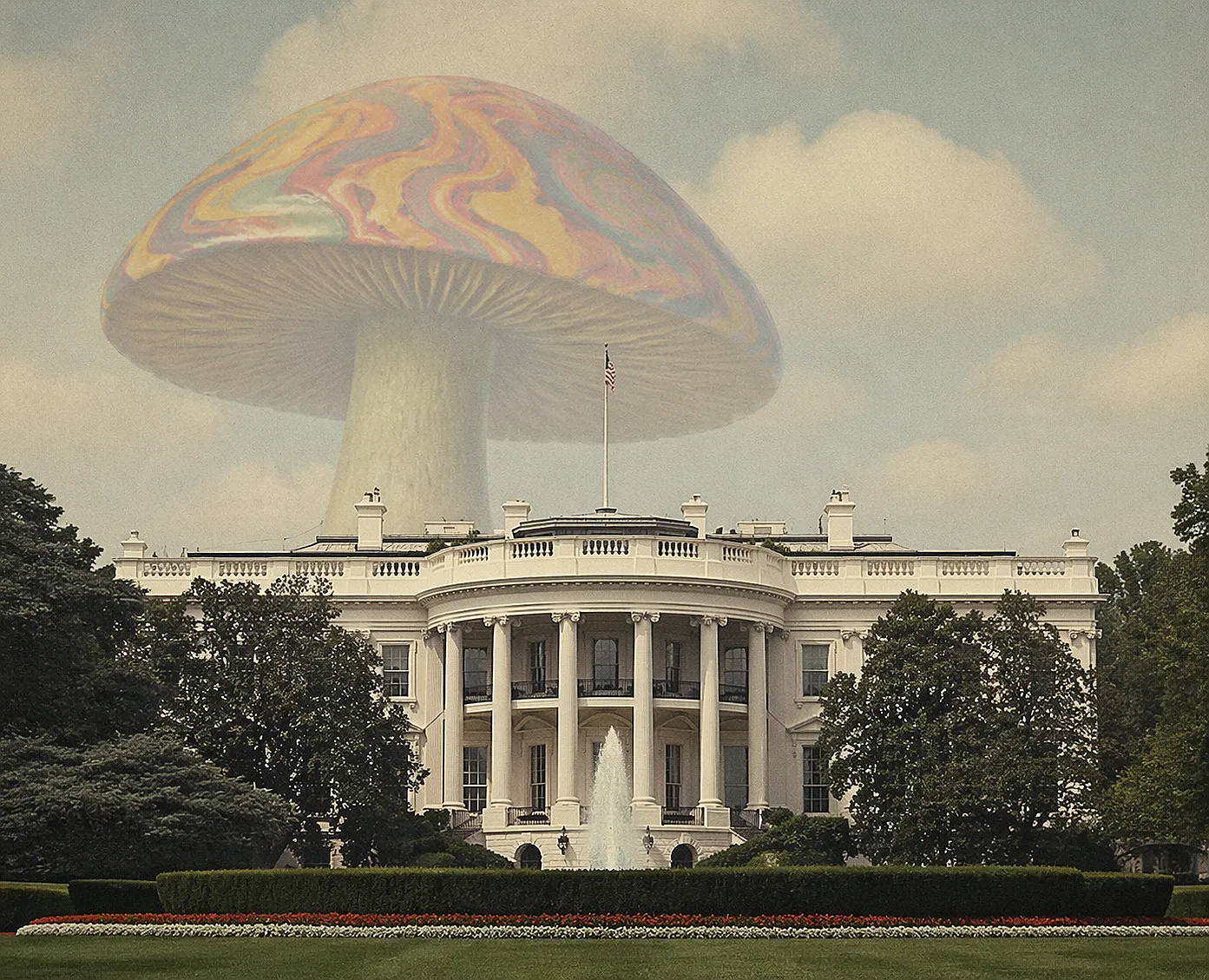
This classification raises questions for many. Psilocybin sits in the most restrictive tier; yet Schedule 2, which is less tightly controlled, includes cocaine, fentanyl and even heroin7. The point wasn’t lost on Parliament. When the Commons debated psilocybin access in May 2023, the motion put it plainly: psilocybin is “currently more controlled than heroin” and “no review of the evidence for psilocybin’s current status under UK law has ever been conducted”.
“It does not prevent research”
The government’s answer to this has been fairly consistent over the years. In 2020, when the Conservative Drug Policy Reform Group8 and the Adam Smith Institute published their report calling for research-only rescheduling, the Home Office responded in comments given to The Guardian:
We need to strike the right balance between enabling legitimate research to take place in a secure environment while ensuring that harmful drugs are not misused and do not get into the hands of criminals. The current classification of psilocybin under Schedule 1 does not prevent research or clinical trials under a Home Office licence.
In response to this statement, the Conservative MP Crispin Blunt put the objection9 bluntly:
“We can find not a single example in the history of the current drug law framework where a drug listed under Schedule 2 has found its way out of clinical trials and into the hands of criminals. […] There is no evidence of any benefit given the objective of Home Office policy of this drug being Schedule 1 as opposed to 2. But the costs are probably enormous”.
He is right about the costs. Technically, yes, the research is not banned. In practice, though, it comes at a steep price. To work with a Schedule 1 substance, a research team needs a Home Office licence that, according to Professor Jo Neill from Drug Science, starts at9 between £3,000 and £20,000. Safe-storage requirements add thousands more, and bureaucracy leads to delays of anywhere from six months to a year before a study can begin.
Speaking about one government-funded trial on psilocybin for treatment-resistant depression, Professor David Nutt from Drug Science said it took 13 months9 to get the drug supplied. It cost around £1,500 per dose — and costs, he argued, were driven almost entirely by the Schedule 1 status of the substance.
“The results of that trial were quite remarkable, possibly the most powerful single-intervention impact in depression there’s ever been, half participants were depression-free at one week and about a third were depression-free at three months”.
However, results like those haven’t moved the government’s position. In 2022, it said there were no plans to reschedule psilocybin. Instead, the Home Office pointed to the existing MHRA10 (Medicines and Healthcare products Regulatory Agency) process, by which a medicine containing a Schedule 1 drug can be trialled and licensed before reaching patients. This is an important detail that could play a huge role in the future of psilocybin access.
Some movement did come last year, though. In July 2025, the government agreed11 in principle to let universities and hospitals research Schedule 1 substances without a special Home Office licence. Encouraging, but with a catch. The change will be rolled out through pilots first, so it’s not yet clear how much will change, or how soon.

The most important conversations shaping the future of psychedelics, delivered weekly.
From thought-provoking podcasts and original stories to research breakthroughs and industry news, stay connected to the conversations that matter.


Joined by 12,000+ readers
Who’s driving the change?
Let’s return for a moment to the new poll2 that drew a fresh wave of attention to psilocybin. It was published by PAR — so who are they? What projects do they promote, and how do they work on public opinion and on policymakers?
Psilocybin Access Rights is a group of volunteers campaigning for the government to review the evidence on psilocybin and move it to Schedule 2, so it can be studied more easily and, in time, prescribed. They aren’t the start of this movement, but they are its current chapter. The Conservative Drug Policy Reform Group8 and others have pressed the same case in recent years. In fact, PAR grew out of a psilocybin rescheduling project run by the Centre for Evidence-Based Drug Policy (CEBDP), though it now exists as an aligned but separate group.
The poll is one of their instruments. Another is an open letter to the Home Office12 which, together with the Royal College of Psychiatrists, calls for an urgent review of psilocybin’s harms and utility. “The UK’s continued resistance to acknowledging psilocybin’s medical potential is a glaring injustice”, it notes. The letter has been signed by eight MPs from Labour, the Liberal Democrats and the Greens.
Behind those initiatives lies a theory of influence. “Our campaigning is based upon the idea that, in order to influence government ministers, you need to think about who it is that they are influenced by, which, of course, is the MPs,” explains Timmy Davis.
In order to influence the MPs, you have to think about who they’re influenced by, which, of course, is their constituents. Who are the constituents influenced by? The mass media and their friends, the weight of social consensus, but also scientists and celebrity endorsers.
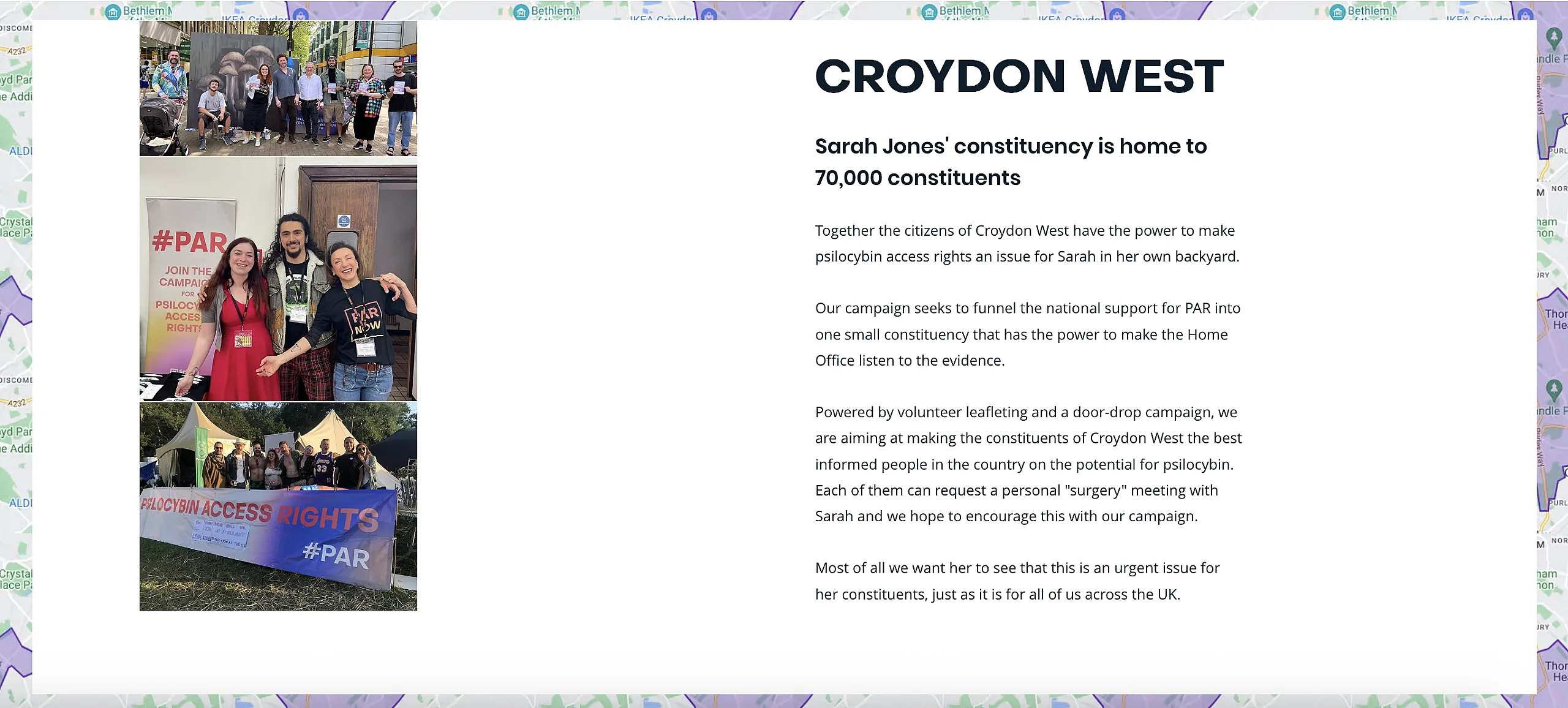
For Davis, increasing awareness of the campaign across the population is its single primary goal, pursued through festival activations, leaflet drops and events. That is also the logic behind PAR’s Project Croydon.
The project concentrates the campaign’s energy on a single constituency — Croydon West, represented by Sarah Jones13, the Home Office minister responsible for drugs policy. Its argument is that the mechanism for rescheduling already exists: a statutory instrument has been drafted in partnership with the Centre for Evidence-Based Drug Policy, and all that remains is the minister’s signature.
These two organisations, CEBDP and PAR, remain closely linked. Timmy Davis co-founded PAR and serves as its Policy Director, and is also Director of Psychedelic Policy and Regulation at the CEBDP — which helps explain how the two work so closely in step. His involvement is long-standing and hands-on: he co-authored the 2020 report calling for research-only rescheduling, and has provided psychological support on psilocybin trials for treatment-resistant depression at King’s College London.
The human side of the debate
Behind the scheduling debate are people for whom the outcome is not abstract. Among them, those often discussed in connection with psilocybin-assisted therapy: people with treatment-resistant depression, those living with PTSD, and terminally ill patients experiencing psychological distress. For them, whether a treatment sits in Schedule 1 or can be prescribed under medical supervision affects whether it is available at all.
PTSD UK14, a charity supporting people affected by post-traumatic stress disorder, stays out of the political argument, focusing instead on evidence-based information for patients15. It points to what decades of restriction have meant:
With the scheduling of LSD and other psychedelics, research into their medical potential was effectively shut down for over 50 years. This censorship of scientific exploration meant that therapies which could have benefited people struggling with PTSD, depression, and addiction were no longer accessible. The lasting consequence is that, even today, many people view psychedelics as inherently dangerous, not because of their actual effects, but because of the historical and political context in which they were banned.
At the same time, the charity is clear that the evidence is still developing, and urges caution:
“The research into psychedelic-assisted therapy is undoubtedly exciting, with studies indicating that substances such as MDMA, ketamine, and psilocybin may offer new hope for those who have struggled with traditional treatment options. However, while these findings are promising, it is essential to acknowledge that research is still in its early stages.”
PTSD UK also warns17 that even if approved, access could stay difficult — the therapy is expensive18, and without NHS funding might reach only those who can pay privately. “This raises ethical concerns about fairness and the potential for psychedelic therapy to become an exclusive treatment option rather than one accessible to all who need it”.
For now, clinical trials are one of the few legal ways to access psilocybin in the UK — so those who might benefit mostly wait, while some travel abroad to try it. That gap, between what the therapy might offer and how hard it is to actually get, is one the recent poll suggests many people have noticed too.
The road to Schedule 2 and beyond
For everyone working to open up access to psilocybin in the UK, one question matters most: will the compound actually be moved to Schedule 2 in the next few years?
Small changes are happening, and public support is high. The Liberal Democrats have adopted a policy19 calling for psilocybin rescheduling to foster research, the Greens have long backed public funding20 for research into psychedelic drugs, the PAR open letter already carries cross-party signatures, and internationally, access keeps expanding.
Timmy Davis’s own forecast is more practical than celebratory, and it runs through the same MHRA route the government pointed to in 2022.
Psilocybin will be considered for rescheduling to Schedule 2 by necessity if or when a psilocybin containing medical product receives market authorisation from the MHRA. This is necessary for that product to be available for prescription outside of clinical trials. This is certainly more likely to happen in the next 5-7 years than a rescheduling decision ahead of market authorisation. But as we’ve seen in jurisdictions abroad, this is not a total impossibility.
He also sees an opening in the current political moment. The government is in a period of transition, and it’s in exactly these moments that change is most likely to occur. He hopes a new Prime Minister, and any reshuffle that follows, will result in a sympathetic, receptive, and proactive approach to easing the country’s mental health burden — by making research and access to psilocybin easier. The real barrier, he says, is political will, which is exactly what PAR was set up to build.
We’re continuing to work hard on this, but there’s certainly no guarantees.
It’s worth being clear about what rescheduling can (and cannot) change. Medical cannabis is a useful example here. In 2018, cannabis-based medications were rescheduled from Schedule 1 to Schedule 2, letting doctors prescribe them. So far only three medicines have earned a full UK product licence.
In one sense, access did grow. By the end of 2025, around 80,000 people were getting cannabis medicine through the legal route. But almost all of it came through private clinics, and patients paid for it themselves. NHS prescriptions are very rare — fewer than five had been issued as of 2024. The reason is that NICE recommends medical cannabis for only a few conditions, and patients must first have tried at least two conventional treatments without success. So the medicine did become available, just, perhaps, not in the way many activists had hoped.

For psilocybin, the lesson cuts both ways. To the Home Office’s concern that any loosening must still ensure “harmful drugs are not misused”, the cannabis story is reassuring: moving to Schedule 2 won’t put magic mushrooms on supermarket shelves. Psilocybin would stay prescription-only and tightly controlled. But for patients and campaigners hoping for a big change, rescheduling tends to move things slowly and narrowly — and the changes it brings are, at first, mainly to research rather than to patients themselves.
There is a deep circularity at the heart of the UK psilocybin question. Psilocybin belongs to Schedule 1, the category reserved for substances with “little or no therapeutic value”. Yet it landed there when psychedelic research was in its infancy, and that same status now makes it slow and costly for UK researchers to prove otherwise. One condition feeds the other, like a snake swallowing its own tail.
Rescheduling would, at the very least, be the first cut in that loop: finally letting the research catch up with the question. And the answer may be a simple one: that the therapeutic value of psilocybin is not zero. But considerably more.