Can Psychedelic-Assisted Therapy Help With Severe Anxiety?
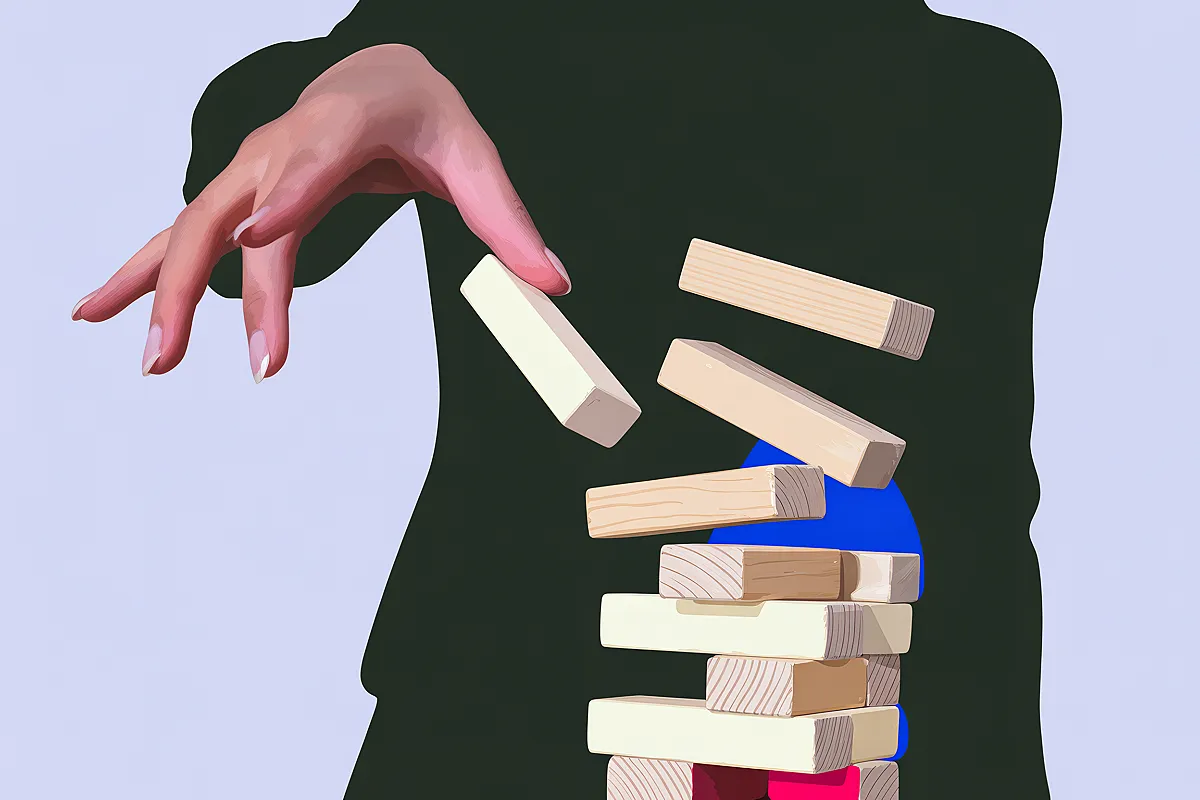
Anxiety is one of the most common reasons people seek mental health treatment, and one of the most stubborn. SSRIs help some people — and do little for others. CBT works well, though not for everyone. Plenty arrive at psychedelics after years of trying the standard route, more out of exhaustion than curiosity.
Psychedelic therapy has been in the headlines for a decade, mostly on the strength of depression and PTSD results. Anxiety is a messier story: the evidence is thinner, scattered across other diagnoses, and complicated by the fact that psychedelic experiences can themselves be frightening.
To make sense of what the available research shows, States of Mind spoke to Floris Wolswijk, founder of Blossom and one of the people who spends a lot of his time reading psychedelic studies. Blossom catalogues and structures the field’s published papers and clinical trials in one place. It now bills itself as the most comprehensive psychedelic research database, and is used by researchers, clinicians and investors across the field.
Together with Floris, we’ve worked through what “severe anxiety” actually covers, what the research shows substance by substance, and why fear during a session is common. You’ll also find what a course of psychedelic therapy looks like, how to tell whether a provider is a good fit for anxiety, and what’s realistically available in Europe today. And if reading all of it in one go feels like too much right now, there’s a wrap-up infographic at the end.
First, what counts as “severe” anxiety?
“Anxiety” covers several conditions that show up differently, and the differences matter for what the research can tell you.
- Generalised anxiety disorder (GAD) is a worry with no fixed target — it moves from work to health to money (and rarely runs out of material).
- Social anxiety is a fear of being watched or judged, strong enough that a life gets reshaped around avoidance.
- Panic disorder means recurring panic attacks plus the dread of the next one.
- Health anxiety turns ordinary bodily sensations into evidence of serious illness: a headache becomes a tumour, a skipped heartbeat becomes a cardiac problem. Normal test results reassure for a few days at most.
- Existential or end-of-life anxiety arrives with a serious diagnosis, and that’s where psychedelic research has been busiest: the landmark cancer trials were built around it.
- PTSD and OCD also involve heavy anxiety but are usually studied on their own terms.
What makes all these types of anxiety “severe” is how much of your functioning they take up, whether they have already survived a course of treatment, and whether depression has turned up alongside it. The early signs, though, are easy to miss. They get filed under stress or burnout — an understandable mix-up, since sustained stress and burnout can both feed into anxiety in the first place.
Psychedelics can also cause anxiety
If you’ve recognised yourself somewhere in that list, this is the point where the subject gets awkward. Fear and panic turn up often enough in psychedelic sessions to count as a normal part of them. Which means the treatment being studied for anxiety can, for a few hours, produce the very thing you came to get rid of.
In one psilocybin dose study with healthy volunteers, 39% reported extreme fear or anxiety at the higher doses. Floris Wolswijk points out that in a cancer study 17% of participants reported transient anxiety, and across other small psilocybin studies, challenging or fearful experiences show up in 20% to 40% of participants. Transient anxiety has also turned up with LSD, DMT, ayahuasca and ketamine. Floris says it appears regularly in trial safety data and tends to track with dose:
In carefully screened and supported trial settings, these reactions usually resolved during the session and serious or lasting complications were uncommon. That does not mean the risk is trivial, or that trial safety necessarily transfers to unsupervised use. It means acute anxiety and later therapeutic benefit can coexist.
For Wolswijk, one of the questions still to be answered is whether the difficult material does part of the therapeutic work, is just a side effect worth minimising, or turns out to be either one depending on the person and the support available.
What the data shows, substance by substance
Several psychedelics have been studied for anxiety, arranged here roughly in order of how strong the evidence is. Asked how he’d describe the field overall, Wolswijk doesn’t oversell it:
The evidence is encouraging, but still uneven. Most of the better-controlled trials point towards reductions in anxiety after treatment, sometimes lasting for months. However, the studies vary enormously in population, substance, therapeutic support and outcome measure, so I would not describe the findings as one consistent body of evidence yet.
He points to the mixed results as readily as the positive ones: a ketamine trial in social anxiety where clinician ratings improved but participants’ own reports didn’t, and an MDMA pilot in people with life-threatening illness that showed a big difference between groups and still fell just short of the statistical bar.
Psilocybin — the broadest signal
Asked which substance has the most convincing evidence, Floris answers without hedging: “If I had to choose one substance overall, I would say psilocybin. It has the broadest and most replicated anxiety signal, particularly in people experiencing anxiety, depression and existential distress alongside cancer or another life-threatening illness.”
Two 2016 trials — one at NYU, one at Johns Hopkins — found substantial, sometimes long-lasting improvements in anxiety, depression, hopelessness and attitudes towards death in cancer patients. Both used a single full dose of psilocybin, around 20 to 25 mg for an average adult, alongside psychological support.
Anxiety, depression and hopelessness overlap so heavily that it’s hard to say which of them actually moved — and someone facing a terminal diagnosis isn’t in the same position as someone who has lived with an anxiety disorder since their twenties. A 2025 trial in the same population (patients with life-threatening illness) shows how uneven the picture is: in-the-moment anxiety dropped clearly against placebo, but on the researchers’ main measure the difference was small enough to plausibly come down to chance. Psilocybin is now being tested directly in GAD.


LSD — the strongest result for anxiety disorder
For a specific anxiety diagnosis, LSD currently has the sharpest result:
LSD deserves a separate mention. The strongest recent disorder-specific result is arguably the 198-person MM120 trial in generalised anxiety disorder, which found a dose-dependent benefit lasting through 12 weeks. Two Phase III GAD trials are now following that study.
That trial, published in September 2025, gave people with GAD a single dose of a pharmaceutical LSD formulation, with no psychotherapy alongside it. Higher doses worked better than lower ones, the benefit held 3 months later, and at the chosen dose around two-thirds improved substantially — almost half of participants no longer met the threshold for the disorder.
Since the interview with Floris, the first follow-on trial has been reported. In August 2026, Definium Therapeutics (formerly MindMed) announced positive results from Voyage, a 214-person study. Over 12 weeks, anxiety scores fell roughly twice as much on a single dose of LSD as on placebo, and 43% of participants improved substantially (vs 16% on placebo). Side effects were mild to moderate and mostly confined to dosing day. A second trial, Panorama, reports shortly in September — though this is still a company announcement rather than a peer-reviewed paper.
Ketamine — the most available
Ketamine therapy is the treatment option most people can legally get today. Wolswijk notes its research base in depression is much larger than its research base in anxiety itself.
There’s a controlled trial in social anxiety disorder with 18 participants, some work in treatment-resistant GAD, and a lot of data on mixed anxiety-and-depression. Much of what gets cited as “ketamine for anxiety” is anxiety measured on the side inside a depression trial.
Ketamine still shows rapid effects, calming rather than producing a full psychedelic experience at lower doses, and is available through supervised clinics across Europe. But a clinic presenting ketamine as an established anxiety treatment is going further than the literature does — worth weighing against its benefits and risks.
MDMA — promising in social anxiety
MDMA’s strongest evidence is in PTSD, where anxiety is part of the picture rather than the target. For anxiety on its own there’s a 12-person pilot in autistic adults and a 20-person study in adults with social anxiety disorder. “The reported effects are sizable, but samples this small can produce unstable estimates and cannot tell us much about uncommon risks or generalisability,” says Floris. A larger trial in social anxiety among young autistic people is now underway.
Ayahuasca, cannabis and DMT
Beyond those four the evidence thins out fast. Ayahuasca has observational and small-trial data, mostly about depression. Medical cannabis is the most widely used and most legally accessible of the lot, and it cuts both ways: easing anxiety for some people and reliably worsening it for others at higher THC doses. Short-acting DMT-related compounds are also in development because a 30-minute experience is easier to deliver in a clinic than a 6-hour one, and several are now in GAD trials.
“GAD was historically under-studied, but that is changing quickly. The MM120 trial provides the clearest published signal so far. Psilocybin, DMT-related compounds and other programmes are now being tested directly in GAD, although several completed or ongoing studies have not yet produced published results,” summarizes Wolswijk.
How much “anxiety evidence” is really about anxiety?
Blossom’s broad anxiety topic currently appears on 774 paper records, but this absolutely does not mean there are 774 anxiety-treatment studies. The tag can reflect a primary diagnosis, a secondary measure, an anxious-depression subgroup, an acute adverse effect or a broader discussion of anxiety.
The trial data makes the imbalance concrete, Floris explains. Of 112 anxiety-linked trial records, 34 have anxiety as a primary topic and 78 mention it in passing. Among papers where the team has structured each outcome, 13 measured anxiety as the main thing they were testing and 33 treated it as a side measure. The literature looks several times bigger than it is, and this is especially relevant for ketamine, where many anxiety findings come from depression trials or anxious-depression subgroups.
The biggest limitation, Wolswijk says, is simply how few people these studies involve. Many of the most frequently cited trials enrolled somewhere between 12 and 50 participants, often at a single specialist site — which means a handful of individual responses can move the headline result, and that result reflects one team’s way of working as much as the drug itself. Those participants also aren’t a cross-section of people with anxiety. They’re carefully screened, in relatively good physical health, and less diverse than the wider anxiety population. Anyone dealing with several conditions at once is usually excluded — even though that combination is the norm in an actual clinic, and often the reason someone is looking at psychedelics as a treatment.
Blinding is the other structural problem. Participants and therapists can usually tell who received a psychedelic and who didn’t. This makes it hard to say how much of the improvement came from the substance and how much from expectation, from the attention of 2 therapists over several sessions, or from the setting around all of it.
We also need better active controls, more consistent outcome measures, independent replication, head-to-head comparisons with established treatments and longer follow-up that does not rely mainly on small groups of trial completers. Safety studies are generally too small to detect rare but serious harms.
What a course of psychedelic therapy for anxiety involves
Whatever the substance, legitimate psychedelic-assisted therapy has the same 3-part shape, and for anxious clients most of the weight sits on the first and third parts.
Preparation runs across 1 to 3 sessions. Medical and psychiatric screening comes first: cardiac health, psychosis and bipolar history, medication history. Then the psychological work: what you’re bringing, what you’re afraid of, what your goal is. If your core fear is losing control, this is where the therapy begins, because the job is building enough trust that letting go becomes possible. In psilocybin trials for depression, for instance, the strength of that bond predicted both how the session went and how well people did afterward.
The dosing session runs 6 to 8 hours for psilocybin or LSD, 1 to 2 for ketamine. You lie down with eyeshades and music, 1 or 2 facilitators in the room throughout, mostly quiet. If panic rises, the standard response is contact and reorientation rather than sedation, though a benzodiazepine often exists as an option in safety protocols.
Integration is what decides whether anything lasts. What happens over the following weeks is the translation work — turning a few hours of experience into a changed relationship to fear, a habit that shifts, or a conversation you finally have. Researchers who study integration argue it’s this ongoing work, not the session itself, that carries change into daily life.
Is this for you? Red flags and Green flags
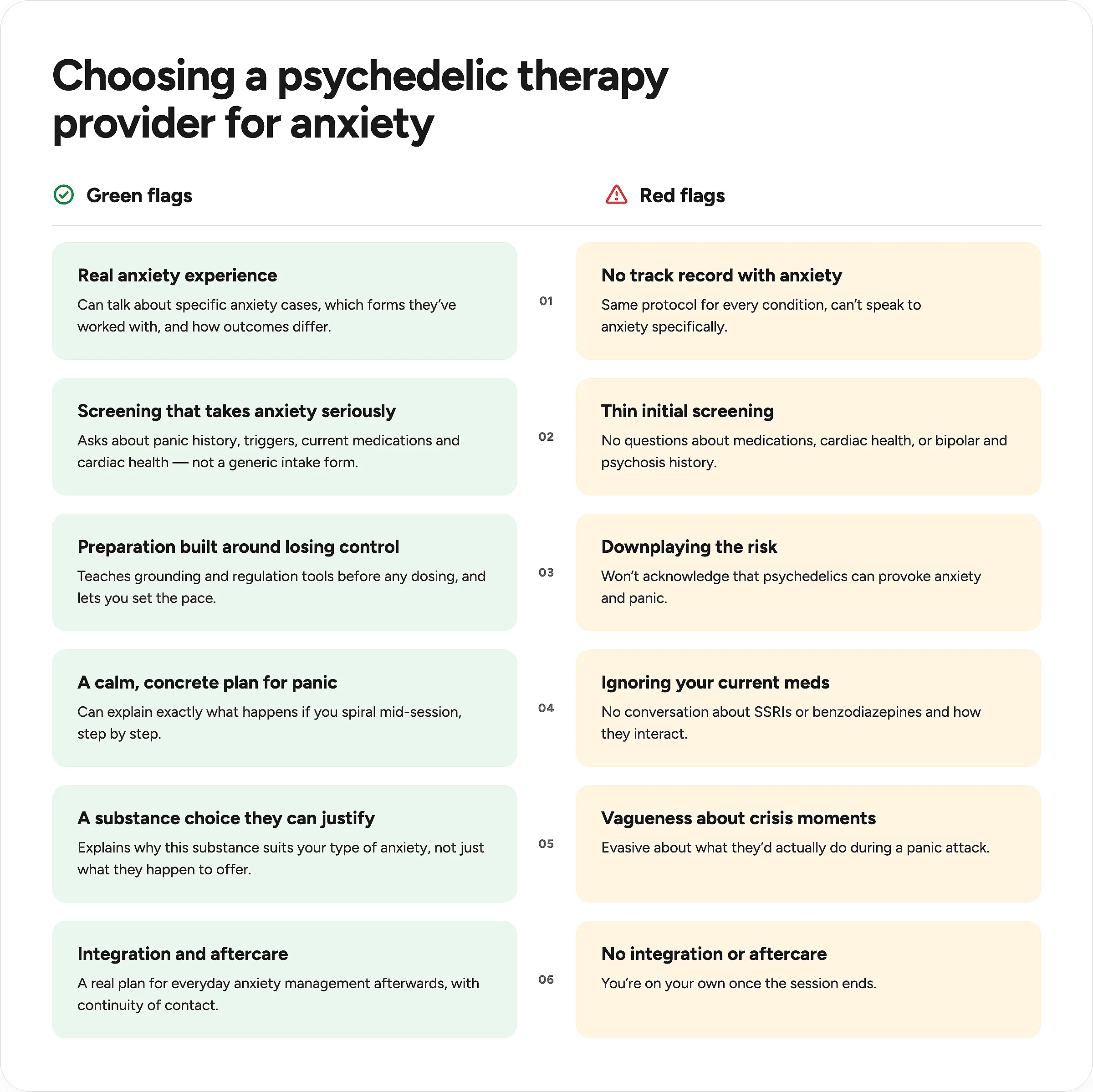
This comes down to 2 separate questions. Is your medical history compatible with psychedelic therapy? And is the clinic in front of you actually good with anxious clients?
Medical history
The list of contraindications is longer than most people expect, and much of it is ordinary: a family psychiatric history, a cardiac condition, or a long-standing prescription. The safety guidelines most research protocols are built on rule out or flag:
- A personal or close family history of psychosis or bipolar disorder
- Serious cardiovascular problems, including uncontrolled high blood pressure
- Certain neurological conditions, including a history of seizures
- Current heavy alcohol or substance use
- Interacting medications, including MAOIs and lithium
- Pregnancy and breastfeeding
Medication deserves the most attention here, because by the time someone is considering psychedelic therapy for anxiety, they have usually been on an SSRI or a benzodiazepine for a while. SSRIs may blunt the effects of classic psychedelics, and benzodiazepines are the standard rescue medication if a session becomes overwhelming. Trial protocols usually require both to be tapered before dosing. That conversation about drug interactions belongs with a psychiatrist who knows your history, and a self-check can help you work out what to ask.
Track record with anxiety
A clinic can be licensed, ethical and getting good outcomes, and still be a poor match for an anxious client, because both its experience and its protocol were built around depression or other conditions.
Getting access in Europe
There are 3 realistic routes today.
Ketamine clinics are the most available. Ketamine is a licensed medicine used off-label for mental health, and supervised clinics operate in the UK, Netherlands, Germany, Spain and elsewhere. Esketamine (Spravato) is EMA-approved for treatment-resistant depression but not for anxiety. Off-label ketamine treatment is almost always self-funded.
Regulated psilocybin access is arriving narrowly. Switzerland’s limited medical use programme runs under Article 8 of its Narcotics Act: roughly 700 case-by-case permits, around 100 authorised physicians, and the therapy is available only after standard treatments have failed. The Czech Republic became the first EU country to legalise medical psilocybin in 2026, though that framework targets treatment-resistant depression and is expected to reach a few dozen patients a year at first.
Clinical trials are the only access route to psilocybin, LSD or MDMA for anxiety in most of Europe, and they’re free. Floris from Blossom counts 17 trials primarily about anxiety currently recruiting or active (at the time of the interview): these include 2 Phase III LSD trials in GAD, a Phase III MDMA study in social anxiety among young autistic people, and several Phase II programmes involving psilocybin or shorter-acting DMT-related compounds. The EU Clinical Trials Information System and ClinicalTrials.gov are where to look.
Asked where the field will be in a few years, Wolswijk doesn’t promise much:
My expectation is that the next few years will give us much better answers for GAD and social anxiety, but probably not a simple conclusion that one psychedelic “works for anxiety”. Researchers are increasingly asking which patients benefit, how durable the response is, whether repeat dosing is needed, how much psychotherapy contributes, and whether shorter experiences can retain efficacy while making treatment easier to deliver. Better management of acute anxiety, more credible control conditions, broader patient samples and independent replication will matter just as much as another positive efficacy result.
So, do psychedelics work?
So far, the strongest numbers come from 2 LSD trials in generalised anxiety disorder: between 43% and 65% of participants improved substantially after a single dose, and between 14% and 48% no longer met the criteria for the disorder 3 months on. The psilocybin trials in cancer patients showed anxiety and depression improvements that held for 6 months in some participants. For a field this young, that’s a lot.
Calling it a cure would still be overstating it. The people running these trials are the first to say they don’t yet know who benefits, how long the effect lasts, or how much of it comes from the substance rather than from expectation and the setting around it.
The alternatives are worth knowing too.
- CBT outperforms placebo across anxiety disorders with moderate-to-large effects and has more evidence behind it than anything else.
- SSRIs help a substantial minority, especially when anxiety and depression arrive together.
- Physical activity has a smaller but consistent effect and costs nothing.
- Mindfulness and acceptance-based therapies change how people relate to anxious thoughts instead of arguing with them.
- Somatic approaches, on thinner evidence, land well with people whose anxiety lives in the body.
None of this makes psychedelic therapy a replacement for what already works. It’s an addition to a fairly short list, aimed mostly at people the existing list has failed, and the research still can’t say who it suits. With 3 Phase III readouts due this year alone, we’ll know a good deal more soon.
FAQ
Nothing in the current evidence supports “cure”. Trials show symptom reduction lasting weeks to months, sometimes longer: relief plus a changed relationship to anxiety, maintained through integration work.
Psilocybin has the broadest signal, concentrated in existential and cancer-related anxiety. For generalised anxiety disorder, LSD has the sharpest result so far in the MM120 GAD trial.
Yes, during the experience they can: 39% of volunteers in one psilocybin dose study reported extreme fear at higher doses. In supervised settings these reactions usually resolve within the session, and unsupervised use carries a different risk profile.
It’s being tested in GAD now, but the published evidence sits mostly in existential and cancer-related anxiety, a different population. The clearest GAD result so far involves LSD.
Microdosing isn’t a type of psychedelic-assisted therapy, and the evidence is much weaker. The largest self-blinding placebo-controlled study found benefits of placebo explained just as well. Reported downsides include increased anxiety, restlessness and disrupted sleep, plus the legal risks of unregulated substances.
A panic history isn’t an automatic exclusion, but it should come up early in screening, since a session can produce sensations resembling a panic attack. Safety guidelines treat preparation and continuous supervision as the main safeguards.
Facilitators stay with you: reassurance, grounding in the body and the room, physical contact if you agreed to it beforehand, and reorientation to the fact that it will pass. Sedative medication (diazepam) exists in most protocols as a last resort.
Ketamine therapy is legal across much of Europe as off-label use of a licensed medicine, and esketamine is EMA-approved — but for depression rather than anxiety. Psilocybin, LSD and MDMA remain controlled, with narrow exceptions in Switzerland and the Czech Republic, plus clinical trials.
There’s no meaningful average, but a supervised ketamine course in Europe typically runs into thousands of euros (around £6,000 for a full course) and residential retreats considerably more. Almost none of it is reimbursed when anxiety is the reason. Clinical trial participation is free.
Ask about their anxiety caseload: which forms they’ve worked with, how outcomes differ, what they do differently for an anxious client, etc. A provider who only talks about depression or trauma treatment is telling you something. Our guide to choosing a clinic with guided sessions goes through the questions.
Look for medical oversight by a psychiatrist or anaesthetist, screening that covers cardiac health and medications, psychological support beyond the infusions, and a full integration plan. Be wary of clinics selling packages upfront or presenting ketamine as an established cure.