Ayahuasca for Mental Health and Personal Growth
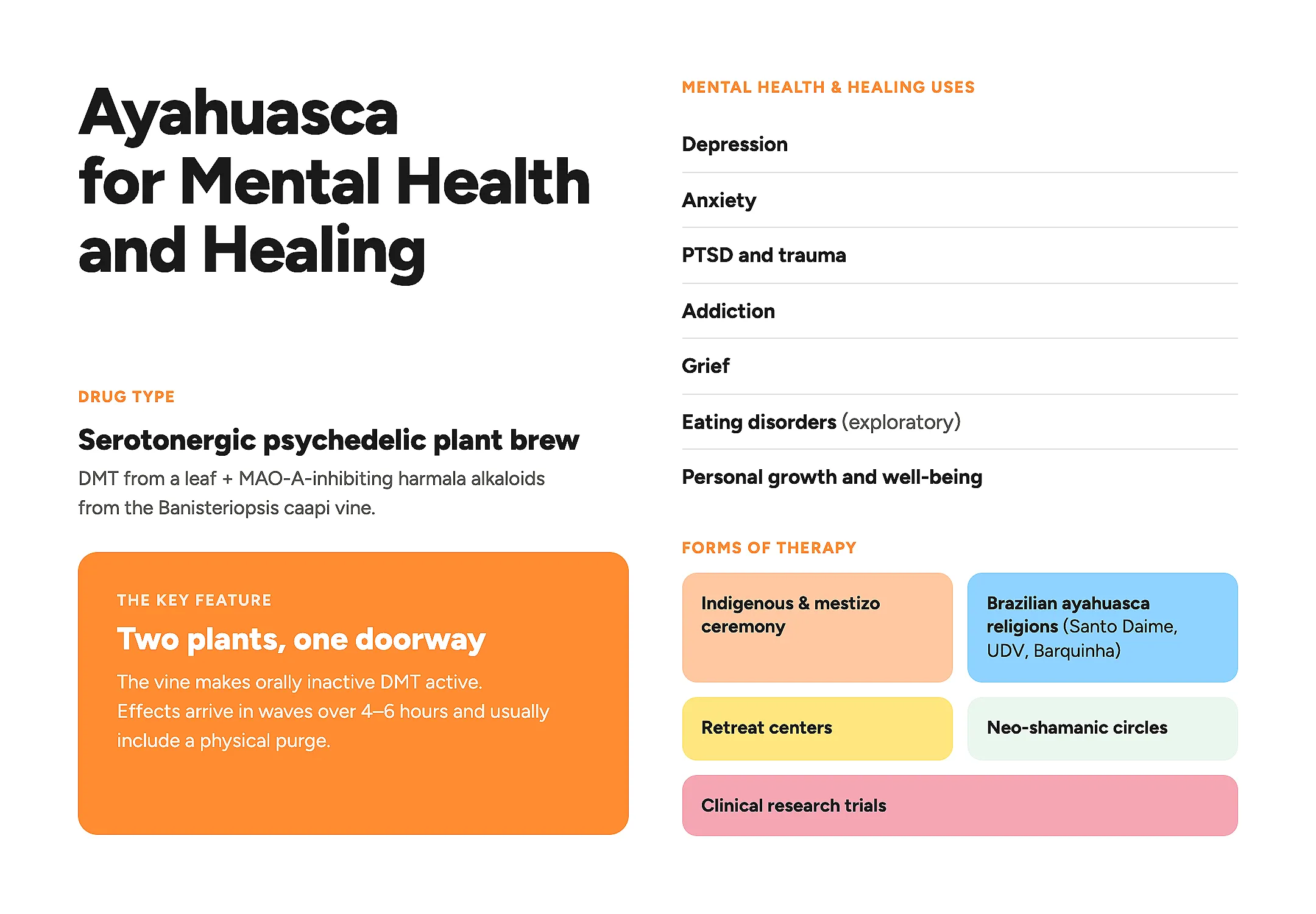
- Ayahuasca is a sacred Amazonian plant brew traditionally used for healing, diagnosis, divination, spiritual communication, protection, cleansing, and communal ritual. It’s more than a “DMT drink”: in many lineages, the Banisteriopsis caapi vine is regarded as the heart of the medicine.
- Research into ayahuasca and mental health is promising, especially around depression, anxiety, substance use, well-being, and psychological flexibility, but the evidence remains limited relative to established psychiatric treatments.
- Most ayahuasca use still happens in ceremonial, religious, retreat, or neo-shamanic settings rather than standardized clinical therapy, so screening, preparation, facilitation, setting, and integration can shape the outcome as much as the brew itself.
- The experience may include nausea, vomiting, diarrhea, visions, intense emotions, fear, insight, spiritual experiences, and a peaceful afterglow — sometimes all in the same night. These effects can feel healing for some people and destabilizing for others.
Many generations ago, somewhere among the vast green intelligence of the Amazon flora, Indigenous shamans realized that boiling a woody jungle vine, now known as Banisteriopsis caapi, yields a potion with otherworldly healing potential.
Depending on the region, language, and lineage, the vine and the preparations made from it are known as ayahuasca, caapi, yagé, hoasca, cipó, bejuco de oro, daime, natem, shori, pildé, and by many other names.
Brewed alone or together with DMT-containing leaves such as chacruna or chaliponga, ayahuasca can catalyze a powerful altered state filled with visions, purging, emotional release, spiritual insight, and deep self-reflection.
In recent years, its effects have also drawn the attention of scientists, therapists, and mental health researchers. Early studies suggest possible benefits of ayahuasca for depression, anxiety, substance misuse, grief, trauma-related distress, emotional rigidity, and personal growth.
The research is still young, though, and many studies are small, observational, or conducted in ceremonial rather than controlled clinical environments. Ayahuasca isn’t a cure-all, a shortcut, or a replacement for professional mental health care. It can be profoundly transformative, but also physically demanding, emotionally overwhelming, and risky in the wrong hands or context.
With this guide, we aim to provide you with a clear, honest, and as well-rounded a picture as possible: what ayahuasca is, where it comes from, how it works, what the experience can feel like, what research says about ayahuasca and mental health, and which safety, ethical, and legal issues deserve serious attention.

What Is Ayahuasca?
Ayahuasca is a sacred, psychoactive Amazonian brew traditionally used by Indigenous and mestizo healers for medicine, diagnosis, divination, cleansing, protection, spiritual learning, and communication with the realms beyond. In contemporary ceremonial and neo-shamanic contexts, people also seek it out for psychological healing, emotional release, personal transformation, spiritual growth, or attaining a deeper sense of meaning.
The word ayahuasca is commonly translated from Quechuan languages as “Vine of the Soul,” “Vine of the Spirits,” or “Vine of the Dead,” with waska meaning vine, liana, or rope, and aya referring to human-like souls or spirits. Author and researcher Gayle Highpine suggests that “vine with a soul” may be a more culturally sensitive interpretation.
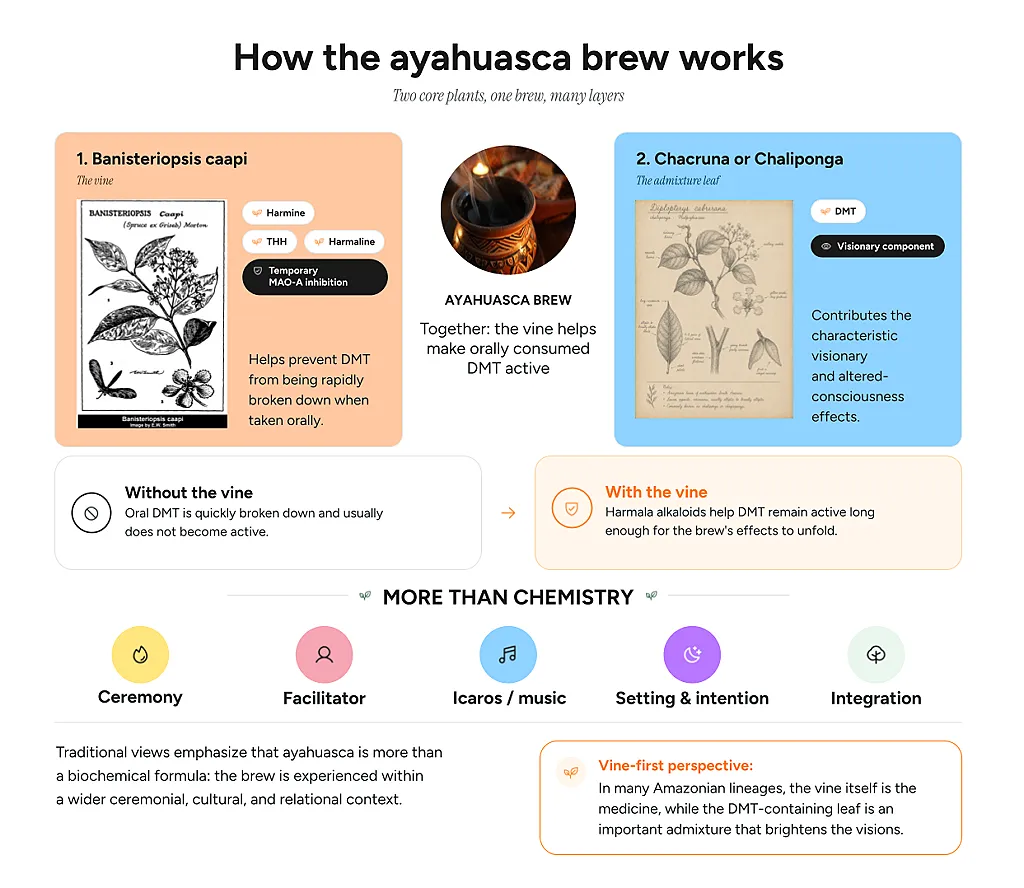
In the West, ayahuasca is often reduced to a combination of two plants: the ayahuasca vine, B. caapi, and a DMT-containing leaf such as Psychotria viridis or Diplopterys cabrerana. The vine contains harmala alkaloids that enable bioactivity of orally consumed DMT, while the leaf contributes the visionary compound itself.
Traditionally, though, this DMT-centered explanation misses something essential — in many Amazonian lineages, the vine itself is the medicine; it is the Master Plant Teacher and the plant properly called ayahuasca. The DMT-containing leaf is an important admixture for brightening and intensifying visions, but it traditionally plays an assisting role rather than starring as the protagonist of the brew.
Traditional Indigenous use
In ancestral Amazonian contexts, ayahuasca belongs to a much larger system of medicine, cosmology, ceremony, music, diet, discipline, and relationship with natural and spirit worlds.
Indigenous and mestizo healers have used it to diagnose illness, commune with plant spirits, locate missing people or objects, identify spiritual causes of misfortune, protect against harmful influences, prepare for hunting or community decisions, and cleanse the body and spirit.
In some communities, the shaman is the one who drinks, entering the visionary state on behalf of a patient or the collective. In others, ayahuasca is shared in group ceremonies involving healing, music, bonding, dancing, rites of passage, and communal cleansing.
In the mestizo Amazonian tradition of vegetalismo, diligently documented by the great Luis Eduardo Luna, certain plants are understood as doctores or teachers who impart knowledge through a long apprenticeship in isolation which involves a stringent diet, sexual abstinence, and repeated communing with the plant spirits.
What Is in Ayahuasca?
There are many ayahuasca recipes across the Amazon. Dozens of medicinal, aromatic, and lineage-specific plants have been documented as possible admixtures, but the most widely discussed preparation is the one with the caapi vine and a DMT-containing leaf.
Banisteriopsis caapi: the ayahuasca vine
B. caapi is the woody Amazonian liana that gives ayahuasca its name and traditional identity. In the jungle, it climbs and wraps around neighboring trees, almost as if stitching together the living architecture of the rainforest. In ceremony, it’s revered as a source of healing, guidance, cleansing, discipline, and spiritual instruction.
One sign of the vine’s central role is the range of ethnovarieties recognized by different Amazonian groups. Indistinguishable to Western taxonomy, seasoned practitioners can tell them apart by color, spirit, effect, intention, origin, strength, or the kind of experience they are said to open. Commonly described ones include:
- yellow, sky, or rayo ayahuasca, typically considered suitable for first-time drinkers due to its gentle yet powerful nature;
- white or yura ayahuasca, associated in some lineages with spiritual defense and sorcery;
- red or puka ayahuasca, said to be used for diagnosis and healing;
- black or yana ayahuasca, often described as strongly purgative and less visual;
- thunder or trueno ayahuasca, associated with forceful, shaking bodily effects;
- rattle or cascabel ayahuasca, considered rare and powerful;
- Indian ayahuasca, said to be gathered from white-sand forest rather than cultivated.
Other systems classify vines through masculine or feminine spirits, animal associations such as boa, jaguar, tiger, or macaw, particular purposes like hunting or ancestor communication, or physical features such as knotted growth.
These are traditional classifications rather than standardized botanical categories, and the chemistry of individual varieties has not been mapped well. Distinct alkaloid concentrations may be one contributing factor.
The DMT-bearing leaves
The most common DMT-containing plants used in ayahuasca are Psychotria viridis, known as chacruna, and Diplopterys cabrerana, known as chaliponga or chagropanga. Their use varies by region, lineage, availability, and tradition: P. viridis is especially common in Peru and Brazil, while D. cabrerana is more associated with parts of Ecuador, Colombia, and the upper Amazon.
DMT, or N,N-dimethyltryptamine, is a powerful serotonergic psychedelic. When smoked or vaporized, it’s (in)famously immediate and intensely astral, resolving relatively quickly in what we consider time units in this reality. In ayahuasca, however, the harmala alkaloids from the vine allow DMT to survive digestion, enter the bloodstream, cross the blood-brain barrier, and produce a slower, longer, more embodied and holistically immersive journey.
Biochemically, DMT drives much of ayahuasca’s visionary effect. In the vine-first perspective, however, the DMT leaf functions more like a torch or signal tuner: it brightens, sharpens, and expands the visions the vine already delivers.
Other admixtures
Other plants may be added according to a healer’s intention. Mapacho, or Amazonian tobacco, is one of the most common Master Plants used alongside the brew, especially in smoke-blowing cleansings known as sopla. Bobinsana, kana, brunfelsia, remo caspi, and many other plants may be used to modulate taste, energetic quality, visionary character, purgative force, or duration.
Toé, also known as Brugmansia or angel’s trumpet, deserves a special cautionary mention. Its tropane alkaloids can add a deliriant and potentially deadly dimension to a brew. Even within traditional practice, it’s considered a high-risk plant requiring exceptional expertise.
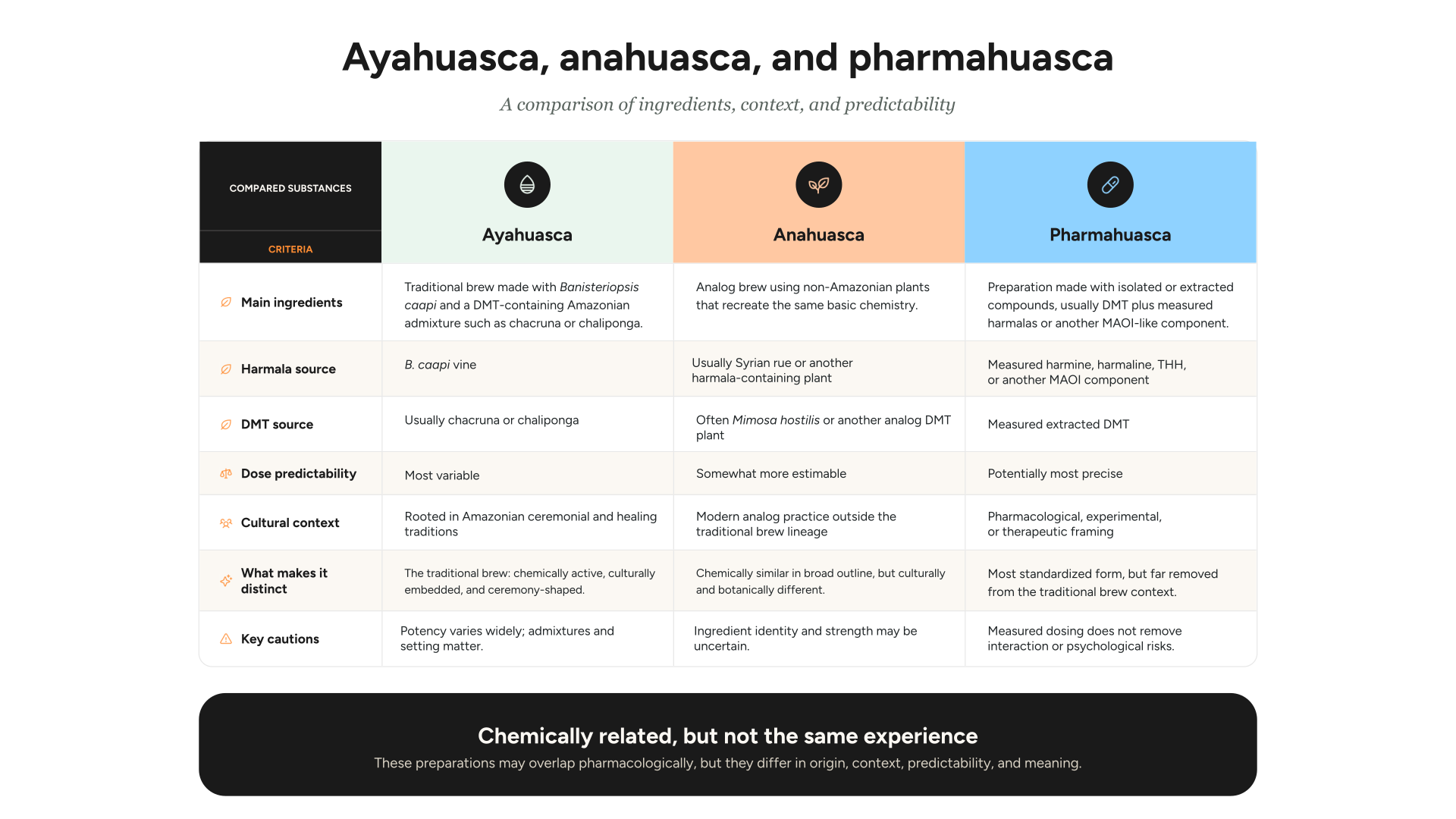
Ayahuasca, anahuasca, and pharmahuasca: you thought there was just the one?
Traditional ayahuasca is a plant brew whose effects come from the synergy of its chemical composition, the brewing process, the ceremony, the songs, the facilitator, the energetic resonance of the environment, the intention, the purge, and the relationship between the drinker and the medicine.
Pharmahuasca is a modern attempt to emulate ayahuasca’s core pharmacology using isolated or extracted compounds, usually freebase N,N-DMT and one or more harmala alkaloids or another MAO-inhibiting substance. It provides the chemical doorway of ayahuasca but it doesn’t reproduce the full botanical, ceremonial, cultural, and spiritual container of the traditional brew.
Anahuasca refers to analog preparations made with nontraditional plants that contain similar active chemicals, such as Syrian rue (Peganum harmala) as a harmala source and jurema (Mimosa tenuiflora or M. hostilis) as a DMT source. Anahuasca can resemble ayahuasca pharmacologically, but it’s, again, not the same culturally, botanically, or experientially.
The Historical Background of Ayahuasca
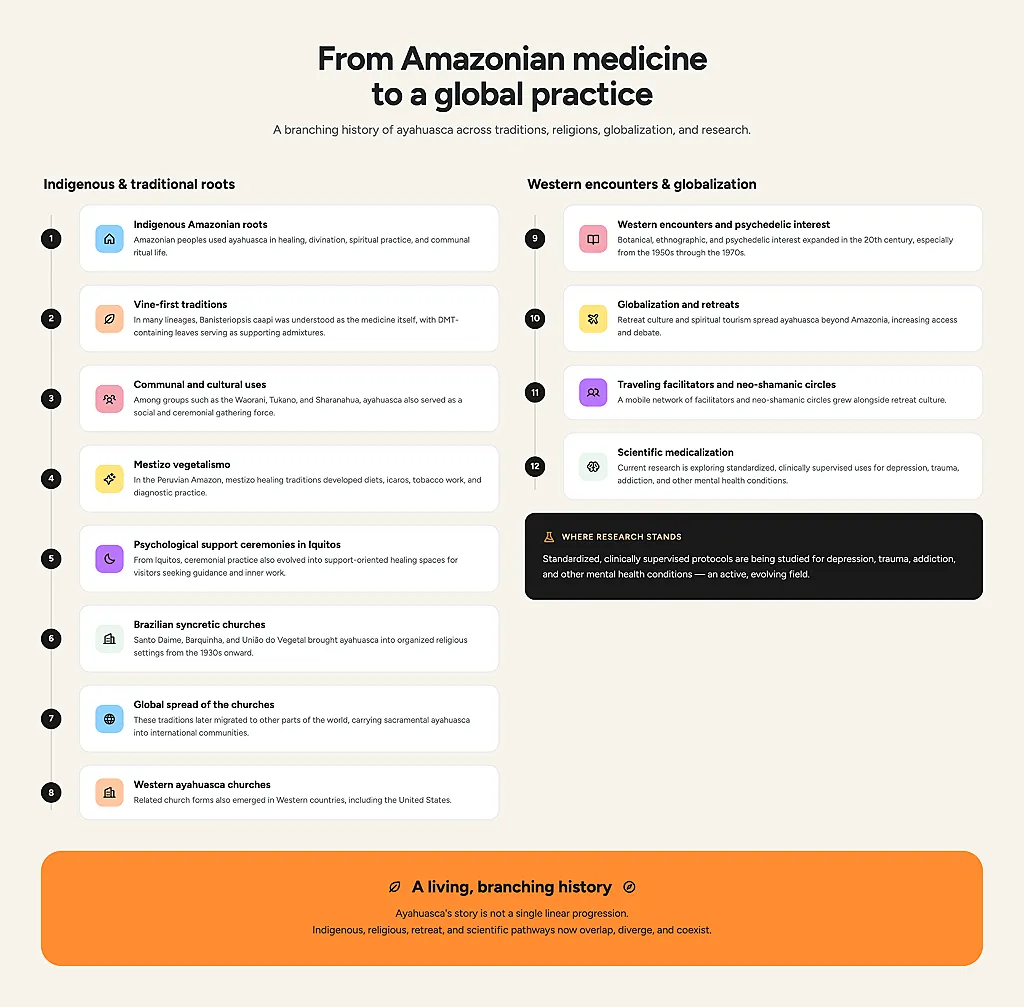
Ayahuasca has one of those histories that refuses to acquiesce to a timeline (although there have been notable attempts to chart one out). It feels ancient, is deeply rooted in Amazonian ways of knowing, and is surrounded by oral traditions that reach far beyond what written records can prove — yet even the basics, like the origin of the familiar B. caapi plus DMT-leaf preparation, remain a mystery to this day.
The most accurate nutshell summary of ayahuasca’s history is that it belongs to very old Amazonian worlds of plant medicine, healing, and visionary practice, while its recipes, ritual formats, and social meanings have changed many times over. This lineage-based forest medicine has also become a sacrament, a symbol of Indigenous knowledge, a subject of scientific research, a centerpiece and growth accelerator of the retreat industry, and an ethereal vessel of healing and personal transformation.
Indigenous roots: ancestral medicine, uncertain evidence
Ayahuasca is often presented as a millennia-old tradition. That may be true in spirit, but the Amazon’s ecosystem isn’t kind to remains, and a liquid decoction leaves little that can be identified archaeologically. Snuff trays, pipes, bowls, and ritual bundles can be uncovered, but a drink made from vine and leaves — not likely.
That’s why the archaeological record of DMT-containing plants has been more clearly traced than that of ayahuasca itself. South America has a long history of psychoactive plant use, but a ceremonial vessel can’t automatically be identified as an ayahuasca cup.
Gayle Highpine’s influential origin hypothesis proposes that ayahuasca originally referred to the B. caapi vine, that vine-centered shamanism may have preceded DMT admixtures, and that those admixtures emerged through the broader practice of adding medicinal plants to caapi brews.
The mystery of the two plants
One of the most famous questions about ayahuasca is also one of the most beautiful: among the thousands of Amazonian plants, how did people discover that combining this vine with leaves of particular bushes produces an unrivaled entheogenic potion?
The Indigenous answer is simply that the plants taught them. Among the Napo Runa, ayahuasca is regarded as “the mother of all plants,” a mediator between humans and the plant world. Within this worldview, no trial and error are needed when a powerful teacher helps healers learn what other plants do and how they can be combined.
Another hypothesis would be that DMT-containing Psychotria plants may initially have been added because related plants were known as purgatives. The original intention may therefore have been cleansing, with their vision-brightening effects recognized later.
Vine-first traditions and the evolution of ceremony
The contemporary psychedelic idea that ayahuasca is simply a way to drink DMT lands almost backwards in many traditional perspectives. Across several Amazonian languages, the many monikers of ayahuasca refer to the vine as well as the beverage made from it, suggesting that B. caapi, rather than the admixture leaf, gives the medicine its identity.
Many trained curanderos or vegetalistas have historically worked with B. caapi-only (or low-DMT) brews, their years-long dieta enabling them to receive the vine’s effects through subtle sensory and spiritual channels that an uninitiated participant barely notices. Chacruna or chaliponga are added when amplifying the visions is needed but, oftentimes, the “fireworks” of DMT are considered unnecessary or even distracting.
In Peruvian mestizo vegetalismo, the practitioner’s knowledge is understood to come from plant spirits. Certain plants are regarded as doctores, or teachers, approached through dieta, isolation, abstinence, and long ceremonial apprenticeship. Sacred songs, icaros, are received by the plant teachers and used to guide visions, invoke spirits, diagnose and cleanse, protect the ceremony, and express the healer’s accumulated knowledge.
In many traditional healing settings, the healer was the principal person drinking. The state they would enter would enable them to diagnose illness, identify spiritual causes, receive guidance, defend against sorcery, locate missing people or objects, or determine which plants and treatments were needed. The patient might drink when cleansing or direct participation was considered necessary.
Still, there has never been only one ayahuasca culture: among the Waorani, Tukano, Sharanahua, and other peoples, ayahuasca has also supported communal gathering, hunting preparation, ceremonial dance, bonding, and collective ritual. The now-familiar group ceremony centered on each participant’s psychological or spiritual healing appears to have emerged more recently, when Indigenous and mestizo migrants to Iquitos sought support amid urban displacement and social upheaval.
Western encounters and changing perceptions
The first written Western observations of ayahuasca use go back to Jesuit accounts in the 1600s, but the most famous early scientific encounter came through the English botanist Richard Spruce in the 19th century. Spruce observed the use of caapi among widely separated peoples in the Upper Amazon and collected botanical samples for ethnobotanical classification.
As Western psychedelic culture developed in the 20th century, DMT became known as an awe-striking, short-acting visionary compound. Ayahuasca was increasingly viewed through that prism — as an oral portal to a prolonged DMT state — which fostered public interest while pulling attention away from the older Amazonian understanding of the vine as the teacher.
By the late 20th century, ayahuasca occupied several Western imaginaries at once: exotic jungle drug, shamanic sacrament, visionary technology, psychological mirror, and potential medicine. Some of these framings opened important doors, while others deflated complex traditions into something more easily digestible to the masses.
Brazilian ayahuasca religions
A major chapter in ayahuasca’s modern history unfolded in Brazil, where the brew entered new syncretic religions blending Amazonian ayahuasca use with Christianity, Spiritism, Afro-Brazilian elements, hymn singing, moral discipline, communal ritual, and institutional organization.
The best-known are Santo Daime, which emerged in the 1920s and 1930s through Raimundo Irineu Serra, known as Mestre Irineu, UDV, which was founded in 1961 by José Gabriel da Costa, known as Mestre Gabriel, and Barquinha.
The auspices of religion also helped ayahuasca travel. Santo Daime and UDV expanded beyond Brazil into Europe and North America, changing how courts, governments, scientists, and the public thought about the brew.
Globalization, retreats, and the rise of ayahuasca tourism
From the 1990s onward, more travelers began visiting Peru, Colombia, Brazil, Ecuador, and other parts of South America to drink ayahuasca. Retreat centers mushroomed, traveling facilitators carried the practice abroad, and ceremonial formats adapted to people seeking trauma healing, depression relief, addiction recovery, spiritual awakening, creative inspiration, or a life reset.
The diversification of ayahuasca’s use, intention, and meaning as it moves across cultural and geographic boundaries, tends to keep some traditional Amazonian elements while departing from Indigenous cosmology as the brew becomes syncretic, institutionalized, commercialized, and otherwise shaped by Western individualism and community needs.
Traditions naturally travel and reinvent themselves. Yet, globalization has also introduced cultural appropriation, unsafe facilitation and sexual misconduct, inflated therapeutic claims, exploitation of Indigenous knowledge, commercial pressure on communities, and concerns about overharvesting. We’ll expound on these issues later, in the Ethics section.
How Does Ayahuasca Work?
Anyone claiming to understand exactly how ayahuasca works is getting ahead of the science.
What research does suggest is that the brew affects several overlapping systems: serotonin signaling, monoamine metabolism, neuroplasticity, emotional processing, self-referential brain networks, and possibly non-serotonergic systems such as the endocannabinoid system.
At the most basic chemical level, ayahuasca depends on a remarkable botanical collaboration: one plant opens the door, and the other walks the consciousness through it.
B. caapi biochemistry: the three harmalas
The door-opening plant is the ayahuasca vine, B. caapi. Its woody stems (especially their bark) contain β-carboline alkaloids known as harmalas, specifically harmine, harmaline, and tetrahydroharmine, or THH. Harmine and harmaline act as reversible inhibitors of monoamine oxidase A, or MAO-A — the gut enzymes that would otherwise break down DMT before it became orally active.
These harmala alkaloids are more than just “DMT enablers.” They have psychoactive, somatic, and potentially medicinal effects of their own (the most notable of which is likely their reported capacity to stimulate adult neurogenesis in vitro).
- Harmine is the most abundant and best-studied of the three. Preclinical research has examined its anti-inflammatory, neuroprotective, antidiabetic, bone growth-stimulating, and anticancer properties.
- Harmaline has been looked into for its CNS stimulant properties, been found to promote the conversion of serotonin into melatonin, and has reportedly displayed antiviral properties against HSV-1 and HSV-2.
- Tetrahydroharmine is less studied than the other two, and it’s considered to contribute more to the serotonergic and mood-related character of the brew rather than to the monoamine oxidase inhibition (MAOI) side like its more biochemically potent relatives.
Many psychonauts have experimented with vine-only or DMT-less pharmahuasca preparations and have reported pleasant, dreamy emotional states, tingling sensations, and mild visionary effects.
The tryptamine-laden foliage: Biochemistry of DMT
The consciousness-escorting plant is a DMT-containing leaf, usually chacruna or chaliponga. Like psilocybin, LSD, and mescaline, DMT is a potent agonist of the 5-HT2A (serotonin) receptor, which is strongly associated with psychedelic states characterized by significant alterations of perception, emotion, cognition, and meaning-making.
Still, ayahuasca is pharmacologically more complex, and phenomenologically more than the sum of its ingredients’ main identified biochemical activities.
DMT interacts with several receptor systems, while the harmalas affect monoamine metabolism and contribute their own bodily and psychological effects. That helps explain why ayahuasca can feel visionary, emotional, purgative, dreamlike, physically heavy, and spiritually charged all at once.
What we know about ayahuasca’s effects on the brain
Again, research into ayahuasca’s effects on the brain is still young, but a few patterns have emerged: the brew appears to influence neuroplasticity, self-referential processing, and possibly the endocannabinoid system. None of these mechanisms explains the whole experience, but together they offer clues as to why a few hours of ceremony can sometimes be followed by changes that continue unfolding for weeks or months.
- Neuroplasticity: Preclinical research suggests that classic psychedelics, including DMT, can stimulate processes related to dendritic growth, synapse formation, neurogenesis, and plasticity-related gene expression. Human evidence is more indirect and remains mixed.
A major review of psychedelic-induced neuroplasticity emphasizes that any plasticity window is experience-dependent: preparation, setting, support, and integration may shape whether increased sensitivity supports healthy learning or yields confusion and destabilization. - Default Mode Network: This proposed system of interconnected brain structures is involved in autobiographical memory, self-referential thought, mind-wandering, and the ongoing sense of “me.”
A small fMRI study of ten experienced participants found that ayahuasca altered DMN activity and connectivity during the acute state. This may help explain reports of ego softening, deep introspection, or seeing oneself from a radically different perspective. - The endocannabinoid system: A pair of small pilot randomized trials examined anandamide and 2-AG after ayahuasca or placebo. The results were preliminary, but suggested that ayahuasca may affect endocannabinoid signaling differently in healthy volunteers and people with social anxiety disorder.
These findings are a useful reminder that the potential way ayahuasca helps with mental health cannot be reduced to “DMT hits serotonin receptors.” The brew appears to act across many layers: neurotransmitters, body sensations, memory, emotion, expectation, ceremony, music, meaning, and whatever psychological material the drinker brings into the ceremony.
How Ayahuasca Is Used for Healing and Personal Transformation
People typically come to ayahuasca because something in life doesn’t feel right. They may be suffering in a way that will not let up, stuck in patterns they can’t seem to break, unable to move past something painful, or unsure where certain emotions keep coming from, let alone how to work with them.
People are complicated, of course, and naming the problem is only the first step. Figuring out what’s really underneath is the next one — and that’s one part of the journey ayahuasca can potentially move the seeker along on.
Someone may say they want the brew’s help with depression, but behind it may be grief, childhood pain, addiction, disconnection, or a longing for meaning. Someone else may come for “personal growth” and discover that the medicine wants them to address their broken family relationships, the way they’ve been neglecting their body, their fear of change, or a deep sense of not-enoughness.
What outcomes are realistic?
Before looking at particular conditions, a vital foreword: evidence for ayahuasca’s clinical efficacy is still very limited. There are promising observational studies and a small number of controlled trials, but ayahuasca isn’t an established treatment for any psychiatric disorder.
Most people aren’t drinking in a controlled environment under observation of professionals equipped to handle medically alarming or dangerous episodes. They drink in ceremonies, churches, retreats, and neo-shamanic circles, where the effects are shaped by ritual, expectation, music, group dynamics, preparation, facilitator skill, and the meaning attributed to the experience.
In a clinical model, researchers try to standardize screening, dose, setting, symptom scales, and follow-up. In the real world, the “treatment” may include dieta, fasting, tobacco cleansings, icaros, purging, group witnessing, prayer, meditation, yoga, plant baths, silence, conversation, and days or weeks of preparation and integration. That’s why the potential ayahuasca health benefits are becoming acknowledged as an amalgamation of its biochemical effects, the shamanic or ceremonial guidance received, and the participant’s interpretation of what happened.
So, science can help clarify mechanisms, efficacy risks, and outcomes. But, all things considered, the ceremony reminds us that healing isn’t only about symptom reduction — sometimes it’s seeing, with unbearable clarity, what we must no longer keep doing.
To boil everything down (pun intended): ayahuasca may help loosen a pattern, illuminate a wound, or reconnect you to something deeper, but the result depends on you, the setting, the support, the timing, and the willingness to integrate what was shown.

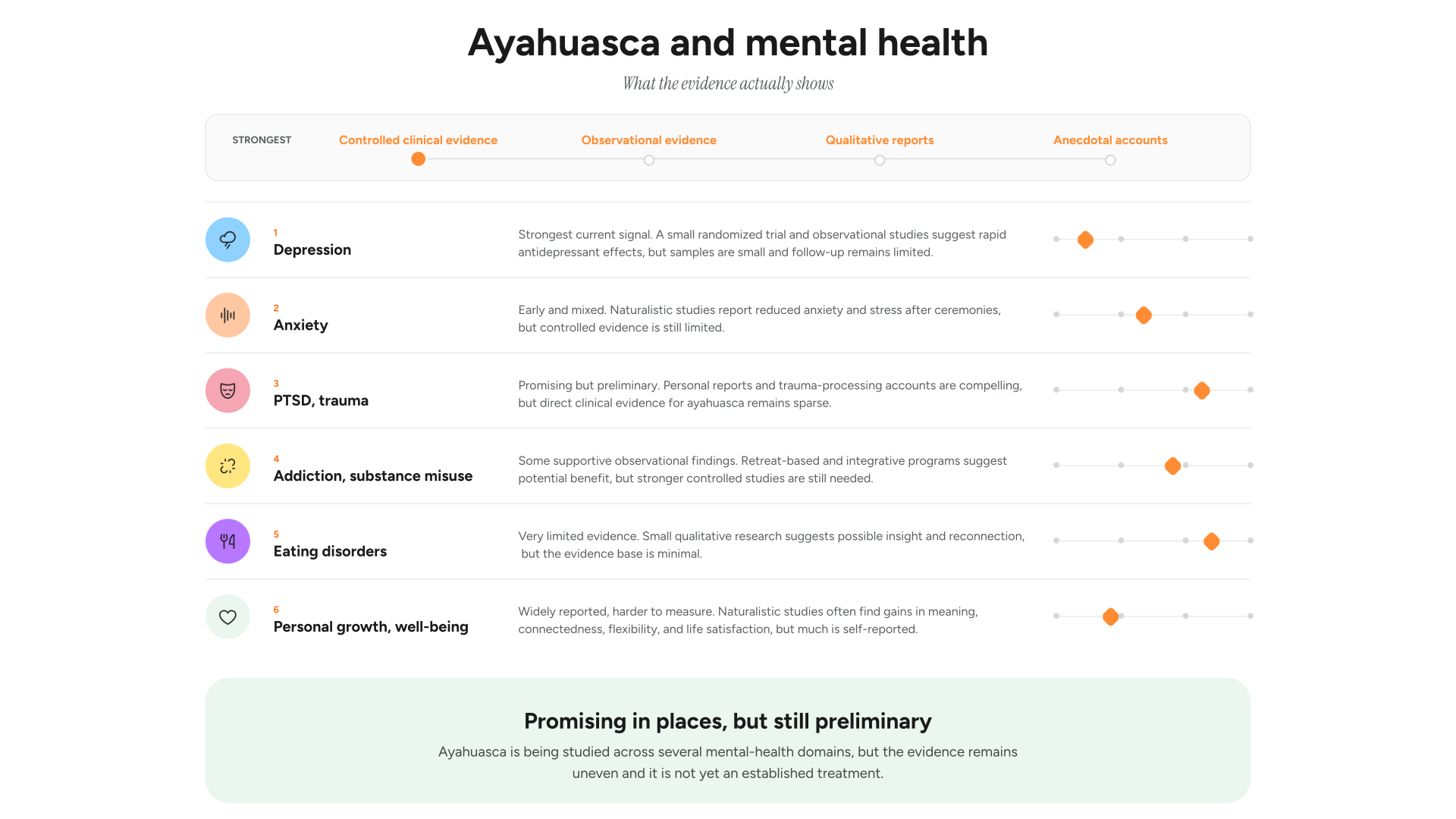
Ayahuasca for depression
Depression is one of the main reasons ayahuasca has entered the mental health conversation. The strongest clinical signal so far comes from a randomized placebo-controlled trial involving 29 people with treatment-resistant depression. The ayahuasca group showed significantly greater reductions in depression scores than the placebo group, with response rates of 64% versus 27% at day seven.
A 2020 naturalistic study also found that many first-time users who met the criteria for a psychiatric disorder at baseline showed improvements that persisted at six months, and a 2022 longitudinal study found one-month reductions in depression alongside improvements in mood and self-efficacy.
It’s worth noting that experiencing a state similar to depression after ayahuasca is a real possibility, too. While some people leave feeling lighter, clearer, and more connected, others feel raw, sad, tired, or emotionally exposed for days or weeks after. That doesn’t necessarily mean the ceremony “went wrong”; more likely, some difficult material came out and now needs care.
But if someone who is severely depressed, suicidal, isolated, or unsupported drinks, the post-ceremony vulnerability can be dangerous, which is why screening, integration, and aftercare are so important.
Ayahuasca for anxiety
Ayahuasca and anxiety have a complicated relationship. On one hand, many people report that ayahuasca helps them soften fear, trust life more deeply, reconnect with their body, and step out of the constant “what if?” ruminations. On the other hand, the come-up, nausea, racing thoughts, visions, vulnerability, and ego dissolution can all feel overwhelming, especially for people used to the illusion of having control.
The research results also paint this mixed picture. An older Santo Daime study found lower scores on panic-like and hopelessness measures one hour after ayahuasca ingestion, but didn’t find changes in state or trait anxiety. But the same longitudinal study from above reported reductions in anxiety and stress one month post-ceremony.
Ayahuasca may help some people by placing them in direct contact with fear rather than allowing continued avoidance. That process can reveal the origin of an anxious pattern or show that fear doesn’t always need to be obeyed. But it can also be destabilizing when someone is unsupported, poorly screened, or pushed beyond what they can safely process.
Ayahuasca and PTSD
Many people with histories of combat trauma, childhood abuse, sexual violence, grief, relational trauma, or chronic dissociation have sought out ayahuasca’s help with mental health after conventional treatment hasn’t sufficed. The brew can bring memories and body states to the surface with tremendous force. This can either lead to release, forgiveness, reconnection, and a new relationship to the past, or feel like being thrown back into the hurtful experience headfirst.
Clinical evidence remains preliminary. A recent systematic review of psychedelics for PTSD found that MDMA and ketamine currently have the most developed backing, while data for ayahuasca and several other psychedelics remain investigational. Research on reexperiencing adverse life events under ceremonial ayahuasca has emphasized both the potential relevance of trauma processing and the risk of uncontrolled re-exposure.
For what anecdotal accounts are worth, hundreds of veterans appear to have experienced dramatic PTSD symptom alleviation with ayahuasca retreats organized by the Heroic Hearts Project. We feature some of these voices in the Community Stories section below. They should be read as individual experiences, not proof that ayahuasca is a valid or viable PTSD treatment.
Trauma work requires safety, pacing, consent, regulation, and support. A powerful cathartic night may begin a process, but trauma healing is rarely completed in one ceremony. Integration, therapy, community, and daily nervous-system care are often what help retain breakthrough insights.
Ayahuasca and addiction recovery
Addiction is another major reason people seek ayahuasca for. Removing cravings is not in the scope of ayahuasca’s effects, however — during the experience, people may be confronted with the pain, avoidance, shame, trauma, disconnection, or lack of meaning propelling their compulsive behavior.
A study of long-term ayahuasca church members found lower levels of problematic substance use, although community, ritual structure, social support, and lifestyle make the brew’s individual contribution difficult to isolate. A more recent naturalistic study reported reductions in alcohol and cannabis use in first-time participants a month after the ceremony, and a preliminary observational study reported reductions in alcohol, tobacco, and cocaine use six months after a program combining group counseling with two ceremonies, but not in cannabis or opiate use.
The Takiwasi Center in Peru combines ayahuasca and other Amazonian plant practices with psychotherapy, communal living, ritual, diet, isolation, and long-term structure. The Ayahuasca Treatment Outcome Project was designed to evaluate outcomes in such integrated settings.
The pattern is consistent: ayahuasca may help someone see and feel the roots of destructive behavior, while counseling, community, and integration help turn that recognition into another way of living.
Ayahuasca and eating disorders
An ayahuasca journey often involves dietary restrictions, vomiting, and an intense body load, all of which can be complicated for someone with an eating-disorder history.
A small exploratory study interviewed sixteen people previously diagnosed with eating disorders who had participated in ceremonial ayahuasca use. Promisingly, many described reductions or interruptions in symptoms and positive changes in body perception, self-compassion, and the meaning of ceremony and aftercare. Some found the preparatory diet activating, although none reported that the purge itself triggered their eating disorder.
The findings are interesting but highly preliminary. Ayahuasca shouldn’t be approached as an eating-disorder treatment, and this population requires careful screening and specialized support.
Ayahuasca for personal growth and well-being
Not everyone comes with a diagnosis. Many people seek ayahuasca because they feel spiritually empty, trapped at a crossroads, disconnected from the body, or unable to live in accordance with what they value.
A review of naturalistic and observational studies describes many reports of greater self-awareness, emotional openness, compassion, clearer values, improved relationships, stronger connection to nature, and renewed feeling of meaning after ayahuasca use. The longitudinal study found increases in mood and self-efficacy, authentic living, extraversion, and agreeableness a month post-aya. Long-term ayahuasca users were also found to score higher in self-transcendence and quality of life compared with ayahuasca-naïve users.
These outcomes are difficult to separate from selection effects, ceremony, community, and expectation, but they help explain why the ayahuasca experience is often described as a transformation that leaves people feeling less separate, less stuck, and more connected to something larger than the everyday self.
The brew may offer a glimpse of a freer way to live, but it doesn’t build that life for them. It can reveal a pattern, open the heart, or shed light on a source of suffering. What follows is the actual work: apologizing, changing habits, going to therapy, ending what needs to end, starting what needs to begin, and returning to the insight when ordinary life starts pulling everything back into its old, defunct shape.
The most important conversations shaping the future of psychedelics, delivered weekly.
From thought-provoking podcasts and original stories to research breakthroughs and industry news, stay connected to the conversations that matter.


Joined by 12,000+ readers
The Ayahuasca Experience
No two ayahuasca ceremonies are exactly alike — not for different people, and not even for the same person across different nights.
One participant may spend hours engulfed in visions, insight, and awe-filled encounters with ancestors, spirits, or a divine presence. Another may mostly purge, tremble, sweat, wail, and feel the medicine ravaging their body rather than expanding their soul. Someone else may have a quiet ceremony that seems almost uneventful, only to notice a subtle but important shift days or weeks later.
Ayahuasca is difficult to describe because it’s not one effect. It’s an unfolding, context-dependent process that can lightly touch or majorly impact the physical, emotional, psychological, spiritual, and relational. The experience is catalyzed by the brew, of course, but also by the person’s mindset, health, intention, fears, expectations, previous (psychedelic) experiences, facilitator, group, music, preparation, and the ceremonial container.
The ceremony setting and container
A typical ceremony takes place at night in a maloca, ceremonial room, temple, retreat space, church, or quiet natural setting. Participants usually sit or lie on mats, mattresses, or cushions, with a purge bucket nearby. The room is kept dim or dark because even small sensory details can feel enormous under the effect.
The facilitator, shaman, curandero, or guide may begin with prayer, tobacco smoke, protective songs, invocations, silence, or instructions. In many Amazonian and mestizo ceremonies, mapacho tobacco is used in a range of ways for cleansing, grounding, and protection. Icaros may be sung throughout the night to guide the medicine, call spirits, protect the space, and support healing.
In modern retreat settings, the ceremony container can vary widely. Some facilitators work in traditional Shipibo, Quechua, or mestizo styles. Some work through Santo Daime, UDV, or other religious frameworks. Others blend Amazonian practices with Western psychotherapy, breathwork, yoga, meditation, somatic work, or neo-shamanic ritual.
The role of the group and the guide
Ayahuasca can feel intensely personal, but the ceremony is rarely private. The breathing, singing, purging, movement, fear, and calm of other participants can influence the entire room. Sometimes the group feels like a cohesive support field; sometimes another person’s distress stirs fear or compassion. Sometimes the healing lies in realizing that everyone is carrying something.
A skilled facilitator doesn’t control the journey, but helps hold the space for it to unravel safely and meaningfully. They know how to recognize distress, maintain clear boundaries, when to intervene and when to allow a process to unfold, and understand the difference between an expected medicine effect and a possible emergency.
In traditional contexts, the healer may take a more active role by singing icaros, blowing tobacco smoke, performing cleansings, diagnosing spiritual problems, extracting harmful energies, or invoking plant and helping spirits.
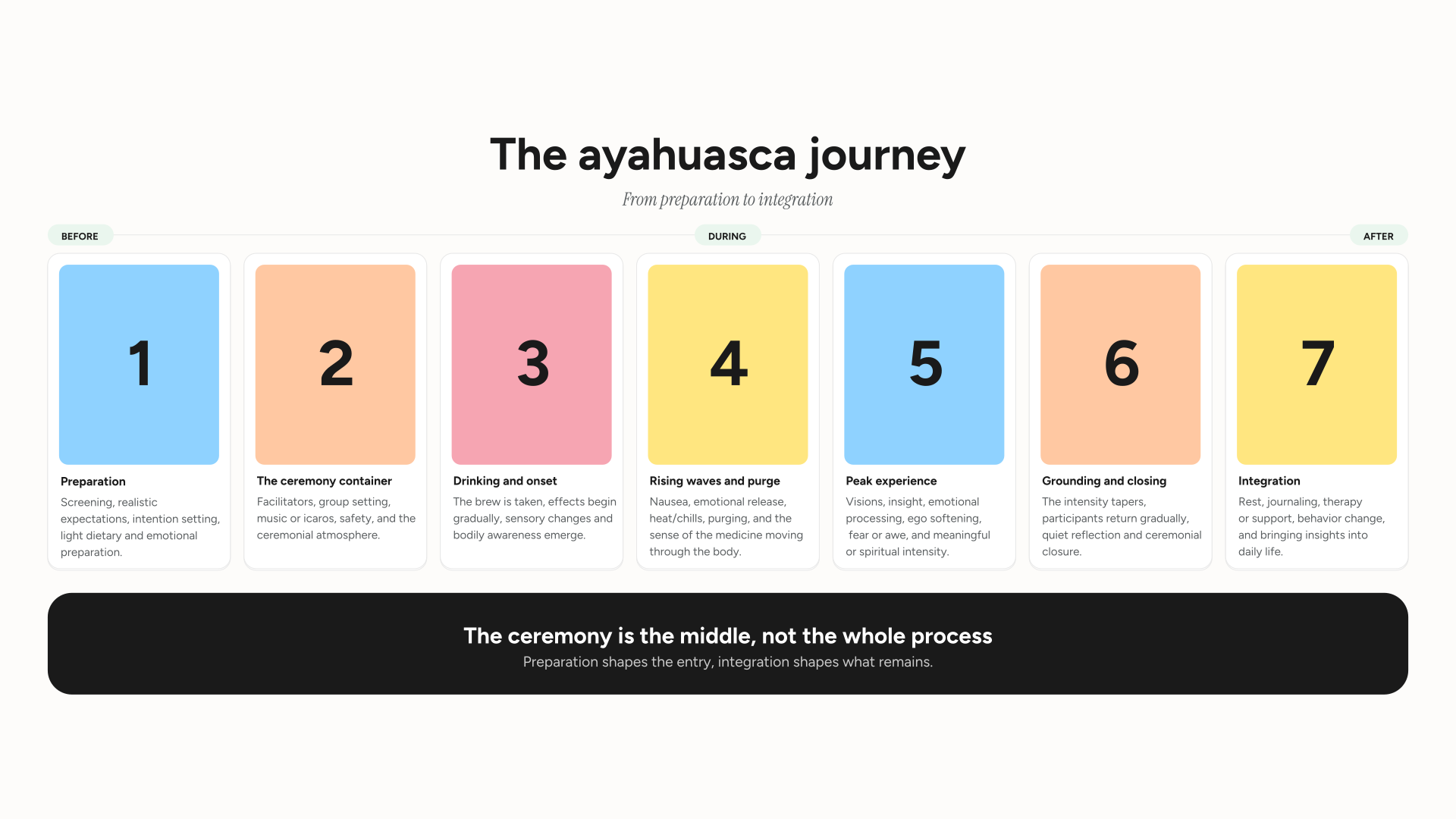
Preparation: before the ceremony begins
In many Amazonian traditions, shamanic apprenticeship may involve months or years of isolation, survival on basic sustenance, sexual abstinence, and regular, disciplined communing with plant-teachers.
While inspired by this dieta process, preparation for a modern participant is usually much less intensive. It may involve dietary restrictions, avoiding alcohol and recreational substances, reducing stimulation, abstaining from sex, resting, reflecting, and following medication or supplement guidance. Any change to prescribed medication should be handled with a qualified medical professional rather than be a facilitator’s guesswork.
Intention setting
Reflection on intentions before the ceremony is well-recommended dot-connecting before Mama Aya lays out your whole psychological and spiritual architecture in front of you.
This inner inquiry can bring forth queries that might help give the journey a direction to gather around and open it up to receiving truly pertinent and personally meaningful wisdom.
Participants should approach the experience without expectations of a particular vision, breakthrough, or outcome. Respect, curiosity, honesty, humility, and openness go much further than attempts to script the journey.
Remember: ayahuasca amplifies what’s present. If someone comes in rushed, distracted, underprepared, or hiding important medical information, the ceremony can become much harder than it needs to be.
How a ceremony unfolds
The effects of ayahuasca usually come in waves rather than one smooth climb.
After drinking, there may be a quiet waiting period. Some people notice the first effects within 20-40 minutes; for others it may take longer. Common early signs are: a change in body temperature, a shift in awareness, heightened alertness, a strange heaviness, tingling, nausea, or the unmistakable feeling that something has started moving inside.
Then the sensory world begins to change. Spatial proportions may seem different, sounds more textured, and the body unusually present. Closed-eye colors, patterns, scenes, or memories may begin to arise. Thought can slow, accelerate, or move in symbolic loops. Time may feel dilated or lose meaning altogether.
The purge may follow suit. It can come in one or more forms: visceral vomiting, aggressive diarrhea, shaking, sweating, crying, yawning, burping, or other variants of bodily and emotional release. In many Amazonian traditions, purging isn’t considered an unfortunate side effect, but part of the cleansing: the medicine moves through the body, finds what needs to be released, and expels it.
After one surge, everything may briefly soften, only for another wave to build. Each flow and ebb might feel grander and may carry more intricate and intense visions, memories, fear, grief, beauty, confusion, insight, or stillness. The person may feel guided, challenged, loved, stripped bare, or asked to surrender.
At the peak, the experience can, but doesn’t have to, become immensely — even overwhelmingly — visionary or emotional. People may see geometric patterns, animals, jungle imagery, ancestors, spirits, scenes from childhood, symbolic stories, or entire dreamlike worlds. Others may see little but feel everything: fear, sadness, love, regret, awe, relief, moving through the body in powerful surges.
Eventually, the intensity begins to settle. The visions become softer. The body relaxes. The room comes back into focus. People may feel quiet, tender, exhausted, grateful, shaken, peaceful, or unsure of what just happened. This landing phase is relatively quick but not disorienting — it can feel like returning from a long journey with sand still on your feet. You are back in the room, but part of you may still be listening somewhere else.
The main effects often last around four to six hours, but this depends on the brew, dose, digestion, and individual sensitivity. The full ceremonial process can take much longer, beginning in the evening and continuing until early morning.
In certain traditions, the ceremony closes with further songs, prayer, tobacco work, or individual cleansing.
Even after the acute effects fade, many people continue to feel altered the next day. This can be pleasant, like an afterglow: clear, soft, open, grateful, and connected, but it can also feel heavy or tender. The body may be exhausted, the mind may feel hollow. Emotions may still be close to the surface.
Effects of ayahuasca on the mind
The psychological effects can be breathtaking, humbling, loving, strange, confusing, reaffirming, or terrifying — sometimes all in one night.
Some people interpret the experience spiritually, as guidance from Mother Ayahuasca, ancestors, plant spirits, or a divine presence. Others understand it psychologically, as memory, emotion, symbolic processing, subconscious material, and altered brain dynamics. Both perspectives can be healing.
These are some of the most notable facets of the mind’s potential expansion under the effects of aya:
- Visions and mystical states: Experiences may range from colors, patterns, memories, and symbolic worlds to feelings of unity, timelessness, sacredness, or contact with something greater. The ordinary sense of self may soften, which can feel liberating or frightening. Strong visuals are not essential; some of the most meaningful experiences unfold through bodily sensation, emotion, or quiet realization.
- Releasing suppressed material: Ayahuasca may bring grief, fear, anger, shame, love, and unresolved memories to the surface through crying, shaking, laughter, or other forms of catharsis. Research on bereaved participants has linked later improvements with reduced experiential avoidance and greater decentering — the ability to witness thoughts and emotions without being consumed by them.
- Self-reflection and embodied insight: Participants often report seeing recurring patterns, relationship dynamics, unresolved wounds, and the behaviors built around them with unusual clarity. Rather than merely understanding something intellectually, they may feel it as an embodied truth through memories, images, sensations, and emotion. Studies have associated ayahuasca experiences with cognitive reappraisal, non-judging, and non-reactivity.
- Loosening of rigid thought patterns: Thinking may become symbolic, nonlinear, dreamlike, or intensely associative, while time may stretch, loop, or disappear. This temporary disruption of familiar patterns may help people step back from depressive rumination, anxiety, avoidance, addiction loops, or self-criticism and consider new ways of responding. It can also produce frightening thought loops, during which meaningful music or an icaro may provide a sanity anchor point.
- Mood, meaning, and lasting change: Fear, awe, grief, gratitude, bliss, confusion, tenderness, humility, and many other emotions we’d never even felt before may all move in waves through a ceremony. Immersion into mystical states and the feelings of profound unity and meaning may contribute to the improvements in mood, self-efficacy, and psychological flexibility reported by many participants post ceremony. However, all of this can also be overwhelming and unstable, so the most vital part is how the experience is supported and integrated afterward.
A word on challenging experiences
Like other psychedelics, ayahuasca can also bring on panic, paranoia-like thoughts, disorientation, fear of dying, fear of going insane, overwhelming grief, traumatic memories, shame, confusion, or the sense of being trapped in the experience.
A difficult ceremony isn’t necessarily a harmful one. Many people later find meaning in experiences that felt unbearable at the time. But difficulty alone isn’t medicine, and distress should never be romanticized or dismissed as “just the medicine.”
The Global Ayahuasca Survey found that psychological challenges after ayahuasca were common, although many respondents later interpreted their hardest ceremonies as the most positively impactful ones.
The medicine can take people into their most vulnerable places. The container has to be worthy of that vulnerability. Every ceremony participant needs to be safe, feel cared for, and have integration support available to make sense of what happened.
Effects of ayahuasca on the body
Ayahuasca isn’t only mental or visionary. Before any imagery appears, you may already feel the brew moving through the stomach, chest, throat, limbs, breath, heartbeat, and even sweat.
Acute physical effects are very common — especially nausea and vomiting, but also headaches and abdominal pains and discomfort.
While these effects are usually transient and not harmful to healthy individuals, ayahuasca’s chemistry makes it more risky than most other psychedelics, so proper screening and competent on-site medical support are paramount.
- Purging: The purge can take the form of vomiting, diarrhea, cramps, sweating, shaking, burping, yawning, crying, or other releases. Ceremonially, it’s often understood as the expulsion of toxins, heavy energy, fear, grief, illness, or blockage. Medically, repeated vomiting and diarrhea can still cause dehydration, weakness, dizziness, aspiration risk, or electrolyte imbalance.
- Heart rate and blood pressure: Ayahuasca can temporarily raise both. These changes are typically temporary in screened, medically healthy participants, but may be dangerous for people with cardiovascular disease, uncontrolled hypertension, arrhythmias, a history of stroke, or on certain medications.
- Temperature changes and trembling: People may feel hot, cold, sweaty, chilled, flushed, feverish, shaky, or as though waves of heat are moving through the body. These sensations may be interpreted ceremonially as energy or emotion moving, while physiologically they may reflect autonomic activation, stress response, nausea, and altered perception.
- Heightened sensitivity: Light, sound, touch, and atmosphere can feel unusually sharp and intense. Sounds may become layered or emotionally charged, and bright light or chaotic movement can feel overwhelming. This is in part why ceremony spaces are usually dark, quiet, and carefully held.
- Motor impairment: The body may feel heavy, weak, wobbly, tense, or unfamiliar. Standing can be disorienting, especially when someone is nauseous or dehydrated. Some people clench the jaw, curl into certain postures, or feel pressure in the chest, throat, belly, or back. Participants should not drive, wander alone, leave the protected space, or approach water while impaired.
Post-ceremony physiological recalibration
After all it’s been through, the body may feel deeply worn out. Some people sleep beautifully, while others barely sleep at all. Appetite may be low the next morning, or the body may crave simple, grounding food. Some feel light and clean, while others feel sore, tender, heavy, or emptied out.
The following day should not be overpacked. Even a beautiful experience may have involved hours of nausea, fluid loss, emotional release, physical strain, altered perception, and little sleep.
Rest after ceremony is integral to integration.
Integration
Receiving transformative insight is the starting point, but the post-ceremony days and weeks are when the real work begins.
Some people awake feeling reborn, forgiven, cleansed, or newly connected to life. Others wake up confused, emotional, raw, or physically drained. Some receive clear messages during the ceremony; others understand the experience gradually through dreams, conversation, journaling, therapy, meditation, or changes in daily behavior.
Integration means learning how to live what was seen, felt, or released.

Risks and Contraindications
It’s likely self-evident by now that ayahuasca isn’t subtle like most other herbal medicines.
While long-term effects of ayahuasca and serious medical emergencies appear to be uncommon in properly screened and supported settings (and the reported ones have mostly stemmed from drug interactions or pre-existing conditions), it’s still a powerful MAO-A-inhibiting psychedelic brew capable of affecting the body, mind, and nervous system in profound ways.
We’ve already covered many of the likely negative effects of ayahuasca (a good portion of which are actually simply “effects” or even benefits in Indigenous perspectives), so here we’ll focus more on the potential complications that could result from the physiological changes precipitated by ayahuasca and its chemical clashes with certain pharmaceuticals.
Physical risks
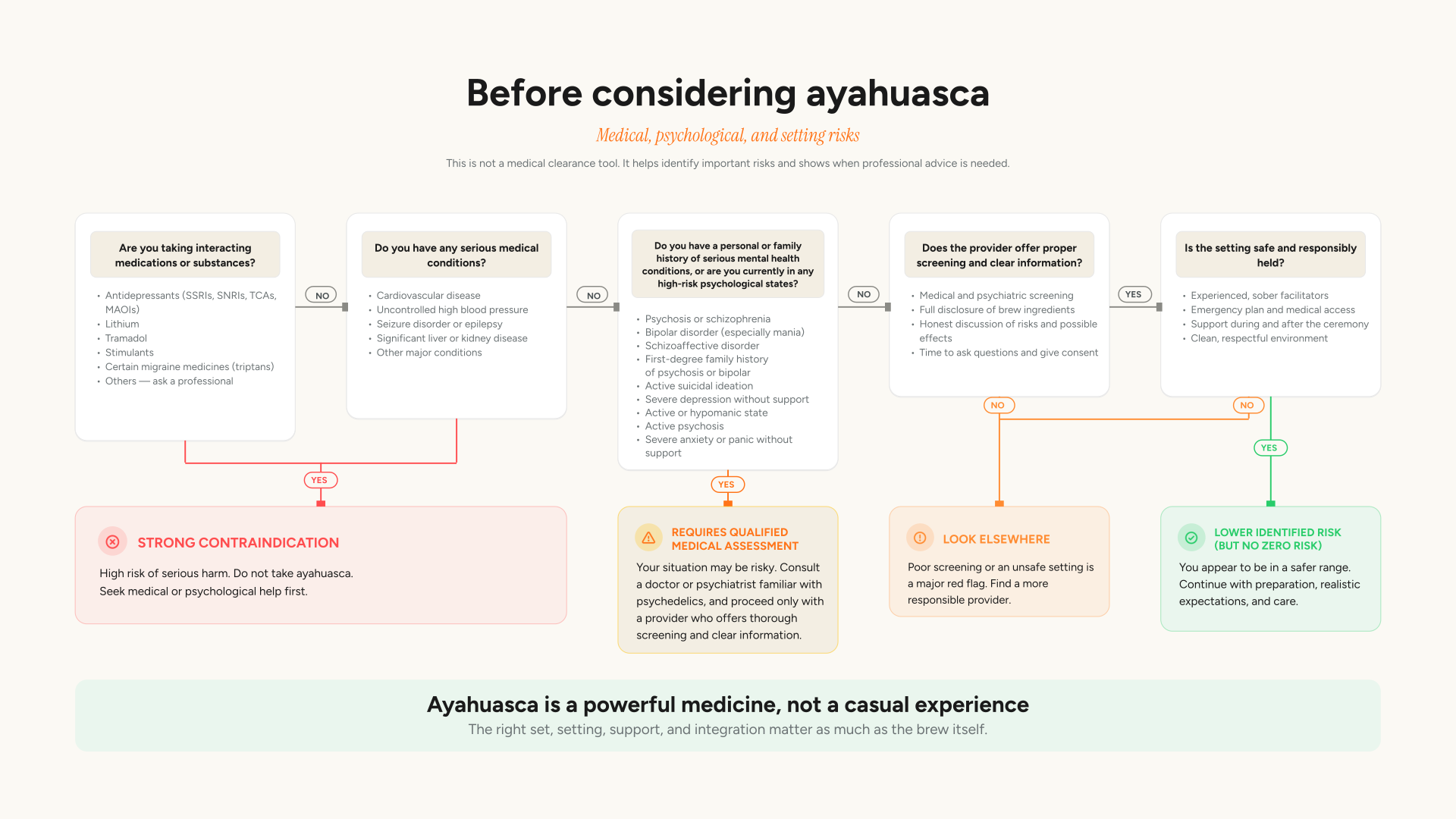
As we’ve already mentioned, ayahuasca can raise the heart rate and blood pressure and may produce chest pressure, trembling, and dizziness. For someone with cardiovascular disease, uncontrolled hypertension, arrhythmias, a history of stroke, or a serious heart condition, these effects may be dangerous.
Other risks include fainting, falls, aspiration during vomiting, overheating, dehydration, breathing difficulties, and rare seizure-like events. Seizure disorders and significant liver, kidney, respiratory, or cardiovascular conditions require individualized medical assessment and commonly lead responsible retreats or studies to exclude a participant.
Mental health contraindications
Ayahuasca doesn’t appear to commonly cause lasting psychiatric problems in carefully screened and supported participants, but it can trigger or worsen mania, psychosis, dissociation, suicidality, or prolonged distress in vulnerable people.
People with a personal or family history of schizophrenia-spectrum illness, psychotic depression, bipolar mania, or other psychotic disorders should generally avoid ayahuasca outside highly specialized research or medical contexts. In these cases, the concern that ayahuasca causes mental health problems by amplifying acute instability is very real.
Medication and substance interactions
The harmala alkaloids in ayahuasca act as reversible MAO-A inhibitors and can interact with substances affecting serotonin, norepinephrine, dopamine, blood pressure, or monoamine metabolism.
Particular concern surrounds SSRIs, SNRIs, pharmaceutical MAOIs, lithium, tramadol, MDMA, cocaine, amphetamines, methamphetamine, and other stimulants or strongly serotonergic substances.
Serotonin syndrome has long been treated as a rare risk when ayahuasca is combined with serotonergic drugs. A recent adverse-events review found no clear confirmed case in the scientific literature, but that shouldn’t be read as permission to mix them; the theoretical pharmacological concern is serious enough to avoid it.
No one should abruptly stop psychiatric medication in order to attend a ceremony. Withdrawal, relapse, and mood destabilization may be dangerous in their own right. Medication changes require a qualified medical professional who understands both the prescription and the proposed psychedelic exposure.
Tyramine interactions
Heavy consumption of tyramine-rich foods and drinks such as aged cheeses, cured meats, fermented products, old, overripe, or even slightly spoiled foods, as well as alcohol (especially red wine and craft beer), and cocoa could theoretically contribute to blood pressure issues when combined with MAO-A inhibition.
The odd-mixtures
Another serious risk is not knowing what is actually in the cup.
Traditional brews may include many lineage-specific admixtures, most of which aren’t inherently harmful in skilled hands. Others, such as toé, Brugmansia, or Angel’s trumpet can produce delirium, amnesia, dangerous behavior, cardiac complications, and potentially fatal poisoning.
A trustworthy provider should be able to explain what plants are in the brew, who prepared it, where it came from, whether unusual admixtures are included, and how its strength is understood. If they cannot or will not answer, skip the ceremony.
When to seek medical help
Most expected effects resolve as the ceremony winds down. However, chest pain, loss of consciousness, seizures, severe overheating, difficulty breathing, stroke-like symptoms, extreme or persistent agitation, dangerously high blood pressure, or severe confusion that doesn’t resolve should be treated as medical red flags.
A serious ceremony or retreat needs a clear emergency plan and the readiness to use it.
Dosage
Traditional ayahuasca is a handmade plant preparation whose strength can vary drastically from one batch to another. The amount of DMT, harmine, harmaline, THH, and other compounds depends on the vine and admixtures used, plant age and storage, brewing ratio, cooking time, degree of reduction, serving size, and individual metabolism.
Published studies can show what researchers administered under controlled conditions but they can’t turn a cup of unknown ceremonial brew into a standardized dose.
Why precise dosing is so difficult
B. caapi is a single botanical species, but it’s far from a chemically uniform ingredient. Amazonian practitioners also distinguish many named ethnovarieties associated with different qualities and used for different purposes.
A chemical study of B. caapi and ayahuasca samples found wide variation in harmine, harmaline, THH, and DMT concentrations. A second analysis of 102 traditional and analog brews likewise found substantial differences across Indigenous, religious, and neo-shamanic settings.
A brew simmered gently and left relatively thin is likely to be less potent than a brew boiled down into a dense, bitter concentrate. Santo Daime, Shipibo retreats, Colombian yagé ceremonies, private mestizo healing sessions, and neo-shamanic gatherings in Europe all have different brewing methods and often use different varieties of ingredients.
Traditional ceremonial dosing
In ceremony, a shaman, curandero, vegetalista, church server, or facilitator usually determines the amount. They may consider the brew’s known strength, a participant’s experience, sensitivity, health, emotional state, and response to the first serving. Some ceremonies involve one cup; others offer additional servings later.
That’s part of why ayahuasca is “served” rather than simply “taken” — the serving is part of the relationship. That said, being served a cup doesn’t automatically make it safe; trust toward a facilitator should be based on how carefully they screen participants, whether they know the brew’s origin, ingredients, tradition, and strength, understand medical and psychiatric contraindications, and are ready to withhold or reduce a serving when needed.
Research-reported doses
Controlled human pharmacology studies have administered encapsulated freeze-dried ayahuasca equivalent to 0.6 and 0.85 mg of DMT per kg of body weight to screened volunteers with prior psychedelic experience.
Those figures are research context, not a public dosing recommendation.

The most important conversations shaping the future of psychedelics, delivered weekly.
From thought-provoking podcasts and original stories to research breakthroughs and industry news, stay connected to the conversations that matter.
Joined by 12,000+ readers
Community Stories
Research describes patterns across groups, but personal stories show what change can feel like inside a life. These accounts are not clinical evidence and cannot predict what ayahuasca will do for anyone else. They can, however, put human language around themes that appear throughout this guide: perspective, release, hope, and the longer work of integration.
For Mags Tanev, a writer, integration coach, long-time ceremony participant, and yagé retreat facilitator, ayahuasca functions less like a source of outside answers than an inner compass.
“Ayahuasca is like a North Star. It brings me back to what’s important in my life.”
Some of her most significant ceremonies, she says, have reminded her of her own strength and reconnected her with wisdom she already carried. In that sense, the medicine’s role was not to impart information onto her, but to help her tune in to her own truth more clearly.
The emotional and energetic release accompanying the purge has been another central part of that relationship.
“There’s something powerful about letting go of what you’re carrying that is no longer serving you. Whether it’s old emotions, habitual patterns, limiting beliefs, or simply something that you feel needs to be released, the act of purging can feel deeply cathartic. For me, it’s often less about what is leaving and more about what becomes possible afterward.”
Tanev describes coming away from ceremonies lighter, clearer, and more aligned, with a sense of space where old emotions, habitual patterns, or limiting beliefs had been weighing her down.
Some of the most touching public accounts come from military veterans. Heroic Hearts Project is a nonprofit that provides veterans and military families with screening, preparation, psychedelic retreat programs, integration, and continuing community support. HHP’s current international programs primarily use ayahuasca and they have served over 1,500 veterans and veteran spouses so far.
Phil, a former U.S. Army Special Operations soldier, sought an HHP-supported retreat after years of depression, anxiety, post-traumatic stress, and difficulty finding a sustainable path forward.
“For the first time in my life, I felt hope. I am a better father, a more present husband, and an honest beacon of peace.”
Josh, a U.S. Navy Special Operations veteran, described his retreat in similarly powerful terms:
“The experience changed my life. It’s like doing 10 years of therapy in one week. I feel like all of my trauma and rage and whatever I had deeply rooted in my body were washed away.”
His full story reveals the tenets central to any breakthrough: he had to let go of expectations, face his own role in his suffering, and keep working with what followed.
Stories like these portray why some people experience ayahuasca as the beginning of a different relationship with themselves, their families, and the life still ahead.
Facilitator Stories
Preparing people for the experience, holding space in ceremonies, responding to distress, and helping participants make sense of what happened lets facilitators in on patterns that symptom scales from scientific surveys don’t always reveal.
Drawing on her experience as a ceremony facilitator, Mags Tanev emphasizes that ayahuasca isn’t “a pill that you take and then passively receive the healing benefits from,” and treating it like a pharmaceutical product misses the reciprocal nature of the work.
“The Indigenous people will say — and I would agree with them — that this is a consciousness that we enter into a relationship with, and that relationship needs to be reciprocal.”
For Tanev, one of the clearest ways to reciprocate is to follow through on what ceremony reveals.“One of the biggest ways that we can show up and give back to the medicine is to do the homework that we receive during the ceremonies, which is the integration work.”
She has supported people who needed to “confront, process, and release traumas and stories that they’ve lived with — oftentimes from childhood — that have stayed with them and manifested as physical symptoms, mental illness, depression, anxiety, PTSD, and other challenges.” Then there are others who aren’t trying to heal one identifiable wound but just want to treat themselves more kindly, relate to others more honestly, pursue what gives their lives meaning, or understand what comes next.
Mags views ceremony as a possible pathway to betterment. Someone struggling with addiction may glimpse how to address the pain beneath the behavior. Someone carrying suppressed pain may finally face or release part of it. Someone who feels directionless may reconnect with a truth they had stopped hearing. Then, they have to build a life around that understanding.
Julian Palmer, an ethnobotanical author, psychedelic researcher, seasoned entheogenic guide, and creator of changa and various techniques of psychic self-defense against malefic entities, describes the most significant change he witnessed over more than two decades of facilitation as spiritual rather than easily clinical.
“The plants are really tools for doing the inner work. Overall, the spiritual shift is the biggest one, and more difficult to track.”
Palmer describes psychedelic plants as “agents of encouragement”: tools that may help people examine their problems, recognize how they contribute to their own condition, and take responsibility for the suffering they cause others. Having seen some of his ceremony participants resolve their depression and discontinue SSRI therapy, he shares:
“Depression is often just revealed as a spiritual stagnation. And so when you move spiritual energies through people, they can get a better horizon, and move energy in themselves to bring themselves out of a funk […] Overall, what I’ve witnessed in people who have had ayahuasca a dozen or two times, they are empowered to work on themselves.”
But Julian also offers an important warning. Spiritual language, repeated ceremonies, and elaborate cosmologies can become forms of spiritual bypassing when they are leveraged to avoid the actual emotional and behavioral rewiring needed.
Didier Lacaze offers another perspective, shaped by more than four decades of immersion in the cultural and ecological landscapes of Indigenous life and plant-medicine practice. Born in France, he has spent most of his 70-plus years in Peru and Ecuador, after previously having lived in India and studied ancient traditions with which he remains connected to this day.
The insights Didier has acquired about ayahuasca’s uses in the Amazon have involved becoming sensitive to concepts that don’t translate easily into Western frameworks, especially Indigenous perceptions of life, death, well-being, and illness. That sensitivity has guided the formation of intercultural health strategies of Sacha Warmi — his organization dedicated to helping Indigenous communities in the Ecuadorian Amazon revitalize traditional systems of health and education, while building dialogue between traditional healers and Western medicine.
Didier’s recently published memoir, The Life That Lives Us, recounts his lifelong search for meaning, tracing his journey through nature, grief, healing, and self-discovery, informed by his study of Indian spiritual teachings and Amazonian shamanic practice. Purchasing the book also helps support Sacha Warmi’s work.
On ayahuasca’s potential to foster well-being, Didier says that “in most cases ayahuasca may have an impact on people’s well-being,” but cautions that “how long this well-being may be lasting, is a difficult question to answer.” He quotes an Indigenous saying “One is a saint a week before and a week after taking ayahuasca.”
From his understanding, the ego never fully loosens its grip during ceremony. He therefore recommends prudence when interpreting the experience and passes along another piece of guidance from an Indigenous shaman he learned from: “After taking ayahuasca, do not think nor talk about it” as “ayahuasca is 50% truth and 75% lies.”
He continues:
“If we live in a world of illusions, as ancient Indian traditions suggest, thus, the ayahuasca experience would be part of it. So, my last recommendation would be to have intellectual humility, confessed ignorance, and critical thinking.”
As ayahuasca becomes increasingly medicalized, a purely clinical model may overlook meaning, initiation, connection, and spiritual reorientation. But spiritual framing becomes equally incomplete when it dismisses mental health risk, encourages grandiosity, or interprets every difficult outcome as sacred instruction.
In different language, Tanev, Palmer, and Lacaze all reinforce the same point we’ve been doubling down on throughout this guide: the medicine may offer perspective, encouragement, and insight, but the participant remains responsible for what happens next, and for staying honest about what any of it actually means.


Ethical Guidelines
Ayahuasca globalization has created a strange situation: people around the world now seek healing from a medicine whose cultural roots they may barely understand.
As the brew spreads beyond the Amazon, the central ethical questions are how the medicine is represented, who benefits, and whether Indigenous knowledge is respected or simply repackaged for global consumption.
Cultural humility means recognizing that icaros, tobacco, dieta, plant spirits, and shamanic diagnosis are not decorative additions to a psychedelic experience, but parts of living and complex worldviews.
Reciprocity means supporting organisations that compensate Indigenous healers and local staff fairly, credit knowledge holders, contribute to Indigenous-led projects and conservation, and avoid extracting traditions, labor, and wisdom without accountability. It also extends to integration: gratitude is expressed not only through money, but through how someone lives after the ceremony.
Sustainability has emerged as a concern as global demand increases pressure on B. caapi, chacruna, chaliponga, and other ceremonial plants. Ethical sourcing means asking whether plants are cultivated or wild-harvested, whether harvesting is regenerative, and whether local communities benefit. A medicine that teaches connection to nature should not be obtained in a way that harms the forest.
Ayahuasca Legal Status
Ayahuasca law is complicated because the brew is as much of a sacred medicine to Indigenous communities and Brazilian churches as it is a DMT-containing substance to drug-regulating institutions.
So here’s a general summary of the laws: DMT is illegal across much of the world, while the plants containing it — and traditional decoctions made from them — are not typically controlled under international law. Still, national governments can prohibit or regulate the plants, brew, importation, possession, supply, religious use, retreats, or commercial facilitation.
DMT vs. the plants
DMT is listed in Schedule I of the 1971 Convention on Psychotropic Substances. The International Narcotics Control Board has nevertheless stated that DMT-containing plants and decoctions such as ayahuasca are not themselves controlled under that convention, leaving countries free to apply their own controlled-substance, medicines, customs, public-health, and religious-freedom laws.
Raw B. caapi, Psychotria viridis, Diplopterys cabrerana, Mimosa hostilis, or Acacia material are legal to possess in many places. However, the moment they’re brewed, extracted, concentrated, or served in ceremony, the legal analysis can change completely.
Where ayahuasca has some legal recognition or protection
- Brazil has the clearest dedicated national framework. CONAD Resolution No. 1 of 2010 sets out principles and procedures compatible with religious ayahuasca use, including traditions such as Santo Daime, UDV, and Barquinha.
- Peru declared the traditional knowledge and uses of ayahuasca practiced by Amazonian Indigenous communities Cultural Heritage of the Nation in 2008.
- Ecuador has no ayahuasca-specific statute, but its Constitution recognizes Indigenous ancestral knowledge, traditional medicine, and collective cultural rights, which offers meaningful support for community-based ancestral practice.
- Bolivia recognizes ancestral traditional medicine through Law No. 459, including traditional doctors, spiritual guides, and plant-based healing.
- Colombia has no simple national ayahuasca law. Yagé practice is commonly understood through Indigenous rights, traditional medicine, and the authority of recognized Indigenous organizations.
- In the United States, ayahuasca is federally illegal, but the Supreme Court’s 2006 Gonzales v. O Centro decision created a precedent by protecting UDV’s sacramental use under the Religious Freedom Restoration Act. Then, in 2009, Church of the Holy Light of the Queen v. Mukasey granted case-specific protection to an Oregon Santo Daime church and its members under defined conditions.
- Canada is similar: not broadly legal, but section 56 of the Controlled Drugs and Substances Act allows narrow exemptions when the government considers them justified for medical, scientific, or public-interest reasons. Some Santo Daime-affiliated groups have received organization-specific exemptions.
None of these recognitions extend as blanket authorization of other churches, private ceremonies, or commercial retreats.
Gray-zone and explicitly restrictive jurisdictions
Outside countries with explicit protection, outcomes often depend on whether a court treats the brew as controlled DMT and whether the case concerns personal possession, importation, supply, or a paid ceremony.
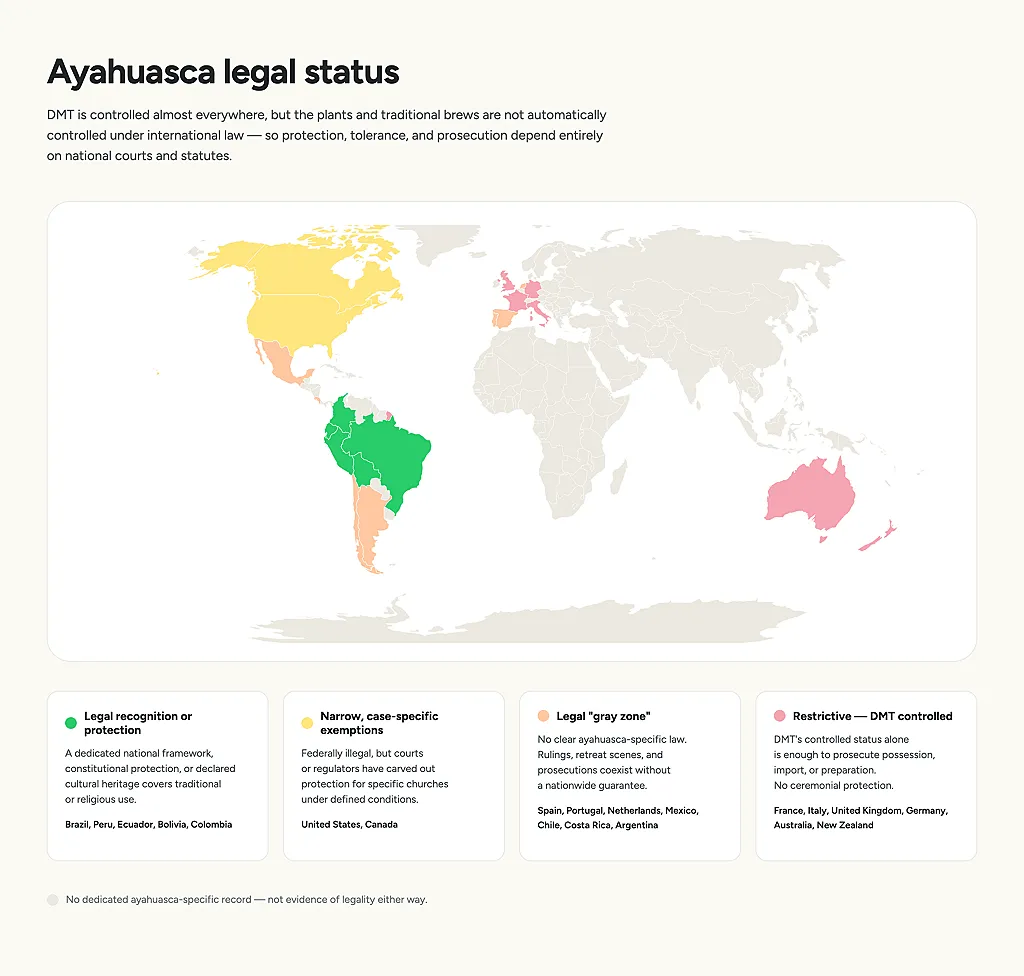
- Spain is a gray zone. A 2025 Madrid High Court ruling upheld an acquittal involving ayahuasca intended for personal use, but it didn’t establish nationwide legality or authorize commercial retreats. Other courts are free to reason differently unless Spain’s Supreme Court eventually unifies the doctrine.
- Portugal sounds like a permissive nation, with its decriminalization of the possession of small personal quantities of drugs. However, DMT is still controlled.
- The Netherlands shows how quickly protection can reverse: Santo Daime groups operated for years under religious-freedom arguments until the Dutch Supreme Court banned ayahuasca importation under the Opium Act, later upheld by the European Court of Human Rights.
- France and Italy are even more restrictive. France specifically scheduled major ayahuasca plants and harmala alkaloids, while Italy added B. caapi, P. viridis, ayahuasca preparations, harmine, and harmaline to Table I in 2022.
- In the United Kingdom, Germany, and several other European countries, DMT’s controlled status alone can secure someone a prosecution for ayahuasca importation, possession, and preparation, even when the plants themselves aren’t individually named. Neither the UK framework nor the German framework offers ceremonial protection.
- Australia and New Zealand are strongly restrictive. Australia treats DMT as a Schedule 9 prohibited substance, while New Zealand classifies it as a Class A controlled drug.
- Mexico, Chile, Costa Rica, and Argentina have active ceremony or retreat scenes but no simple nationwide guarantee. Past acquittals and open advertising coexist with customs seizures and prosecutions. Costa Rica’s drug law contains no ayahuasca exemption, while Argentina has seen plenty of legal action particularly around supply and paid ceremonies.
Availability, safety, and borders
Ayahuasca is available through Indigenous and mestizo ceremonies, Brazilian ayahuasca religions, retreat centers, traveling facilitators, underground groups, and research programs. But availability isn’t legality, and legality isn’t safety — a ceremony can be legal and poorly held, underground and carefully facilitated, or legal and still experimental.
It goes without saying but it’s still worth saying: never carry ayahuasca, DMT or harmala extracts, prepared brews, or plant ingredients across a border without verified authorization. Protections tied to one Indigenous group, religious organization, research protocol, city, state, or country don’t travel well.
The safest approach is to verify the law where the ceremony actually takes place and treat advertisements as marketing rather than legal advice.
The Cultural and Scientific Future of Ayahuasca
Ayahuasca research is more active than ever, inquiring into its potential for depression, anxiety, substance use, grief, trauma, personality, neuroplasticity, pharmacology, and long-term well-being.
The science is still nowhere near as mature as the public conversation sometimes suggests, though. Ayahuasca has not become a standardized medical treatment, and much of the real-world evidence still comes from ceremonies and retreats where the brew is only one element of a larger healing environment.
A very encouraging recent systematic review of 18 prospective studies outlined long-term population-level changes in well-being, quality of life, depression, substance misuse, cognitive flexibility, personality, and prosocial behavior. But it also found the usual limitations: small samples, nonrandomized designs, unstandardized dosing, few control groups, and subsets of participants reporting persistent psychiatric complications.
The field is promising, but it’s also young.
What researchers still don’t know
The unresolved questions are the ones that will determine whether ayahuasca can ever enter formal mental health care responsibly:
- What dose and alkaloid profile are most appropriate?
- How many sessions, if any, are useful?
- Who is likely to receive healing, and who is more likely to destabilize?
- What preparation, psychotherapy, music, facilitation, and integration are actually necessary?
- How durable are benefits, and what are the long-term risks?
- How does ayahuasca compare with established psychotherapy, medication, and other psychedelic treatments?
There’s also no settled answer to how much benefit comes from the compounds and how much comes from ceremony: the purge, music, facilitator, group, expectation, mystical experience, and willingness to face what has been avoided. The honest answer may be that all of them matter, in different proportions for different people.
Standardization and novel De(MT)livery systems
If ayahuasca therapy is ever to become a reality, it will need protocols, which raises a complex question: what exactly should be standardized? A clinic can standardize dose, screening, and follow-up, but traditional ayahuasca is built from so many elements that are integral to how the medicine is understood to work.
The clinical world wants precision, the ceremonial world works with complexity, and responsible medicalization mustn’t force one to erase the other.
That tension is pushing research toward measured compounds that could solve concrete clinical problems like unpredictable potency, long session duration, and the difficulty of fitting an overnight ceremony into a modern healthcare system. A scoping review of registered trials identified studies involving ayahuasca, DMT, and DMT combined with harmine.
DMT research, of course, isn’t the same as ayahuasca research. DMT is one major compound within a context that also involves harmalas, surrounding plant chemistry, and a ceremonial setting. Still, because they act more quickly and can be delivered more predictably, vaporized, intravenous, and transdermal forms of DMT appear more likely to enter psychedelic-assisted therapy before traditional ayahuasca does.
Again, none of this is the same as ceremony. A standardized formulation can measure compounds precisely, but it can’t reproduce the vine as the Master Plant it is, the purge as cleansing, or the relationship between healer, patient, icaros, and plant spirits.
Whether that trade-off is worthwhile depends on the problem being solved: predictability for a hospital, surrender for a ceremony, scalability for a pharmaceutical company, access and safety for someone with a treatment-resistant mental condition.
Culture, commercialization, and Indigenous rights
Ayahuasca’s medical future is unfolding alongside the broader psychedelic renaissance of psilocybin, MDMA, ketamine, and other compounds entering mental health care, which creates both a pathway for legitimacy and a pressure to fit ayahuasca into medical systems that may not understand its cultural origins.
Retreat culture will likely keep growing regardless of clinical approval. People looking for relief, meaning, and spiritual connection are not waiting for medical systems to catch up. That makes strong standards around screening, consent, sourcing, boundaries, emergency planning, and accountability increasingly important.
Indigenous and mestizo communities preserved and transmitted ayahuasca through colonization, missionization, criminalization, migration, and ecological pressure. As companies patent delivery systems and DMT-harmine formulations (1, 2, 3, 4), will those communities see real benefit, or just symbolic acknowledgment while outsiders profit?
A more equitable future would include Indigenous-led research, legal protection for traditional use, fair compensation, cultural education, ecological conservation, and real participation in decisions about how ayahuasca-derived knowledge is commercialized.
Where ayahuasca may be heading
The most likely future isn’t one ayahuasca world, but several continuing at once:
- Indigenous and mestizo healing traditions;
- Brazilian and international ayahuasca religions;
- commercial and nonprofit retreat centers;
- underground ceremonies;
- clinical DMT and harmine research;
- legal battles for religious and cultural protection;
- continuing ethical debates over safety, ownership, and access.
Traditional ayahuasca may never become a standardized pharmaceutical product. It’s too variable, culturally embedded, physically demanding, and context-dependent to fit easily into mainstream psychiatry.
But ayahuasca-inspired medicine will almost certainly keep developing and may reach clinics before the traditional brew does. The important thing is not to confuse the two.
The brew is the manifestation of a living Amazonian lineage; its active compounds are increasingly being appropriated by modern pharmacology.
The future of ayahuasca that’s worth pursuing is one that holds both the culture and chemistry, with honesty, humility, reciprocity, and gratitude.
FAQ
Ayahuasca may help some people with depression, but it’s not an established treatment. A small randomized trial found rapid antidepressant effects in treatment-resistant depression, while observational studies have reported longer-lasting improvements. Larger, better-controlled trials are still needed, and severe depression or suicidality requires professional care and careful screening.
Possibly, but it can also make anxiety much stronger during and after the ceremony. Some studies report reductions in anxiety-related symptoms, while the acute experience may involve panic, fear, racing thoughts, and loss of control. It’s not a guaranteed cure.
Ayahuasca doesn’t appear to produce the usual pattern of craving, compulsive daily use, or physical withdrawal. People can still become psychologically dependent on ceremonies, facilitators, spiritual identity, or the belief that the next experience will solve everything. Integration matters more than repeated drinking.
No. Ayahuasca isn’t a direct replacement for antidepressants or psychiatric care, and its harmala alkaloids may interact dangerously with many medications. No one should stop prescribed medication for ceremony without qualified medical supervision.
The most common effects are nausea, vomiting, diarrhea, dizziness, trembling, fear, confusion, and emotional overwhelm. More serious risks include dangerous medication interactions, cardiovascular complications, dehydration, accidents, mania, psychosis, traumatic destabilization, undisclosed admixtures, and facilitator misconduct.
It depends on the country, the preparation, and the context. DMT is widely controlled, while plants and traditional decoctions may be treated differently. Some countries recognize Indigenous or religious use; others prosecute ayahuasca as a DMT-containing preparation. The existence of a retreat is never proof that it’s lawful.