Psychedelics for Longevity: Can They Support Healthy Aging?

For most of human history, longevity meant one thing: living longer. Today, that definition is shifting. Researchers, clinicians, and the growing “longevity science” movement are less interested in simply adding years and more interested in adding healthy ones, disease-free years with intact memory, mobility, and a sense of purpose. That shift in emphasis, from lifespan to healthspan, is exactly where a surprising new research thread has entered the conversation: psychedelics.
Longevity & psychedelics sound like an unlikely pairing. Psychedelics have spent the last sixty years associated with counterculture, not clinical trials. But over the past two decades, institutions like Johns Hopkins, UCSF, Yale, and Imperial College London have built dedicated psychedelic research centers, and a new body of evidence is emerging that suggests compounds like psilocybin may influence some of the same biological processes involved in aging itself, such as brain plasticity, inflammation, cellular stress, and resilience.
The evidence, to be clear, is early. Much of it comes from small pilot studies, animal models, or single case reports. But the questions being asked are serious ones, and the early signals are compelling enough that even biohackers like Bryan Johnson have added psilocybin to their longevity protocols.
This guide walks through what the current research actually shows about psychedelics and healthy aging.

Why Are Psychedelics Being Studied for Longevity?
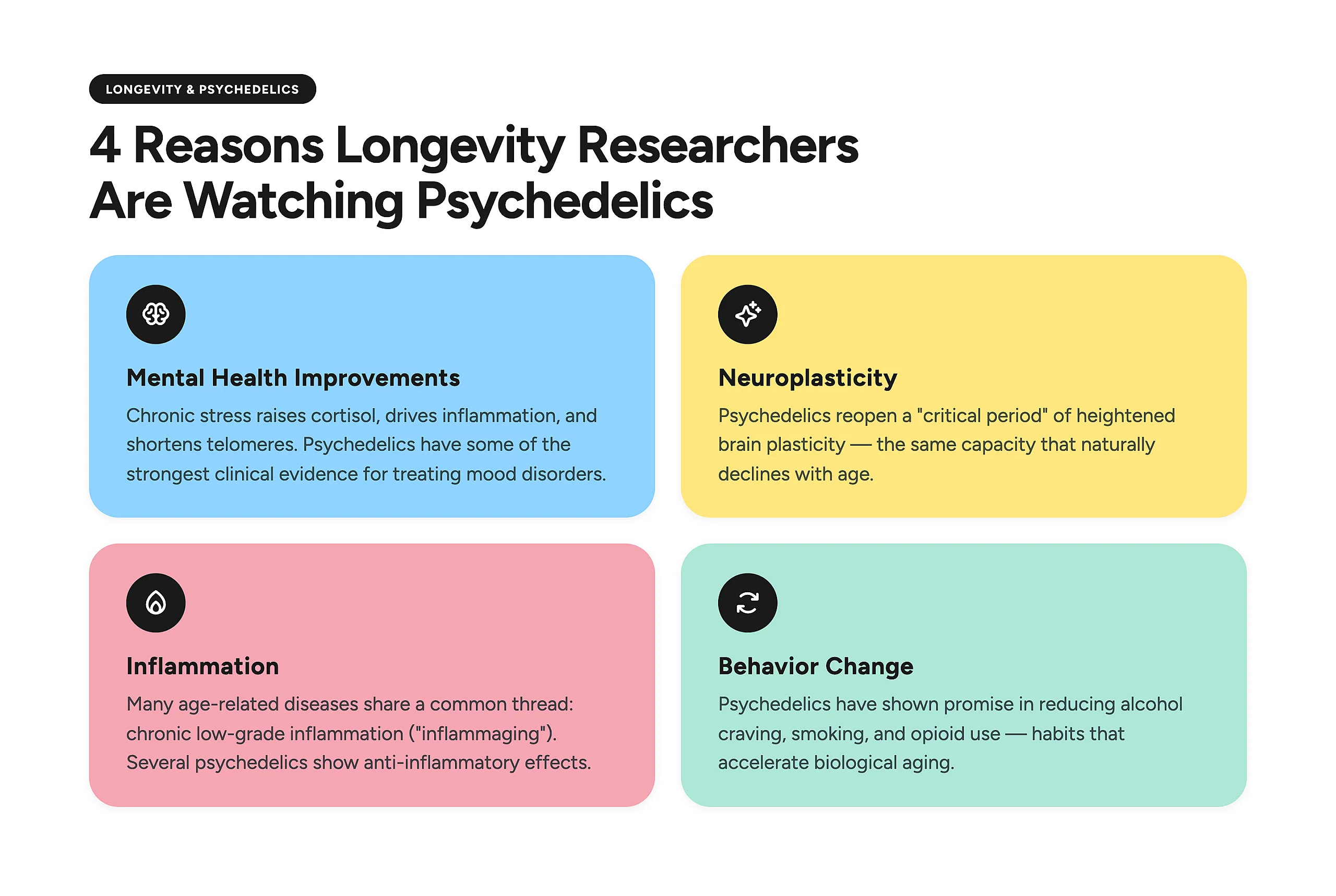
Scientists have identified several overlapping reasons why psychedelics keep showing up in longevity research, the first being mental health. Depression, chronic stress, and anxiety don’t just affect mood, they accelerate biological aging.
Chronic stress raises cortisol, drives inflammation, and is associated with shortened telomeres1, the protective caps on our chromosomes. Psychedelics currently have some of the strongest clinical evidence available for treating mood disorders, so if they can durably improve mental health, they may indirectly slow some of that biological wear and tear.
The second is neuroplasticity, the brain’s ability to rewire itself, form new connections, and recover after damage. This capacity naturally declines with age, which is part of why learning gets harder and recovery from injury gets slower as we get older. Psychedelics appear to reopen what researchers call a “critical period”2 of heightened plasticity3, essentially flipping a switch that allows the brain to rewire again.
The third compelling reason to study psychedelics for longevity is inflammation. Many age-related diseases share a common thread of chronic, low-grade inflammation4, sometimes called “inflammaging.” Early research suggests several psychedelics have anti-inflammatory effects.
Finally, psychedelics may catalyze5 positive behavior changes, even beyond mental health. Psychedelics have been used in treating alcohol6 and tobacco misuse. Resulting in refraining from smoking7, and reduced craving for alcohol6. Psychedelics, like ibogaine, have come into the headlines as a treatment for opioid addiction. To support ibogaine research, Texas passed the largest state investment in psychedelic research in U.S. history, $50 million, specifically for ibogaine trials targeting veterans and opioid use in 2026.
Putting these threads together researchers have a reasonable hypothesis, that psychedelics might contribute to healthspan and lifespan by touching multiple hallmarks of aging at once.
The Science of Aging and Where Psychedelics Might Fit In
To understand the link between aging and psychedelics, it helps to understand how scientists currently define aging. Researchers have identified twelve “hallmarks of aging,” up from nine just a decade ago, which shows how quickly this field is evolving. The twelve hallmarks of aging paper organizes the hallmarks as integrative, primary and antagonistic.
The twelve hallmarks mostly fall more broadly into three categories: cellular housekeeping failures, communication breakdown and runaway processes. Let’s break them down.

- Cellular housekeeping failures mean that your cells don’t repair and clean up like they used to. Your DNA accumulates damage it can’t fully repair, and your telomeres, the protective caps at the end of your chromosomes, think of them as the plastic tips on shoelaces, fray with each cell division until they can no longer protect the chromosome.
- The second is communication breakdown. Cells constantly signal to each other, monitoring nutrients and coordinating function. With age, those signals get garbled, a bit like a game of telephone where the message is unrecognizable by the time it reaches the last person in the room.
- The third is “runaway processes.” Some cells stop functioning properly but don’t get cleared out of the body. Scientists call these senescent cells, or “zombie,” cells. They linger, drive inflammation, and even convert healthy neighboring cells into more zombie cells. Alongside this, mitochondria, the cell’s power plants, lose efficiency.
These are the most illustrative examples, not the full list of hallmarks of aging.
In 2020, researcher Christopher Germann proposed the “psychedelic telomere hypothesis8“: that psilocybin’s mental health benefits might be inseparable from its effects on biological aging markers. The reason being that chronic stress and telomere shortening are so closely linked.
That hypothesis has since been tested directly in 2025 by researchers at Emory and Baylor published the first direct evidence that psilocybin can extend lifespan9 in cells and animals.
They found that in the lab, human lung cells treated with psilocin (the active metabolite of psilocybin) lived 30% longer at low doses and 57% longer at high doses. The researchers were able to measure hallmarks of aging and they found that in the cells, the telomeres stayed intact, they saw less DNA damage, and reduced oxidative stress. The cells also showed increased activity of SIRT1*, sometimes called a master regulator of aging.
A member of the sirtuin family of proteins, SIRT1 helps regulate DNA repair, inflammation, and cellular metabolism. Because its activity tends to decline with age, treatments that boost SIRT1 (like caloric restriction10, resveratrol11, and, per this study, psilocybin9) are of particular interest to longevity researchers.
The research team then repeated the experiment, but this time in animals rather than cells. They treated aged mice, roughly equivalent to a 60- to 65-year-old human, with monthly psilocybin dosing over ten months.
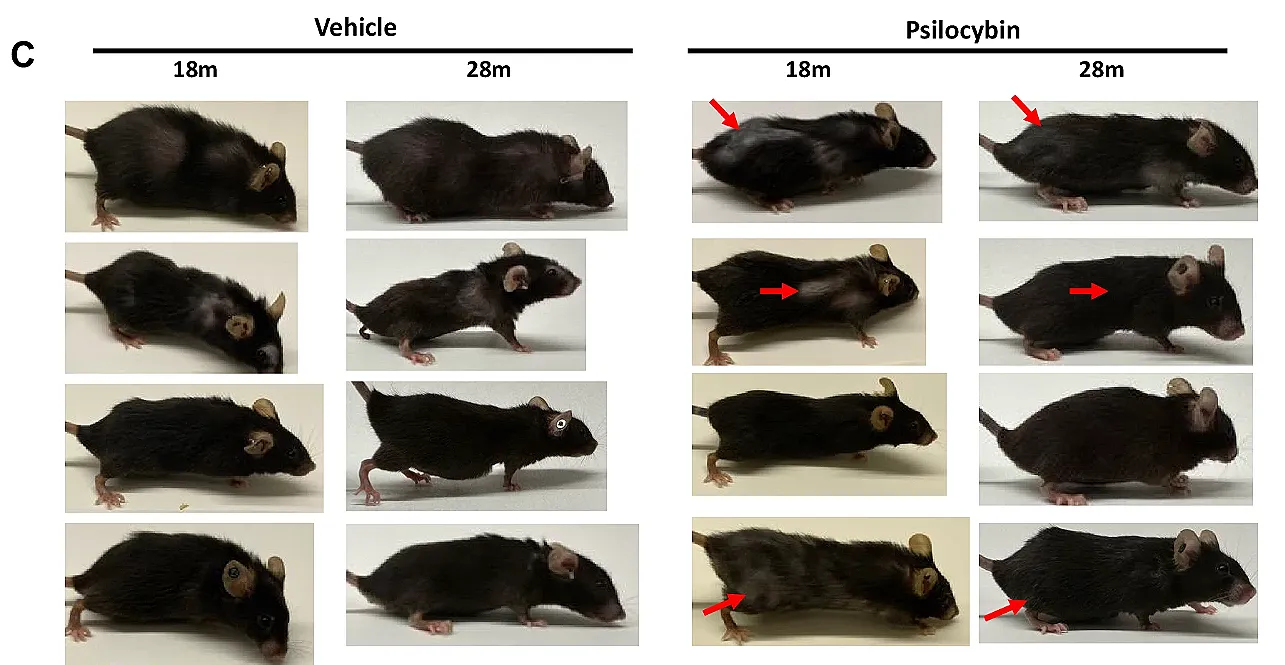
What they found is that the mice given psilocybin significantly increased survival compared to untreated mice, the mice looked younger with thicker fur and even less graying fur. This is the study that reportedly inspired Bryan Johnson’s own psilocybin protocol he started at the end of 2025.
Furthermore, at the cellular level, evidence also shows psilocybin promotes neuroplasticity by promoting dendritic growth13. Dendrites are the branch-like structures neurons use to connect, and the growth and changes promoted by psilocybin persist for weeks after a single dose.
Another study found encouraging results linking psilocybin to neuroplasticity. A citizen science project led by mycologist Paul Stamets found that adults over 55, who microdosed psilocybin, showed measurable improvements in finger-tapping speed (a standard test of motor-cognitive function) compared to those who didn’t.
Psilocybin, Alzheimer’s, and Cognitive Longevity
“Cognitive longevity” refers to preserving memory, executive function, and processing speed as we age, and it’s one of the areas generating the most public interest, partly because of a striking case report published in 2026 in Frontiers in Neuroscience14.
In the study, an 80-year-old woman with advanced Alzheimer’s disease, nonverbal, incontinent, and unable to walk independently after a decade of decline, received a single high dose (5g) of psilocybin mushrooms.
After entering a sleep-like state for 19 hours, she regained speech, recalled memories she hadn’t reported in years, and walked independently. The improvements were held for at least a month.
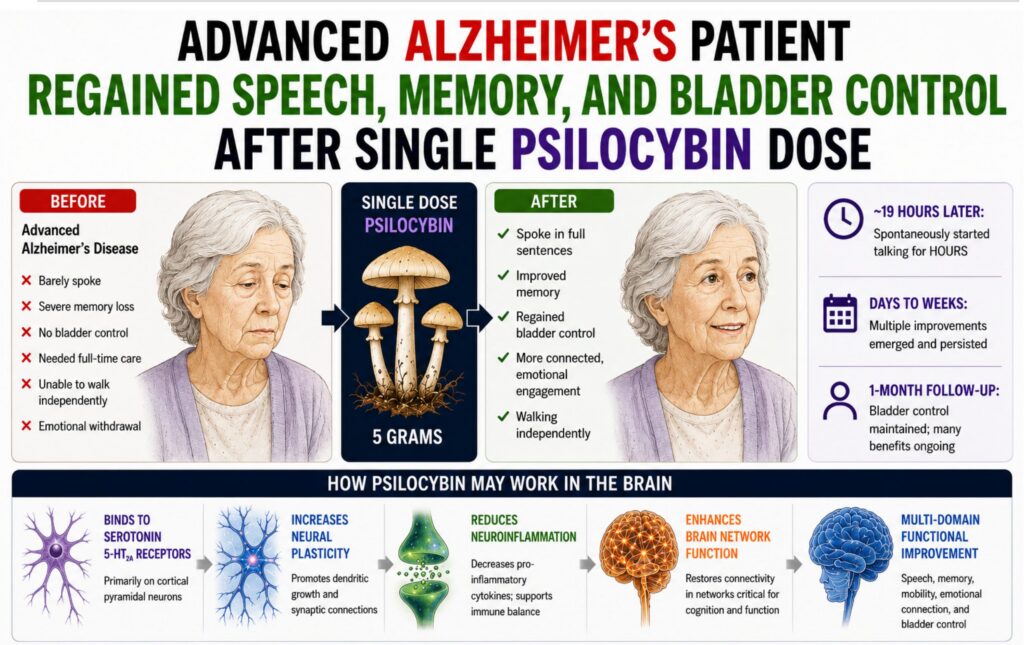
This is a single case, not a controlled trial, and it needs to be treated with caution, as we don’t yet know if or why it would generalize. But, researchers hypothesize the mechanism involves psilocybin’s activation of serotonin (5HT-2A*) receptors, which promotes neuroplasticity, reduces inflammation, and may improve communication between brain networks.
Short for serotonin 2A receptor, this is the main receptor classical psychedelics like psilocybin and LSD bind to in the brain. Activating it is believed to be what triggers the neuroplasticity and mood effects associated with these compounds.
It’s exactly the kind of early signal that tends to justify a larger trial, which is what the field is now pushing toward.
Psilocybin and Parkinson’s Disease
Parkinson’s disease affects more than 10 million people worldwide, and there is still no therapy that slows its progression. It’s classified as a movement disorder15, but depression and anxiety are actually stronger predictors of quality of life than the tremors and stiffness most people associate with it. Those mood symptoms often appear years before16 any motor symptoms do and standard antidepressants rarely help.
In 2025, a UCSF research team published a pilot study in Neuropsychopharmacology17 testing whether psilocybin could help with the mood disorders.
The pilot study tested twelve patients with mild to moderate Parkinson’s. The patients either received a low (10 mg) or high (25 mg) dose alongside structured psychotherapy. The results showed meaningful improvements in mood and cognition, as expected.
Unexpectedly and surprisingly, patients showed improvements in motor symptoms and cognitive function, with effects lasting up to three months.
Researchers suspect the mechanism involves reduced inflammation and enhanced neuroplasticity, potentially even a degree of disease modification rather than just symptom relief.
The success of this pilot study suggests that psilocybin therapy in Parkinson’s diseases warrants further investigation. The team at UCSF is now expanding the study into a 100-patient randomized controlled trial with Yale, incorporating brain imaging to better understand what’s happening mechanistically.
The most important conversations shaping the future of psychedelics, delivered weekly.
From thought-provoking podcasts and original stories to research breakthroughs and industry news, stay connected to the conversations that matter.


Joined by 12,000+ readers
Psychedelics and Stroke Recovery
Stroke is one of the leading causes of long-term disability worldwide, leaving 30% of stroke patients permanently disabled18. The weeks immediately following a stroke are the most important window for rehabilitation, while the brain is still highly plastic, but many patients don’t receive high-intensity therapy during the period following the stroke.
Researchers at Johns Hopkins and UCSF are now testing whether psychedelics can reopen a critical window of neuroplasticity, even years after a stroke occurred.
The approach pairs psilocybin with the immersive rehabilitation game, MindPod Dolphin, in which patients control a virtual dolphin using their own body movement, already shown to help rebuild motor pathways on its own.
If psychedelics can extend or reopen that plastic window, even years after the damage occurred from the stroke then, then this can mean hope for many stroke and traumatic brain injury patients.
And the implications go beyond stroke: it would suggest a way to restore the brain’s adaptability more broadly as we age.
End-of-Life Care, Existential Distress, and Emotional Longevity
Some of the oldest and most robust psychedelic research involves end-of-life care and distress about death. In 2016, Roland Griffiths at Johns Hopkins published a landmark study19 of 51 patients with terminal cancer diagnoses who were struggling with depression and existential anxiety about dying, which reinvigorated the current psychedelic research renaissance.
After a single psilocybin session with psychological support, 80% of the terminally ill cancer patients showed significant reductions19 in depression and anxiety. Many also described losing their fear of death entirely. With the results lasting up to six months later.
Two-thirds ranked the experience among the five most spiritually meaningful of their entire lives, alongside events like the birth of a child.
That study helped revive psychedelic research after decades of dormancy, and this pioneering work is being extended through a four-year, multi-site EU-funded clinical trial examining psilocybin in palliative care called PsyPal.
The trial is coordinated by UMCG in the Netherlands with 19 partner institutions across 9 countries and is testing whether psilocybin can ease psychological distress in patients with progressive, incurable illnesses, including COPD, multiple sclerosis, ALS, and advanced Parkinsonian disorders. It will eventually enroll more than 100 patients, each receiving two therapy sessions with either a therapeutic or a low (non-therapeutic) dose.
PsyPal was awarded over €6.5M in EU funding, and is the first publicly funded psychedelics trial in the EU.
This connects to the concept of emotional longevity, how psychological health shapes how well, not just how long, we age. Resilience, optimism, social connection, and a strong sense of purpose are all associated20 with better long-term health outcomes; longitudinal research has linked a strong sense of purpose to lower mortality risk over 8 years in older adults.
Psychedelics may support healthy aging not only through inflammation and neuroplasticity, but by helping people reconnect with what makes life feel worth living, a less measurable, but no less real, longevity lever.


Which Psychedelics Show the Most Promise for Longevity?
Most of the research above centers on psilocybin, and there’s a practical reason for that. Both psilocybin and MDMA received FDA “breakthrough therapy”21 designation in the mid-2010s, which made research meaningfully easier to fund and conduct. That’s why the evidence base for longevity specifically is more developed for psilocybin than for LSD, ayahuasca, DMT, or ketamine, not necessarily because those compounds are less promising, but because they’ve been studied less in this specific context.
Ketamine has more established use in other areas, particularly treatment-resistant depression and certain women’s health conditions. LSD and DMT are being actively studied for mental health applications, but longevity-specific data is still minimal.
Safety Considerations
Psychedelics are generally well tolerated, but they are not risk-free, and this is not a do-it-yourself category of intervention. Physical side effects can include nausea, elevated heart rate, and temporary dizziness or fatigue.
On the mental health side, psychedelics can surface difficult emotional material, and while a genuinely “bad trip” is less common than reputation suggests, the experience should happen in a supported setting with proper integration afterward.
Certain groups should avoid psychedelics altogether, or only proceed under close medical supervision: people with a personal or family history of psychosis or bipolar disorder, those with uncontrolled hypertension or cardiovascular disease, and anyone on medications that interact with MAO inhibitors. Older adults, the population most relevant to longevity applications, may also carry higher baseline cardiovascular risk, which makes medical screening especially important before any psychedelic use.
The Future of Psychedelic Longevity Research
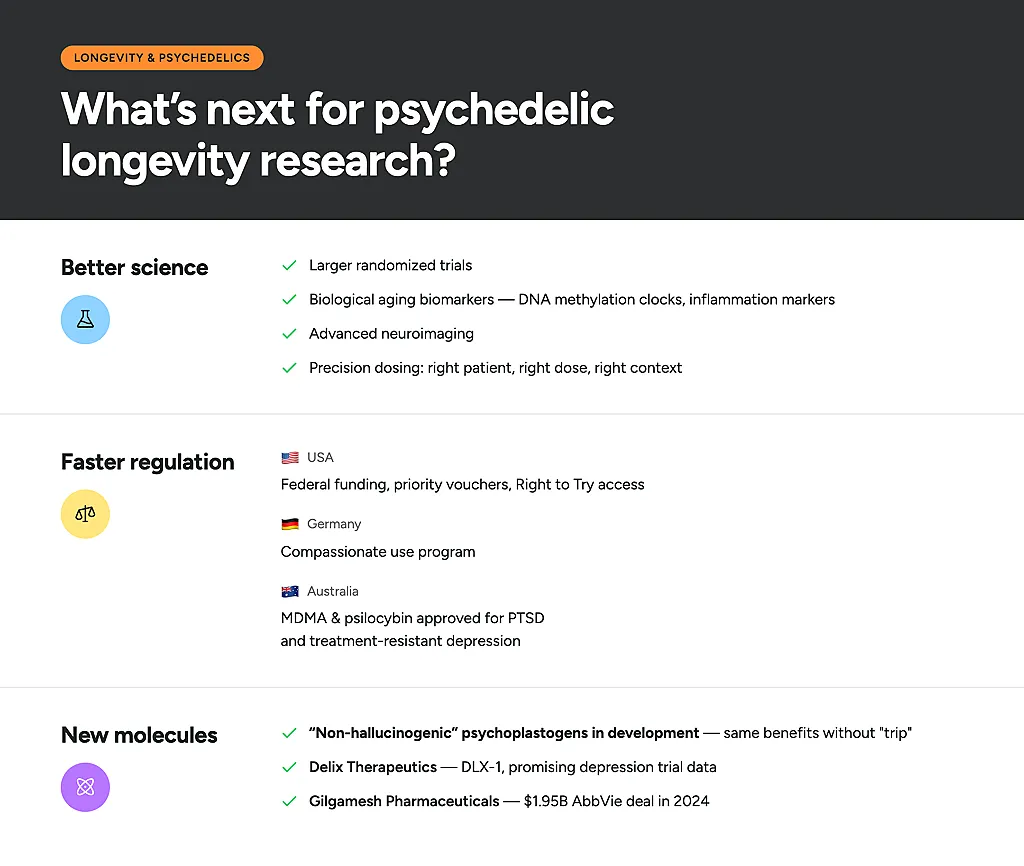
This field is moving quickly, but it’s still early. Much of the strongest evidence remains preclinical or comes from small pilot studies and single case reports. The next several years should bring larger randomized trials, better use of biomarkers like DNA methylation clocks and inflammatory markers to track biological, not just chronological, aging, and more sophisticated neuroimaging to understand exactly how these compounds affect the aging brain.
Researchers are also increasingly interested in precision approaches: identifying which patients, doses, and contexts produce the most benefit, rather than a one-size-fits-all protocol.
Regulation is also shifting faster than it has in decades. In the U.S. a recent executive order signed in 2026, covered new federal funding commitments, an initiative to provide National Priority Vouchers to psychedelic drugs that have received Breakthrough Therapy designations for treating serious mental illnesses, and also instructs the FDA and DEA to establish a pathway for eligible patients to access investigational psychedelics, including ibogaine, under the Right to Try Act22.
This executive order echoes similar moves already underway in Germany with the compassionate use program and Australia’s approval of MDMA and psilocybin for post-traumatic stress disorder and psilocybin for treatment-resistant depression.
A handful of biotech companies are also working on “non-hallucinogenic” psychedelic analogs23, molecules designed to trigger the same neuroplasticity and anti-inflammatory effects without the subjective trip, which, if successful, could make some of these mechanisms accessible without the time, cost, and supervision a full psychedelic session currently requires.
Delix Therapeutics, for instance, is developing DLX-1 (zalsupindole), a non-hallucinogenic psychoplastogen that showed rapid symptom improvement in major depressive disorder patients in late-2025 trial data without dissociative or hallucinogenic effects. Gilgamesh Pharmaceuticals, which struck a $1.95B deal with AbbVie in 2024, is pursuing a similar approach
If the current signals hold up under more rigorous testing, psychedelics could become a genuinely novel addition to the longevity toolkit. Not a replacement for exercise, sleep, and diet, but a complement that addresses the brain’s capacity to adapt, and our relationship to meaning itself.
FAQ
In cell and mouse studies, yes. Psilocybin extended lifespan significantly, up to 57% in cells and ~30% in mice. Human lifespan data doesn’t exist yet.
Psilocybin has the most research specific to aging and longevity, largely due to its breakthrough therapy designation and resulting research access.
Early evidence suggests psilocybin may influence several hallmarks of aging, including telomere preservation and cellular senescence, but this hasn’t been confirmed in humans.
Controlled studies haven’t shown statistically significant biological effects from microdosing so far; most of the promising longevity data comes from full, macro doses.
They appear to promote neuroplasticity and dendritic growth in lab and animal studies, and some human studies show cognitive benefits, particularly in older adults with Parkinson’s Disease.
Multiple studies point to anti-inflammatory effects, though the magnitude and durability in humans is still being studied.
Psychedelics are generally well tolerated, but older adults should be medically screened first, particularly for cardiovascular risk factors.
No study has shown prevention. A single case report showed dramatic improvement in an existing Alzheimer’s patient, but this needs to be replicated before any broader conclusions can be drawn.