
487 Records, 27 Countries. What PsyAccess Reveals About Psychedelic Care in Europe

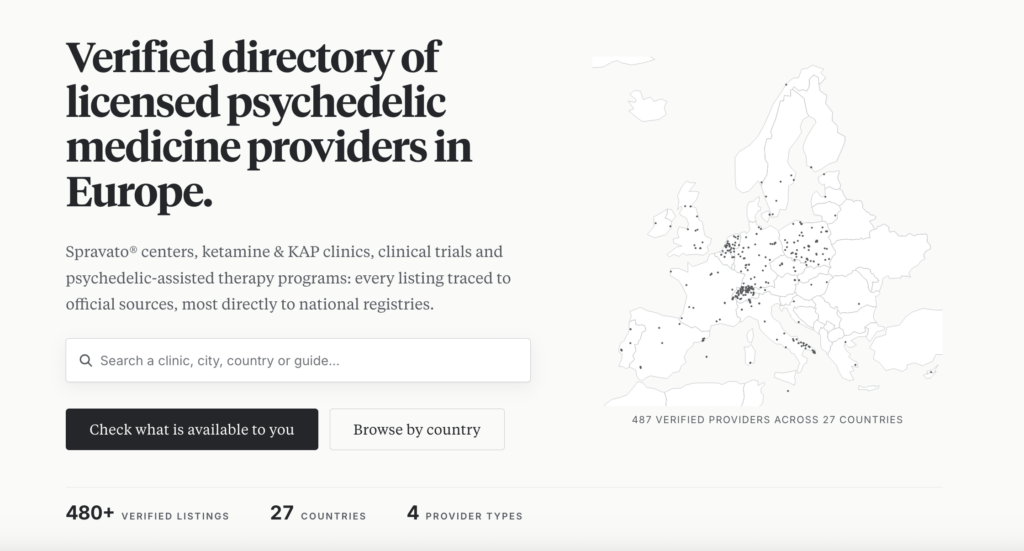
PsyAccess, a free directory of licensed psychedelic treatment in Europe, launched on September, 15. It lists 487 records across 27 countries: licensed esketamine centres, ketamine and ketamine-assisted psychotherapy clinics, clinical trial sites and providers authorised to deliver psychedelic-assisted therapy.
Every listing is traced to an official register, with the source link printed on the listing itself. Providers pay nothing to be listed, and payment has no effect on inclusion, ranking or verification.
Iurii Filatov, co-founder and CEO of Pink Elephant Group, explains how the group sees the project’s role:
“PsyAccess is the patient-facing part of how we think this field gets better: on trust, not hype. […] Anything we can’t prove, we delete rather than dress up. PsyAccess is part of Pink Elephant Group, and it earns that trust by running independently of everything else we do.”
Disclosure:
States of Mind and PsyAccess are both part of Pink Elephant Group. PsyAccess operates independently within the group. Two of the experts quoted in this piece are Pink Elephant Group executives — co-founder and CEO Iurii Filatov, and Chief Science and Innovation Officer Nataliya Vorobyeva.

Why it matters now
Access to psychedelic medicine in Europe is slowly expanding. Germany approved its first psilocybin compassionate-use programme in 2025, and a Czech law allowing medical psilocybin came into force in 2026. Yet the information patients need is spread across 27 regulatory systems in a dozen languages, and clinic marketing often sits right next to verified fact.
Clinicians who work with psychedelic medicine, in Europe and beyond, say many patients struggle long before treatment begins, when they try to find a provider they can trust.
Grischa Judanin, M.D., CEO of the German telemedicine provider 5SWAN, says:
“In my daily work, I see the same pattern: a treatment is legal and even reimbursed in Germany, yet patients cannot find a licensed provider, cannot tell approved from off-label, and end up trusting whoever answers first.”

What the map shows
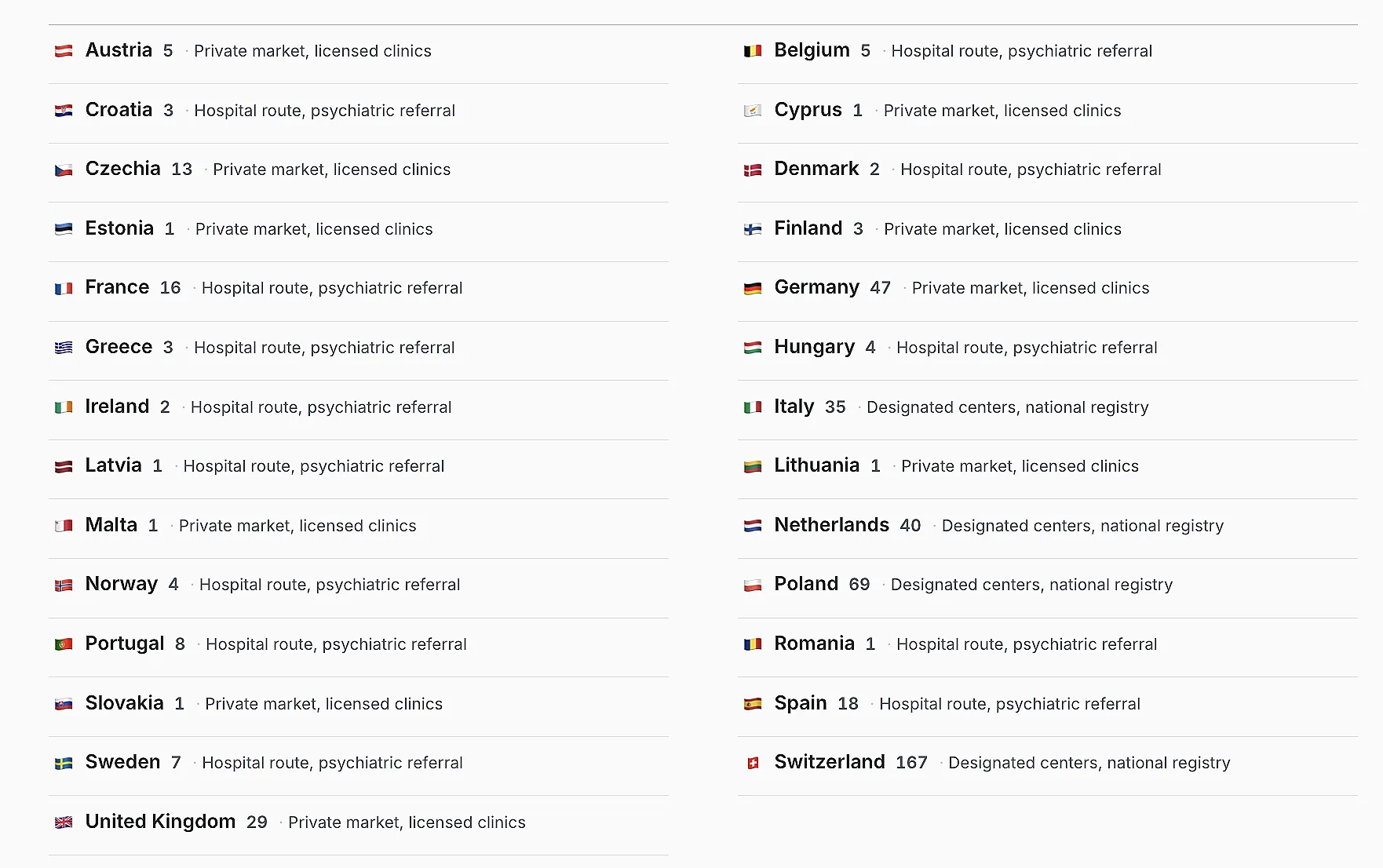
The sharpest finding concerns psychedelic-assisted therapy itself. Of the 103 providers authorised to deliver it, 101 are doctors in Switzerland, working under the country’s per-patient authorisation scheme, in which physicians apply to the Federal Office of Public Health to treat each patient individually. The remaining two are the German sites in the psilocybin compassionate-use programme approved by the federal drug regulator BfArM.
The other 25 countries in the directory have no authorised provider of psychedelic-assisted therapy in the strict sense (meaning treatment with psilocybin, LSD or MDMA). In most of Europe, these substances are currently available only through clinical trials, if at all.
Of all 487 records (as of September, 15), 358 are places where a patient can receive treatment, according to the launch data. Besides the 103 therapy providers mentioned above, these include 212 licensed esketamine (Spravato) centres and 43 ketamine or ketamine-assisted psychotherapy clinics. The remaining 129 records are clinical trial sites, where participation means joining a study under a research protocol.
Seven countries have exactly one verified provider (ketamine or esketamine centre): Cyprus, Estonia, Latvia, Lithuania, Malta, Romania and Slovakia.
In the Czech Republic, access under the new law still depends on insurers agreeing to pay. Filip Tylš, MD, PhD, psychiatrist and clinical director at Psyon Clinic, explains what this means for patients:
“Legal access in the Czech Republic does not equal reachable care, as significant practical barriers persist across legal frameworks. While off-label ketamine is increasingly accessible and partially covered by public insurance, other psychedelics lack coverage. Clinical trials offer free treatment but are constrained by strict eligibility criteria and temporary availability, whereas newly legalized medical psilocybin remains practically unavailable and cost-prohibitive until integrated into insurance schemes.”
Dr Rayyan Zafar, a neuropsychopharmacologist and UKRI Postdoctoral Fellow at Imperial College London, says:
As interest in psychedelic medicine grows, patients face an increasingly complex landscape spanning authorised treatments, off-label clinical practice and investigational therapies available only through research. Simply finding a provider online tells you very little about the regulatory status, evidence base or safeguards surrounding that care.
The most important conversations shaping the future of psychedelics, delivered weekly.
From thought-provoking podcasts and original stories to research breakthroughs and industry news, stay connected to the conversations that matter.


Joined by 12,000+ readers
When legitimate care is hard to find
When patients can’t find a licensed provider, many keep searching wherever they can. Òscar Parés, founder and CEO of the Barcelona ketamine clinic Clínica Synaptica, shares where this can lead:
“When someone is suffering and cannot find a clear path, it is very easy to end up turning to improvised options out of sheer desperation. But mental health requires a baseline standard: a coordinated team, a clear ethical framework, and a safe environment. It is not about judging anyone, but about recognizing that supporting vulnerable processes demands a structure and collective expertise that protects everyone involved.”
Dr Christopher Gauci, an anaesthetist and intensive care specialist, agrees:
“As a doctor administering ketamine treatments, patient safety and strict clinical protocols are my absolute highest priorities. Unfortunately, many patients seeking psychedelic therapy in Europe stumble into unregulated or unverified settings simply because they don’t know where else to look.”
According to Tylš, settling for unregulated care exposes people to serious physical risks, including cardiovascular decompensation, dangerous drug interactions and complications with existing physical conditions. Unguided sessions can also cause existing mental disorders to worsen severely, or even trigger a psychotic episode in vulnerable people. And without clinical containment and professional ethics, he adds, patients are at high risk of emotional exploitation and retraumatization.


Even a licensed clinic can be the wrong choice. Laura Shapiro, founder and CEO of Bassé Life Sciences, which runs an ibogaine clinic in Mexico, works outside Europe but sees the same problem:
“The biggest wrong turn I see people make is choosing a psychedelic treatment center based on its marketing rather than the quality of care behind it. A beautiful website and compelling testimonials can be appealing, but they don’t tell you who is actually caring for you.”
Her advice is to look closely at the clinicians and advisors: their training and experience, who they learned from, and the medical standards and safety protocols they follow. Most importantly, she says, patients should look for a team with the experience and judgment to know when treatment is appropriate and when it isn’t.
Tylš adds that challenges can also start once a patient is already in treatment:
“The most common mistake is treating the psychedelic molecule as a standalone cure while ignoring the surrounding psychotherapy. Many view basic preparation and integration as the entire solution, when in reality, they are merely the mandatory safety minimum.”
Nataliya Vorobyeva, co-founder of the Malta-based ketamine-assisted psychotherapy provider HIVE BIO and Chief Science and Innovation Officer at Pink Elephant Group, explains why the care around the substance matters:
“Appropriate patient screening, medical oversight, preparation, carefully managed set and setting, and a deep integration process are all fundamental to both safety and therapeutic outcomes. Yet patients in Europe are still navigating a highly fragmented landscape, where it can be difficult to distinguish rigorous clinical care from unverified or poorly supervised options.”


How the listings are checked
Dr Gerard van Kesteren, founder and director of the Dutch mental health organisation 1nP, puts the patient’s position this way:
Patients should not have to become experts in national regulations, licensing systems and clinical terminology before they can find legitimate care.
PsyAccess tries to take that work off the patient. Each record needs at least two independent sources, the standard newsrooms apply to a fact. Where a public register exists, one of the sources must be that register. Every listing shows a last-verified date and is re-checked every 3 months. Records that can no longer be verified are removed until they can be proven again. The full process is set out in the published methodology.
As van Kesteren puts it, “In a rapidly developing field, transparent verification is essential to distinguish regulated treatment from claims that are difficult to substantiate.”
The full dataset is published under a CC BY licence, and providers can correct or remove their own listings. The site is available in English, German, Spanish, French and Polish, and its eligibility check stores no data unless the user sends an enquiry.
Open data also helps when people ask AI assistants where to find treatment. Until now, those assistants have had no reliable source to cite.
Gauci sees the directory as a safeguard for patients: “A platform like psyaccess.health is an essential tool, providing a much-needed medical filter that connects patients directly with rigorous, professionally supervised care.”
And for Judanin, the project answers the problem he described at the start:
“A verified, neutral overview of who is allowed to offer what, and where, takes that guesswork away and gives people a safe starting point before their first appointment. That is the resource I would hand to a patient, and I am glad it now exists.”
Beyond the map
PsyAccess is open about its limits. It verifies licensing and factual claims against official registers, but it does not assess clinical quality or whether a treatment works, and it doesn’t rank providers. Where a country has two licensed sites, the directory shows two.
A directory also can’t solve what the field itself still lacks. There is yet no shared European standard for training psychedelic therapists, and accreditation, supervision and ethics oversight vary widely between countries, where they exist at all. Clinics differ in how they screen patients, prepare them and support integration afterwards. For now, a verified licence tells patients who is allowed to treat them, and judging the quality of that care is still largely up to them, which is why Shapiro’s advice to check the team behind a clinic applies to every listing.
Prof. Dr Anup Mathew, a consultant psychiatrist and Royal Navy Medical Officer, comments:
“The PsyAccess directory is an invaluable tool to protect and propel this emerging industry. It is vital to support a wide spectrum of groups such as government institutions, clinics, researchers and patients to improve knowledge and awareness and provide access to progressive treatments.”
Tom McDonald, board member and co-founder of the UK psychedelic research company Clerkenwell Health, looks ahead:
“The past decade has seen a surge of demand for psychedelic therapies, but patients often don’t know where to turn for treatments with robust clinical oversight. PsyAccess is helping to close that gap. […] I expect the number of treatment centres will proliferate in the coming years as psychedelics reach approval, so a free and up-to-date directory will only increase in utility.”
Psychedelic medicine in Europe is moving at two speeds. Laws and programmes are slowly opening new routes to treatment, while the practical question of where to go, and whom to trust, has largely been left to patients. A verified map can’t close that gap on its own, but it can shorten the distance between a legal treatment and the person looking for it.
As van Kesteren puts it:
“Living with a mental health condition is already difficult enough. Finding appropriate help should not add another burden.”