Psychedelic News & Headlines #1

What’s going on in the world of psychedelics? For everyone curious about the field, whether you’re new to it or have been following it for years, States of Mind picked a few news stories that have sparked our interest as of late.
Not just research and conferences (although ICPR truly impressed us!), but from across the whole landscape: trends, public opinions, cultural conversations, and above all, human stories.
Let’s take a peek behind the psychedelic headlines.
UK polls show consistent support for psilocybin-assisted therapy
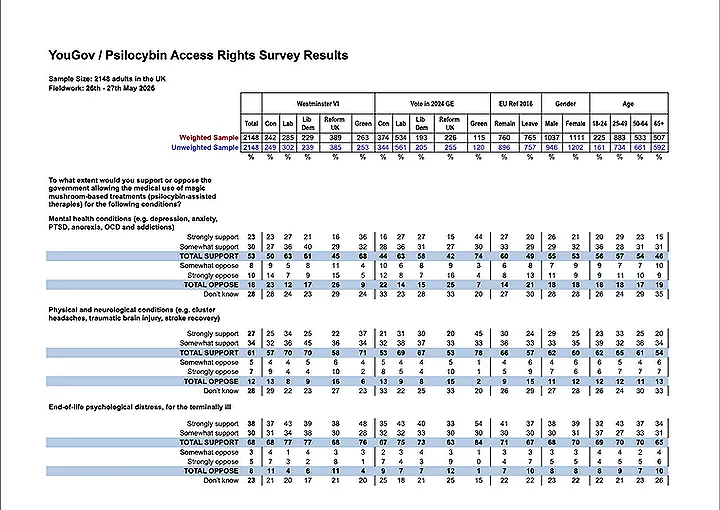
A new YouGov poll of 2148 adults1, commissioned by Psilocybin Access Rights (PAR) — a group of volunteers campaigning for psilocybin access in the UK — finds majority support for making psilocybin available as a clinical treatment. Or, precisely speaking, most respondents “would support the government allowing the medical use of psilocybin”.
That support is remarkably consistent across gender, region, income level, and even political preferences. Where the numbers do shift is by condition: 68% support psilocybin as an option for terminally ill patients and end-of-life psychological distress, compared to 61% for physical and neurological conditions, and 53% for mental health conditions such as depression and PTSD. Age also plays a role: younger respondents are more enthusiastic, particularly on mental health cases (57% among under-50s vs 46% among over-65s), though even older groups show majority support when the question turns to end-of-life care.
The poll also captures how much the context matters. The UK is currently the only major English-speaking country without any form of legal medical access to psilocybin. Australia, Canada, New Zealand, and several US states have created legal pathways for psychedelic-assisted therapy, though access remains very limited. The survey explicitly points to this international background: one set of questions asked respondents to consider that “recent clinical trials and policy changes in several countries have expanded access to psilocybin-assisted therapy under regulated conditions.” Interestingly, support rose by 4-6% on every condition once that context was introduced.
“When people learn that the rest of the world is moving forward, and that British scientists previously led in this field, they want their country to act,” said PAR co-founder Tara Austin.
The findings could become a powerful argument for those pushing to move psilocybin from Schedule 1 to Schedule 2 drugs — a regulatory shift that would make it significantly easier to research and potentially prescribe. Some political reaction is already there: according to PAR, MPs from Labour, the Liberal Democrats and the Green Party have signed an open letter2 calling for a review of psilocybin’s scheduling status.
Psilocybin examined as a treatment for anorexia nervosa by a UK court — for the first time
In 2026, the UK High Court examined psilocybin3 not as an illegal drug, but as a medical treatment, and ruled accordingly. It happened in the case of an anonymous woman, referred to in court documents as EB, who took part in a psilocybin clinical trial at Imperial College London in 2022. Psilocybin was the first treatment that had helped her anorexia, but when the trial ended, so did her access to the medicine. To continue receiving it legally, EB applied to the Home Office for an individual license. This application for exceptional case legal aid funding was turned down, with the Director of Legal Aid Casework concluding that her case wasn’t about healthcare, but about personal drug possession.
EB challenged that decision, and months later, the Deputy Judge sided with her, calling the original ruling fundamentally flawed. Treating EB’s application as a matter of drug use was, the judge found, “clearly wrong” and shaped by decades of prohibitionist thinking. “EB is now experiencing the condition worse than before because she has lost hope of recovery,” the Deputy Judge noted4.
But the story doesn’t have a happy ending yet. The ruling means only that the legal aid decision must be reconsidered, and current Home Office policy offers no obvious route to obtaining a personal license. But the case raises a nontrivial question the psychedelic research has rarely had to confront: what happens to trial participants after the trial ends? And how to establish a clear legal route for them to access psychedelics for medical use when no such pathway currently exists?
A study found taking psychedelics at ceremonies and raves may help healing childhood trauma
A study in the journal Progress in Neuro-Psychopharmacology and Biological Psychiatry5 suggests that people who use psychedelics at a ceremony or rave (but with clear therapeutic intent!) report improvements in mental health, including reduced trauma symptoms and a stronger sense of connection to others.
Researchers followed 85 adults with childhood maltreatment histories who were already planning to take psychedelics at an upcoming event. The most commonly used substances in this experiment were mushrooms (38%), ayahuasca (24%), MDMA (20%), and LSD (18%).
The most important conversations shaping the future of psychedelics, delivered weekly.
From thought-provoking podcasts and original stories to research breakthroughs and industry news, stay connected to the conversations that matter.


Joined by 12,000+ readers
Two months after the experience, participants reported lower levels of PTSD symptoms and internalized shame, along with increased social connectedness. Surprisingly, it didn’t matter whether the experience took place at a ceremony or a rave — the outcomes were similar in both settings. The researchers suggest this makes sense: both environments share features like immersive music, a sense of community, and an atmosphere of openness and trust.
“The amount or degree of these therapeutic benefits that people experience is directly associated with the strength and quality of various subjective dimensions of the psychedelic experience, both personal and social, experiences of oceanic boundlessness, ego dissolution, psychological insight, emotional breakthrough, group togetherness/bonding, and interpersonal closeness,” said CJ Healy, a clinical psychologist and lead author of the study.
Despite the inspiring results, the study has real limitations. There was no control group, so it’s hard to know whether the improvement came from the substance itself or simply from the setting and people around. There was also no way to verify each participant’s therapeutic intent. And since all the data came from self-reports, personal bias can’t be ruled out.
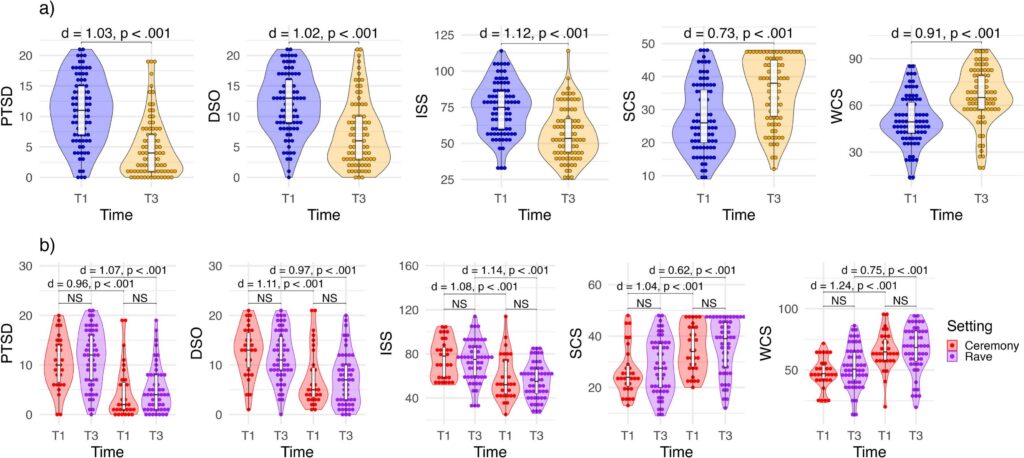
PTSD = Post-traumatic stress disorder scale
DSO = ITQ Disturbances in Self-Organization (CPTSD) Subscale
ISS = Internalized Shame Scale
SCS = Social Connectedness Scale
WCS = Watts Connectedness Scale
Single-dose psilocybin treatment reduces suicidal ideation for 3+ months
According to a study published in The Journal of Clinical Psychiatry6, a single session of psilocybin therapy, paired with psychological support, can rapidly reduce chronic suicidal thoughts. Most importantly, the relief may last more than 12 weeks.
20 adults with major depressive disorder (MDD) and persistent suicidal ideation joined the trial. On average, they had already tried 5 (!) different treatments without success, including antidepressants, electroconvulsive therapy (ECT), ketamine therapy, and other options.
The first results after a 25-mg dose were promising: one week after the session, 75% of participants showed a meaningful reduction in suicidal thoughts, and 45% achieved full remission. However, the main breakthrough was in the duration of improvements. Three months later, 70% maintained remission or near-remission. Notably, two participants did report an increase in suicidal thoughts during the study.
What makes this open-label trial notable is its participant criteria. In all previous psychedelic research, active suicidal ideation was a huge red flag — a contraindication rather than a condition worth targeting. As a result, suicidality was not assessed as a symptom of depression, and those who might benefit from a rapid-acting antisuicidal intervention were never studied.
“Suicidal ideation tended to demonstrate a better target for the treatment than depressive symptomatology but it is a more discrete target,” said one of the study authors Scott Aaronson, MD.
The conversation around psychedelics is expanding, and the questions it raises are getting more and more interesting. Let’s keep watching together — see you in the next issue!